Get Full Government Meeting Transcripts, Videos, & Alerts Forever!
Get email alerts on the Public Finance topic
No spam. Unsubscribe anytime.
Committee holds bill to require Public Finance Authority subsidiaries to join GERS after testimony
Summary
Lawmakers held a bill that would require officials and employees of the Public Finance Authority’s subsidiaries to be members of GERS after testimony from PFA, VINGN and WICO about financial and operational impacts; sponsor signaled an amendment to narrow the change to future hires and opt‑in for current employees.
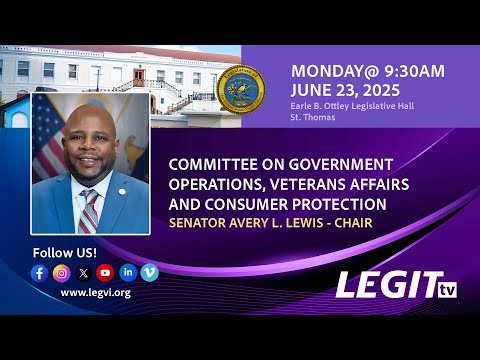
The Committee on Government Operations, Veterans Affairs and Consumer Protection held at the call of the chair a bill (36‑0066) that would require officials and employees of the Virgin Islands Public Finance Authority (PFA) and its wholly owned subsidiaries to be members of the Government Employees Retirement System (GERS).
Senator Alma Francis Heiliger introduced the bill, which would add section 928A to Title 29, Chapter 15 of the Virgin Islands Code. Administrator Angel E. Dawson and GERS representatives testified in support of the bill’s spirit; Dawson noted court rulings classifying certain PFA subsidiaries as public corporations and the system’s interest in extending membership and contributions to employees of subsidiaries. Dawson and the GERS board asked that contribution timing match existing pay‑period rules and recommended applying the statute prospectively, with an opt‑in for long‑tenured employees.
Representatives of the Public Finance Authority and two subsidiaries—Virgin Islands Next Generation Network (VINGN) and West Indian Company Limited (WICO)—testified to oppose mandatory, retroactive inclusion. Director Nathan Simmons (PFA) and VINGN’s president Steven Adams and controller Alisa G. Hodge said the subsidiaries operate as separate legal entities with distinct finances and argued mandatory GERS participation could create untenable employer contribution obligations and jeopardize ongoing operations. VINGN said 18 of its 24 employees participate in a SIMPLE IRA (Fidelity) with a 3% employer match and said forced GERS membership (employee contribution and employer match rates in statute) would raise employer costs dramatically — testimony estimated the employer match difference could exceed $500,000 annually for VINGN alone and the company said the obligation could force layoffs or undermine planned infrastructure investment.
Senators and witnesses discussed options: sponsor Senator Francis Heiliger said she would offer an amendment to make the requirement prospective (applying to new hires) and to allow current, vested employees (roughly 10+ years service) to opt in if they wish. PFA said it did not support language that would force PFA to make payments on behalf of subsidiaries; it suggested subsidiaries should remain responsible for contributions. Several senators noted the broader policy goal—improving GERS solvency by expanding membership—but also acknowledged operational concerns raised by the subsidiaries’ representatives.
Action: After extended discussion and receipt of written testimony, Senator Francis Heiliger moved to hold Bill 36‑0066 at the call of the chair; the motion was seconded and the committee ordered the bill held pending further work and amendments. The hearing record shows the bill held in committee rather than reported out. The sponsor said she will circulate amendments that narrow the bill to prospective application with opt‑in rights for existing vested employees.
Why it matters: The question balances GERS expansion and long‑term funding stability against near‑term financial burdens on semi‑autonomous public corporations whose business models and current retirement arrangements differ from central government agencies. The committee deferred action to allow targeted amendments that aim to address operational and fiscal concerns raised by PFA and subsidiary testimony.