Get Full Government Meeting Transcripts, Videos, & Alerts Forever!
Get email alerts on the Drinking Water topic
No spam. Unsubscribe anytime.
Hemet council hears design, cost and operating outlook for TCP treatment at Wells 15 and 16
Summary
Consultants gave a status update on a proposed granular activated carbon treatment system to remove 1,2,3‑trichloropropane (TCP) from two groundwater wells; construction is estimated at $4.9 million with an estimated 20‑year operations cost of about $25 million and treated water costing under $700 per acre‑foot.
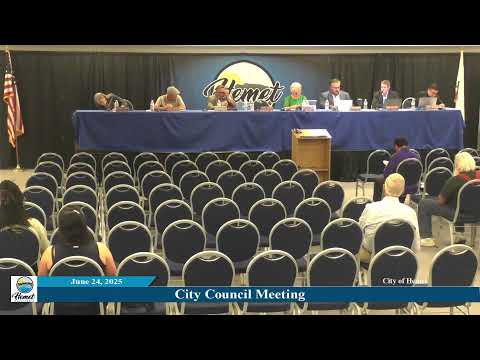
The city received a design and status update June 24 on a proposed drinking‑water treatment system to remove 1,2,3‑trichloropropane (TCP) from two production wells, Wells 15 and 16. The system would be built at Henley Park and would combine flows from both wells into a single treatment train.
Consultant Greg Yen of N2W Engineering, representing the city’s design‑build team, told the council the system is sized to treat up to 2,200 gallons per minute (GPM) combined and would use granular activated carbon (GAC) in a two‑stage, lead‑lag configuration to reduce TCP to below California’s drinking‑water limit. “The city contracted with us to provide a drinking water treatment system for 2 of its groundwater wells, specifically removing, contaminant called 1 2 3 trichloropropane or TCP as we call it,” Yen said.
Why it matters: the wells are currently inactive because measured TCP concentrations exceed the state maximum contaminant level. The project aims to restore those wells to service and produce treated water into the city potable system without having to buy as much imported treated water.
Key details and status
- Site and flow: The proposed main treatment site is at Henley Park near Well 15; water from Well 16 will be piped to that site. The system design capacity is 2,200 GPM (two trains at 1,100 GPM each).
- Treatment approach: Consultants propose GAC vessels with prefilters and chlorine disinfection after treatment. Yen described a two‑stage (lead/lag) GAC configuration so carbon in the second vessel can catch any breakthrough from the first.
- Costs and lifecycle: Preliminary construction cost for the chosen alternative (shorter, lower‑profile vessels) is about $4.9 million. The consultant’s 20‑year life‑cycle analysis estimates total operating and maintenance costs could approach $25 million over that period; that yields an estimated treated‑water cost “a little under $700 an acre‑foot,” Yen said, compared with earlier estimates for imported treated water of about $1,500 per acre‑foot.
- Media replacement and monitoring: Yen said carbon change‑out frequency depends on how the city runs each well; consultants factored a target of no more than one media change every six months into the sizing. The state will set monitoring and reporting requirements tied to the permit; sampling is expected to be frequent initially (monthly) and may be relaxed later if the system demonstrates consistent performance.
- Water quality baseline: Yen reported recent sample results (city‑provided): Well 15 had TCP near 140 parts per trillion (ppt) and Well 16 around 9–10 ppt; the California MCL cited by staff for TCP is 5 ppt (0.005 parts per billion). Yen said the proposed treatment is designed to reduce TCP to nondetect levels below the state MCL.
Questions from council and follow up
Council members asked about carbon capacity, how many gallons each carbon bed will treat before replacement, and whether operating both wells at full capacity would shorten media life. Yen said the team has bed‑volume and media‑weight estimates but did not give a precise gallons‑per‑media figure on the spot and offered to provide that number later. He confirmed the city is currently designing the pipeline to carry water from Well 16 to the Henley Park site.
No formal council action was taken on the design update; staff and the consultant said they will return with refined cost estimates and additional technical details as design advances.
Ending
City staff and the consultant said they are at roughly 30–60% design development and will provide follow‑up information requested by council on media volumes, projected media change schedules, permit monitoring requirements, and the pipeline design.