Get Full Government Meeting Transcripts, Videos, & Alerts Forever!
Get email alerts on the Elections topic
No spam. Unsubscribe anytime.
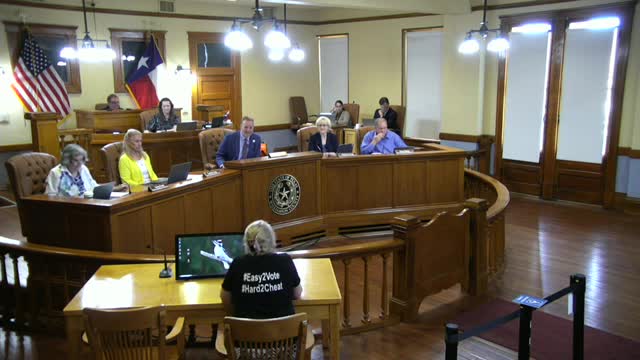
Williamson County OKs HAVA resolution and purchase of ballot‑on‑demand printers after public debate on secrecy and operations
Summary
The commissioners court voted 5‑0 to approve a resolution to apply for federal HAVA funds and to buy ES&S ballot‑on‑demand printers for November; public speakers and election integrity advocates urged caution about ballot secrecy, certification and operational readiness.
Williamson County Commissioners Court voted unanimously June 24 to approve a resolution to apply for 2025 Help America Vote Act (HAVA) funds and to purchase ballot‑on‑demand (BOD) equipment from ES&S, a purchase elections staff said would cost about $1,100,000.
The action directs the county to submit a HAVA resolution to the Texas Secretary of State and authorizes the election administrator to purchase the ES&S BOD system and related supplies. Elections Administrator Bridget Escobedo told the court the state set aside roughly $10 million in HAVA funds for Texas; Williamson County is guaranteed about $52,000 but she said the county will request reimbursement for the full equipment purchase.
The nut of the debate focused on ballot secrecy, certification and operations. Multiple members of the public, including Marsha Strickler Watson, Laurie Gallagher and Dr. Laura Presley, urged the court either to reject the federal funds or to delay buying the BOD printers until more testing and cybersecurity review. "A million dollars...for a ballot on demand printer that 1) has not been tested, 2) we don't know the output of, 3) is proprietary to ES&S," Marsha Strickler Watson said during public comment. Watson argued the county should return to precinct‑level, preprinted ballots and manual processes rather than invest in the new equipment.
Laurie Gallagher, who said she has acted as a poll watcher in Williamson County, described incidents logged by election judges she said show ballot‑on‑demand systems sometimes produce incorrect ballot styles. "Voters are being prevented from voting for races that they're constitutionally eligible to vote for," she said. Dr. Laura Presley, of True Texas Elections, said the Secretary of State classifies BOD printers as "peripheral devices" rather than voting systems and urged the court to obtain cybersecurity review and legal advice before spending.
Escobedo responded with operational details the office is testing. She described a process in which voters check in on the existing electronic poll book, staff use an air‑gapped laptop to print a full‑face ballot at the polling place, the voter hand‑marks the ballot with a pen, and the county continues to scan and tabulate ballots electronically. Escobedo said the county has created a mock polling location to refine procedures and plans to borrow a BOD system from ES&S for local testing before November. She also said the county has budgeted roughly $300,000 more for consumables, printers, voting booths and other supplies and intends to fund the purchase from the elections fund rather than the general fund.
Escobedo said the county consulted the Secretary of State and legal counsel on compliance with Texas Election Code §62.009, which governs how paper ballots are presented and selected at polling places. She described a proposed randomization process—"disarrang[ing] or shuffl[ing]" ballot stock—so voters select among shuffled, sequentially numbered ballot stock rather than choosing an ordered stack. Escobedo said several other Texas counties, including Denton, McLennan and Collin, already use BOD systems.
Court members acknowledged the rapid timetable and supply‑chain considerations Escobedo described. After discussion, Commissioner Bowles moved to approve items 43 and 44; Commissioner Cook seconded. The court voted 5‑0 to approve both the HAVA resolution and the equipment purchase.
The county and public speakers also discussed related state law changes: Escobedo told the court she is working with the Secretary of State on implementation of Senate Bill 2753 (which adjusts the early‑voting/election period) but said some portions do not have to be implemented until 2027. Escobedo told commissioners she will bring more detailed procedures and training plans back to the court and to local stakeholders as the office refines operations.
Escobedo recommended using HAVA funds where possible to offset the purchase; she said the county will seek reimbursement but is prepared to fund the equipment and additional consumables from the elections fund if reimbursements fall short.
Votes at a glance: items 43 and 44 — motion by Commissioner Bowles, second by Commissioner Cook; outcome: approved 5‑0.