Get Full Government Meeting Transcripts, Videos, & Alerts Forever!
Get email alerts on the Street Safety And Art topic
No spam. Unsubscribe anytime.
Leesburg council sets interim painted‑crosswalk rules: art and awareness allowed; organizers pay costs
Summary
The Leesburg Town Council directed staff to draft a painted‑crosswalk policy allowing both awareness displays and limited artistic designs while emphasizing safety and organizer payment for costs.
The Leesburg Town Council directed staff to draft a painted‑crosswalk policy allowing both awareness displays and artistic designs on a trial basis while prioritizing safety and preserving standard crosswalk markings.
Town staff told the council there is currently no approval process for painted crosswalks and that the June 6 rainbow crosswalk sponsored by Equality Loudoun was approved temporarily while staff developed procedures. “Currently, there is no process for approval of painted crosswalks,” staff member Renee said during the presentation.
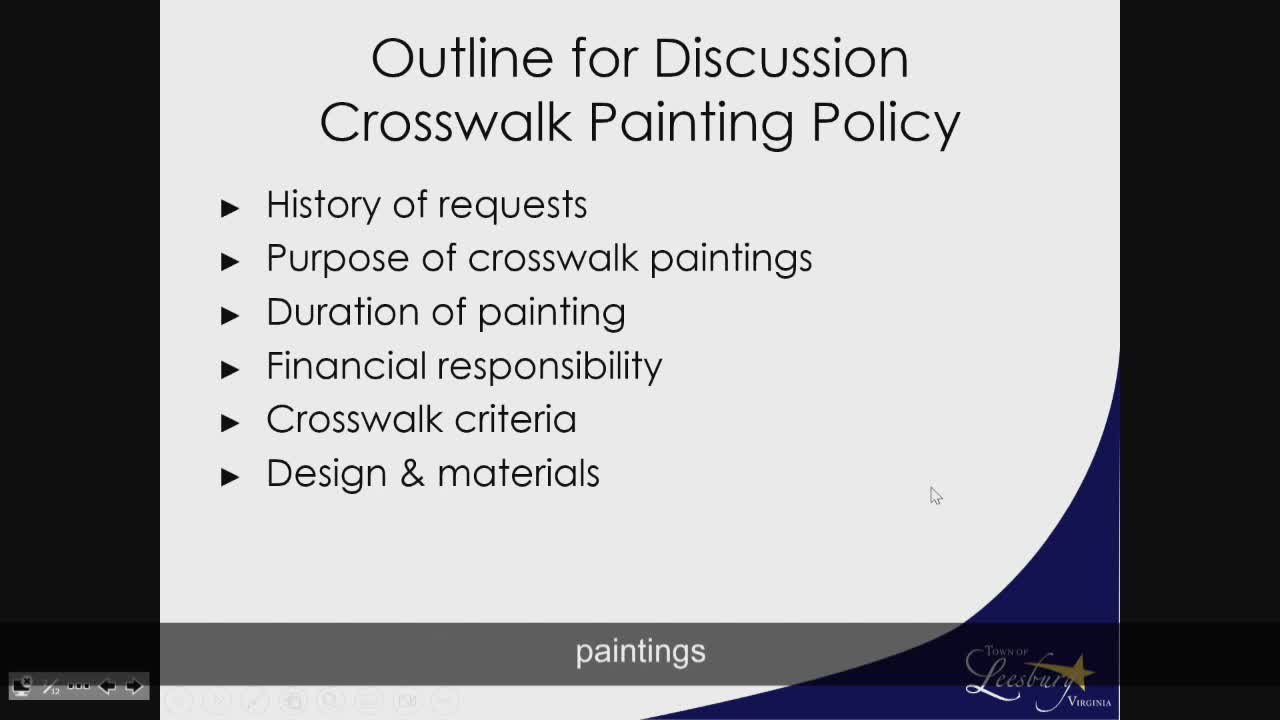
Staff outlined criteria drawn from federal guidance: the Federal Highway Administration’s Manual on Uniform Traffic Control Devices (MUTCD) limits designs that could be confused with traffic‑control devices and discourages distracting or 3‑D treatments. Staff recommended limiting painted crosswalks to roads with 25 miles per hour speed limits or lower, low accident histories and low vehicle volumes, and avoiding primary corridors such as Battlefield Parkway and King Street. Materials should be skid‑resistant, glare‑reducing and reflective; chalk paint and adhesives that do not adhere reliably to older asphalt were discouraged.
Councilors discussed costs and operations using the recently painted Harrison Street example: staff estimated supply costs around $575 and labor (including road closure staffing) around $1,200 for that installation; removal was estimated in the $2,000–$3,000 range depending on conditions. Kate Trask, town staff, said the town purchased appropriate highway asphalt paint with grit to ensure safety and material durability.
On policy direction, councilors reached consensus on the following points for the draft policy: - Permit painted crosswalks for both limited awareness displays (public issues, historical events, health topics) and for artistic designs, not limited to awareness only. - Require organizers (an individual, nonprofit or business) to pay all upfront costs including materials, staff time for traffic control and street closure and removal; require a good‑faith deposit to guarantee removal/cleanup costs. - Limit allowable designs to maintain recognizable crosswalk patterns (standard parallel lines or continental/ladder markings) so drivers can readily identify the crossing; ban 3‑D, game‑like or text/logos that could distract drivers. - Limit eligible locations to low‑speed (25 mph or less), low‑volume streets and intersections with low accident histories; avoid main arterials and stamped/bricked pavements in the historic downtown. - Require artistic or non‑awareness designs to be reviewed by the Commission on Public Art (COPA) before council consideration; simple blocks of color like the recent rainbow were expected to be administratively approved by staff. - Pilot the program as a trial limited to four or five locations for 90 days, with an assessment and return to council after the trial year.
Councilmembers emphasized safety and even-handed administration. Dr. Simona Johnson suggested allowing applicants to propose duration, noting cost sensitivity for smaller groups; the council settled on a 90‑day trial duration because the council had already approved the recent rainbow crosswalk for that period. Councilmembers also asked staff to include an application timeline and recommended a 90‑day minimum lead time so staff can plan traffic control and public‑safety resources.
Staff will prepare the formal policy language and a recommended list of candidate pilot locations, estimate costs and a deposit schedule, and return to council for final adoption. The council did not record a roll‑call vote; the direction was captured as majority consensus during the discussion.