Get Full Government Meeting Transcripts, Videos, & Alerts Forever!
Get email alerts on the Arpa Fema Reserve topic
No spam. Unsubscribe anytime.
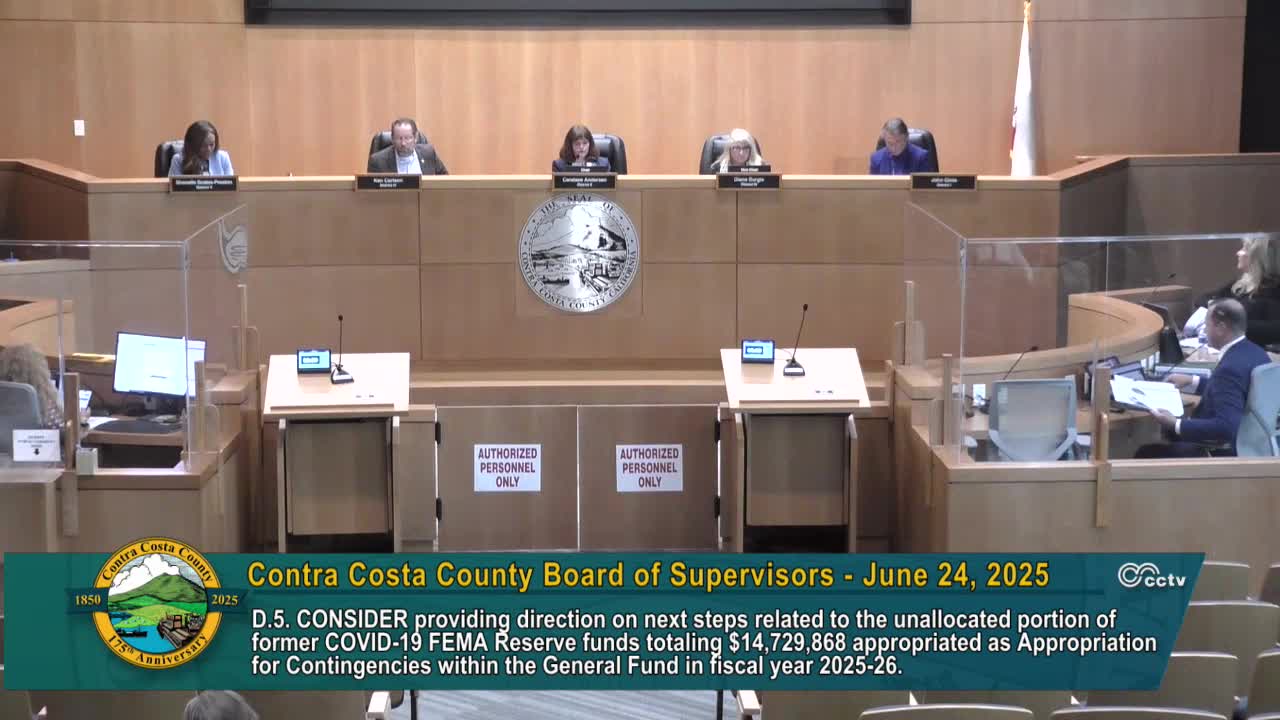
Board directs community outreach and sets $1 million per‑district allocation from unallocated ARPA/FEMA reserve funds
Summary
Supervisors authorized a process for community outreach on unallocated funds from the county's former COVID‑19 FEMA reserve and directed staff to prepare options; the board agreed to allocate $1.0 million to each of the five supervisorial districts as a near‑term step and asked staff to return with more details on countywide uses on Aug. 5.
Contra Costa County supervisors moved to begin a public outreach process and to allocate $1,000,000 to each of the five supervisorial districts from the unallocated portion of previously reserved COVID‑19 American Rescue Plan (ARPA) / FEMA funds.
Background and board action County staff explained that earlier accounting and board actions had designated roughly $37.5 million related to hospital subsidy work into an assigned COVID‑19 FEMA reserve; at budget adoption the board had instructed staff to free up $20.9 million of that pool for possible allocations. Since the budget hearings the county has also received additional FEMA reimbursements totaling roughly $8,000,000, bringing FEMA cost recovery to about $82.1 million (about 99.6% of claimed costs for the county's FEMA public assistance COVID claims), county staff said.
At the meeting the board confirmed the need for a public process and for more detailed information from departments and community providers about existing program capacities and gaps. Supervisors voted unanimously to: - Allocate $1,000,000 to each supervisorial district (total $5,000,000) for near‑term, district‑level uses, to be shaped by community outreach in each district; and - Direct the County Administrator to prepare a written plan and departmental inventory of current programs, existing contract balances and the number of people served, and return to the board with a recommended approach for potential countywide allocations (the board set August 5 as the target date to revisit countywide allocations and program options).
Why it matters Board members and dozens of public commenters described an immediate and growing need for housing supports (rental and rapid rehousing), food security, and services to help households cope with proposed cuts to federal and state safety‑net programs. County officials described pending state actions that could limit Medi‑Cal enrollment for undocumented residents and federal proposals on Medicaid/SNAP that could reduce coverage and increase county costs.
Public comment and provider data More than 30 public commenters and multiple nonprofit speakers urged immediate spending to preserve housing and food supports. County homelessness staff and providers supplied figures the board cited in discussion: a preliminary point‑in‑time (PIT) result noted in public comment showed a year‑over‑year reduction in homelessness (speaker reported ~26% decrease overall and ~35% decrease in unsheltered counts) and a large expansion in rapid‑rehousing capacity (a referenced ~95% increase in rapid rehousing beds over two years and a 34% increase in bed capacity). County staff and providers said rapid rehousing and emergency rental assistance are often effective at keeping households housed, and cited an estimated cost of roughly $13,000 per household for rapid rehousing and about $15,000 per family (estimates provided during public testimony).
Officials and providers warned that proposed state and federal rollbacks could be substantial. County health staff estimated possible state budget impacts that could reach tens of millions for county health services (one county estimate cited roughly $50,000,000 per year in later budgets under certain scenarios); federal proposals discussed in the meeting were described as potentially larger, though amounts depend on final federal legislation. Food‑security partners said the nonprofit food‑rescue network has already lost expected federal support and could face additional reductions.
Next steps The board asked the County Administrator to: - Build a countywide inventory showing current ARPA/Measure X and other funding already supporting housing, food, health enrollment and related programs, including how many people are served and what additional capacity can be leveraged; - Create a county website portal for public input and support each supervisor's district outreach (town halls and translated materials) so that allocations are informed by residents across the county; and - Return on August 5 with a staff report that summarizes community input, departmental capacities, and recommended countywide allocation options for the balance of the unallocated ARPA/FEMA reserve (the staff report should include program‑level details such as numbers served and per‑unit cost estimates).
The board's motion carried unanimously.