Get Full Government Meeting Transcripts, Videos, & Alerts Forever!
Get email alerts on the Hazmat Consolidation topic
No spam. Unsubscribe anytime.
Board directs staff to pursue transfer of county hazardous‑materials program to Contra Costa County Fire
Summary
Contra Costa County supervisors gave unanimous direction for staff to pursue a transfer of the county's hazardous materials program and its employees to the Contra Costa County Fire District.
Contra Costa County supervisors gave unanimous direction for staff to pursue a transfer of the county's hazardous materials program and its employees to the Contra Costa County Fire District.
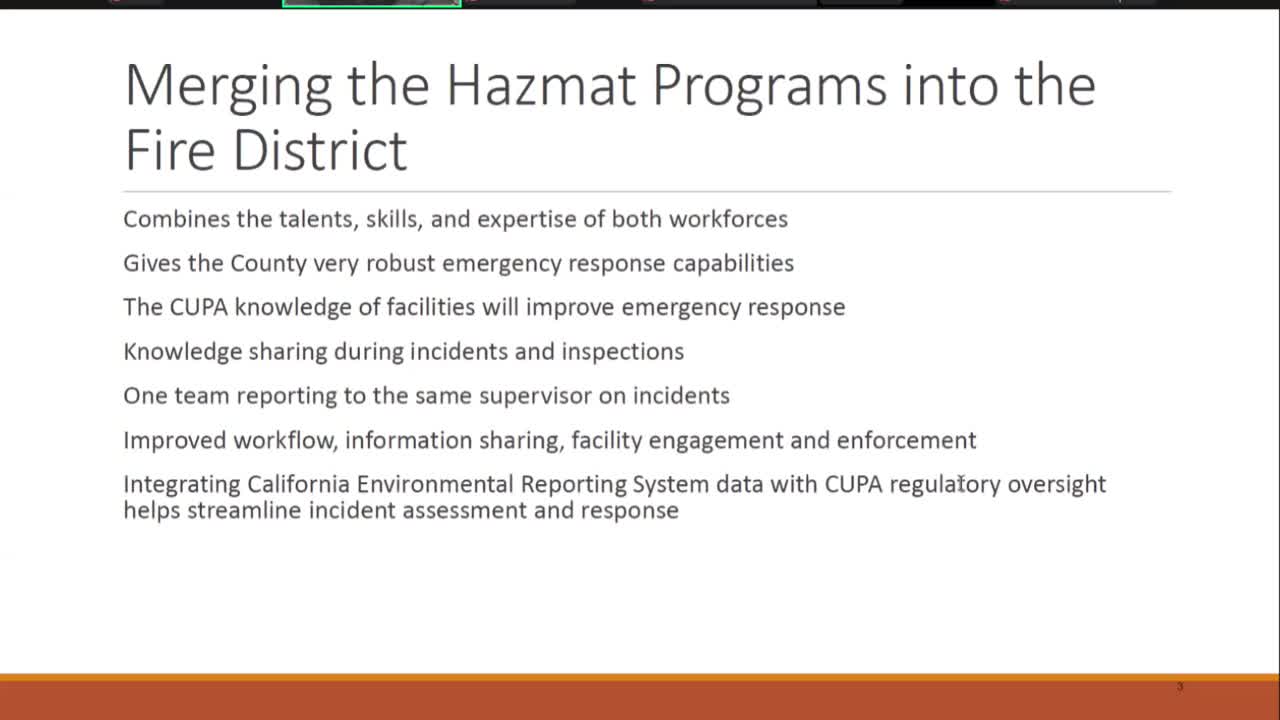
Proponents said combining the county and fire districts' HAZMAT functions would create "one team" with a single incident command, unified public messaging, and opportunities to reduce duplicative inspections, permitting and enforcement while maintaining current regulatory programs.
The move would, according to the fire district's presentation, transfer county hazardous‑materials staff into the fire district while preserving technical units such as the county's Industrial Safety Ordinance (ISO) engineers and the California Accidental Release Program (CalARP) responsibilities. The chief leading the presentation said there is "no substitute for one team" and that a single command structure would improve field mitigation and public communications during incidents.
Why it matters: County officials and public commenters said the proposal could improve emergency response and grant competitiveness while consolidating administration and cost‑recovery systems. Supervisors pressed staff to preserve specialized engineering capacity that oversees complex refinery safety reviews — work that county speakers described as unique and recognized by federal investigators after past incidents.
What the board heard and directed - Fire and county staff described operational and administrative benefits of consolidation: shared training and equipment, a single incident command and unified public messaging, plus reduced redundancy in inspections and permitting. - County and fire presenters said the ISO would remain in force and be administered by the fire district if the transfer proceeds; technical staff now working on refinery process hazard analyses and CalARP would remain dedicated to those functions, the presenters said. - Staff listed a draft project schedule and regulatory steps, including human resources work, creating job classifications, CalEPA notifications and County Counsel review. The presenters said the transfer could be targeted for early 2026 but called the January 1 date "arbitrary" and discussed other options, including a mid‑fiscal‑year effective date.
Supervisors gave direction to proceed and asked staff to return with a timing plan and additional details on labor, CalEPA approvals, fee and cost‑recovery arrangements, and written protocols to maintain health‑department involvement in post‑incident health advisories.
Public comment and operational details Public commenters raised questions about continuity of public‑health oversight, community access to technical information and the need to retain the county's prevention‑focused programs. Some speakers urged a dual‑authority framework to preserve the health department's regulatory role while integrating operational response.
County and fire staff said offices and most personnel would remain at the current county HAZMAT facility in Pacheco and that first‑responder apparatus would continue to operate from existing fire stations. The fire district said it expects to increase the number of trained HAZMAT responders districtwide (an illustrative staffing goal given during discussion was to move from 42 to 60 responders this fiscal year) and that the large HAZMAT vehicle currently based at Station 87 in Pittsburgh would continue to be used.
What was not decided No formal transfer ordinance, contract or effective date was adopted at the meeting. Board members directed staff to return with detailed plans and timelines, including a written plan showing how refinery‑focused engineering expertise and community notification protocols would be preserved.
Looking ahead Staff said they will prepare written protocols and expectations for notification and coordination with the county health officer cadre, and will work with the City of Richmond to transition local ISO administration where necessary. The board asked for a follow‑up report on timing and next steps.