Get Full Government Meeting Transcripts, Videos, & Alerts Forever!
Get email alerts on the Park Safety topic
No spam. Unsubscribe anytime.
APF-funded security audit recommends dedicated PARD security role, lighting and CPTED measures; staff to prioritize short-term fixes
Summary
An audit of parks safety and security funded by the Austin Parks Foundation and conducted by Arup recommended a mix of immediate and long-term actions including a dedicated safety and security role within Parks and Recreation, standardized lighting and signage, stronger APD coordination and short-term process and training fixes.
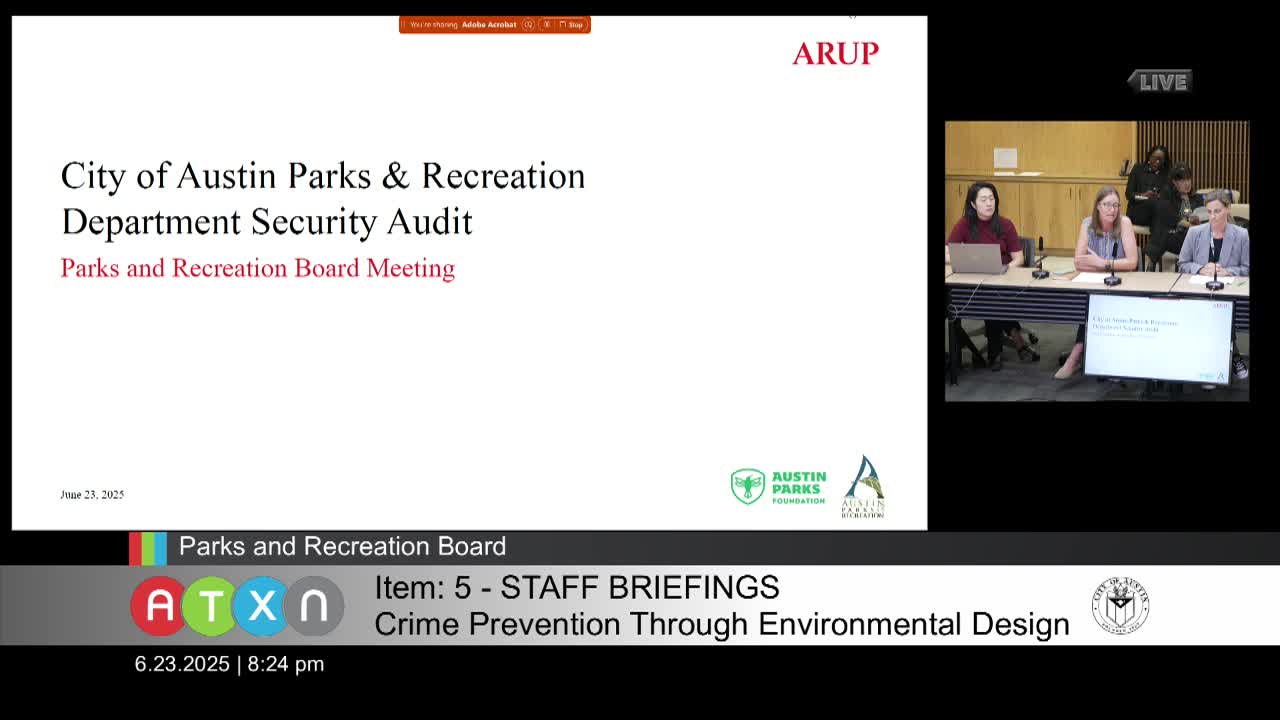
The Austin Parks and Recreation Department presented findings from a citywide safety and security audit conducted by Arup and funded by the Austin Parks Foundation. The report, based on stakeholder interviews, APD crime data, park-ranger reports and 30 site visits, recommended near-term and longer-term changes spanning governance, lighting, signage, staffing and operational procedures.
Amanda Ross, division manager for Natural Resources at PARD, said the department worked with APF to commission the audit to document existing physical and operational security measures, identify vulnerabilities and produce actionable recommendations. Joy Kosnowski of the Austin Parks Foundation described APF's role as funder and administrative partner on the contract and said the foundation intended the audit to produce a practical dashboard and priorities list PARD could implement.
Arup presented key findings: property crimes near parks were dominated by larceny/theft and motor-vehicle theft; crimes against society (disorderly conduct and drug offenses) were the second largest category; and park-ranger incident logs most often recorded dog off-leash, park closure violations, alcohol-related incidents and fires. Arup noted that many parks were designed before current safety expectations and that uneven application of security measures (lighting, vegetation management, access control and monitoring) created 'patchwork' vulnerabilities across sites.
Recommendations were organized into guidance and standards compliance, strengthened interagency partnerships, process improvements and lighting upgrades. Phase 1, near-term actions that Arup and staff identified as priorities, include:
- Create a dedicated PARD safety-and-security role or team to coordinate standards and projects across all PARD assets. - Develop and publish tailored operating procedures and training for staff on when/how to contact APD and the Homeless Strategy Office; create training decks in partnership with APD. - Improve signage, including unique site identifiers and 311 contact information, to help the public report issues by location. - Implement lighting improvements using warm color temperature fixtures, correct controls for daylight savings and prioritized maintenance. - Adopt an annual security-audit cadence and a decision dashboard to prioritize measures by cost, effectiveness and equity.
Arup's presentation included estimated costs and a dashboard tool for filtering recommendations by effectiveness and cost. Multiple board members stressed community engagement, and Arup and PARD staff said many recommendations will need neighborhood input (for example, vegetation management that affects tree canopy and sight lines).
Board members asked about signage, reporting mechanisms and coordinating responses to people experiencing homelessness; staff acknowledged those are complex, cross-departmental issues and highlighted the need to partner with APD, the Homeless Strategy Office and community groups. PARD said it will review and finalize the audit report with Arup, prioritize phase 1 items that can be implemented quickly and return to the board with an implementation plan and proposed resourcing.