Get Full Government Meeting Transcripts, Videos, & Alerts Forever!
Get email alerts on the Park Equity topic
No spam. Unsubscribe anytime.
Trust for Public Land ranking prompts board, public calls for funding equity and transparency
Summary
The Trust for Public Land's latest ParkScore placed Austin 54th among the 100 largest U.S. cities and a drop of 10 places from the prior report. Board members and multiple public commenters urged deeper review of partnership spending, equity, and how investments are distributed across council districts.
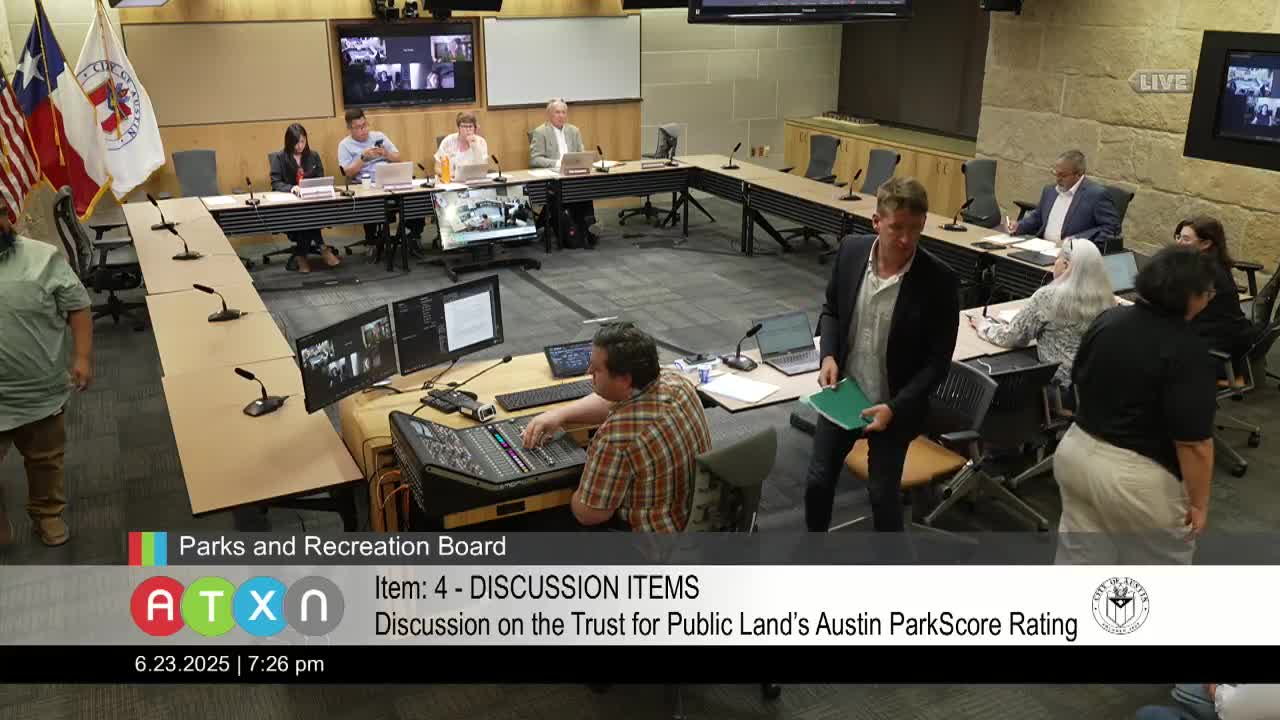
Board Member Eubanks opened a board discussion on the Trust for Public Land's latest ParkScore, which placed Austin 54th among the 100 most populous U.S. cities. The report measures acres per resident, access (10-minute walk), amenities, equity and investment; the board reviewed component scores and an observed 10-place decline.
Public speakers raised concerns that private philanthropy and nonprofit partners have concentrated capital improvements downtown and in affluent districts, leaving some neighborhoods ' particularly in East Austin and other lower-income areas ' without comparable investment. Robin Rather of Rewild ATX and Gail Rody of Free Wild Austin each called for the board to examine the partnership model, ensure funding for maintenance and restoration, and pursue equitable distribution of capital and operating resources. Bertha Rendon Delgado and other East Austin residents criticized perceived underinvestment in District 3 parks and said neighborhood master-plan priorities have gone unfulfilled.
Board members said the ParkScore is one metric among many but that the decline merited a policy-focused review. Eubanks noted the city's partnership model dates to a 2020 resolution and asked staff to look at trends since that date; he and others requested a future agenda item that would present a clear accounting of public and private investment, the role of park foundations and conservancies, and options for funding that could address equity gaps.
Several board members stressed the need to compare Austin to similarly sized cities with different governance models (for example, metro or regional park systems funded by dedicated levies) to identify structural options. The board asked staff to assemble prior briefings and reports on partnerships to inform a deeper review; some members suggested inviting academic or external research partners for independent analysis.
No formal action was taken; board members asked staff to return with materials and recommended next steps.
Speakers who appeared during the public comment portion included community advocates and neighborhood leaders calling for stronger maintenance funding, transparent partnership accounting and neighborhood engagement in master-plan implementation.