Get Full Government Meeting Transcripts, Videos, & Alerts Forever!
Get email alerts on the Library Fees topic
No spam. Unsubscribe anytime.
Library proposes raising nonresident card fee and changing meeting‑room policy
Summary
Georgetown Public Library staff proposed increasing the annual nonresident card fee and adjusting meeting‑room charges, while noting statutory limits on library fees and the need to balance TexShare participation and equitable access.
Sally, the library director, told council the Georgetown Public Library's FY24 revenue was roughly $152,427 and proposed raising the annual nonresident card fee to better align cost recovery with service costs and neighboring libraries' prices.
Sally emphasized legal limits: under Texas State Library and Archives Commission standards, libraries cannot charge for building entry or deny core services to city residents; the library also participates in TexShare, which requires a public‑access reciprocity component for certain statewide services. She said the library currently charges $35 annually for a nonresident card and has about 40,000 active cardholders, and that the cost per active cardholder is roughly $100 per year based on the library's budget.
Proposal details: staff proposed a $100 annual nonresident card, an $80 senior nonresident rate, and 3‑ and 6‑month trial options. Sally said other nearby jurisdictions (Round Rock, Cedar Park) have raised nonresident rates and provide a broader set of digital services to nonresidents. The Georgetown library would not offer all streaming services to nonresidents because some are pay‑per‑use and unpredictable in cost.
Meeting rooms: staff proposed removing a resident/nonresident distinction for meeting‑room rentals and increasing fees for closed, commercial or admission‑charging events while continuing to favor government, nonprofit and community organizations with lower or no fees. Sally said the current resident/nonresident structure led some groups to identify a resident to make a reservation even when the group is not resident‑based.
Why it matters: raising the nonresident card fee would shift more of the library's operating cost to out‑of‑city users while preserving free access for Georgetown residents and state‑required services. Councilmembers asked staff for details about the number of rentals by nonprofits versus commercial users and for comparisons of what services nonresident cardholders would retain versus what would be limited.
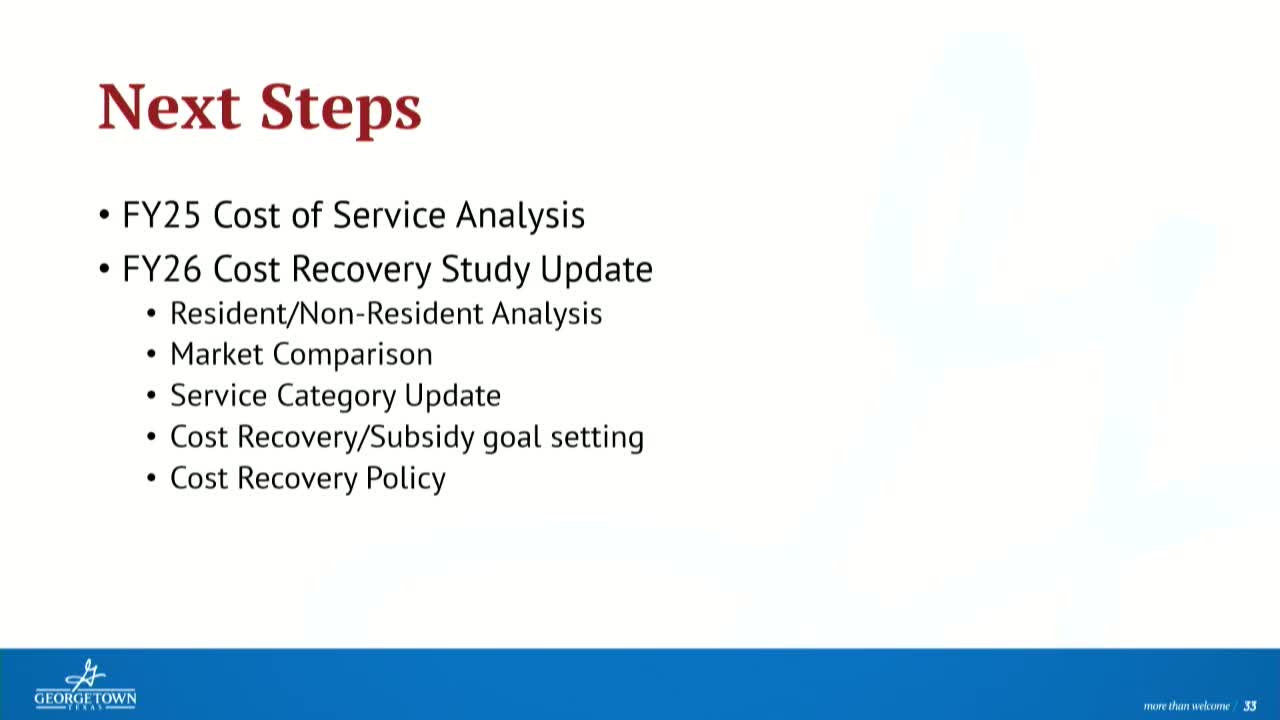
Next steps: staff will return with more analysis on peer comparisons, the likely revenue effect and the membership/service bundle associated with a higher nonresident fee, and will include any proposed meeting‑room fee changes in the FY26 draft budget.
Ending: council asked for a small follow up data package on who rents rooms and what services would change under higher nonresident pricing before making a final decision.