Get Full Government Meeting Transcripts, Videos, & Alerts Forever!
Get email alerts on the Land Use topic
No spam. Unsubscribe anytime.
County council rezones Claymont riverfront to encourage transit‑oriented redevelopment
Summary
New Castle County Council on June 24 approved Ordinance 25‑001 to rezone several parcels in the Claymont area from heavy industrial to commercial regional, a change backers say will enable mixed‑use, transit‑oriented development around the newly built Harris McDowell Transit Center.
New Castle County Council on June 24 approved Ordinance 25‑001 to rezone several parcels in the Claymont area from heavy industrial to commercial regional, a change backers say will enable mixed‑use, transit‑oriented development around the newly built Harris McDowell Transit Center.
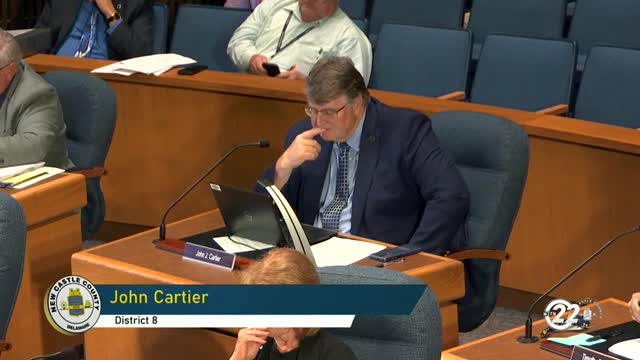
The ordinance, presented by Councilman John Cartier, covers an assemblage of parcels bounded by Naamans Creek to the north, the Delaware River to the east, Philadelphia Pike to the west and the I‑95 interchange to the south. The proposed zoning would allow residential, office and retail development and is intended to support riverfront park development and higher density near the transit hub.
Supporters, including Brett Sadler of the Claymont Renaissance Development Corporation, told council the rezoning advances the community‑endorsed North Claymont master plan and helps shift uses away from legacy heavy industry. “Heavy industry is not part of that vision,” Sadler said at the podium, and the board of the Claymont Renaissance Development Corporation “absolutely support this rezoning.”
Council members also spoke in favor. Councilman Paul Carter said the plan meets code and “will create a housing opportunity that has not existed south of the canal,” and Councilman John Cartier described the rezoning as an effort to encourage transit‑oriented development after the state investment in the transit center.
Public commenters and some residents urged caution and asked for environmental safeguards. Robbie Anstead of the Claymont Coalition for Environmental Justice said the area carries a legacy of contamination from industrial operations and argued the county should require an updated environmental review and structured community engagement before changes in land use increase residential exposure. “The environmental risks in the surrounding area carry a legacy of industrial contamination,” Anstead said.
Bernadette Coughlin Walsh, speaking for Messer LLC, which operates an industrial facility in Claymont, urged the council to require future developers to include buffering and design protections to avoid conflicts between new residential occupants and existing, long‑standing industrial uses. “Any future developer of the rezone land must be required to incorporate buffering and other design protections in its plan to avoid negative impacts to existing compliant industrial uses,” Coughlin Walsh said.
County staff and council members said environmental cleanup and site‑specific remediation are handled through state regulators and will be triggered during later development review. David Culver, general manager of the Department of Land Use, told council the rezoning should not affect separate port‑expansion litigation and that DNREC and other agencies have overseen cleanup efforts on parts of the site.
The council recorded a roll‑call vote of 12 in favor and 1 not voting (Councilman Street did not cast a vote). Council members cited the planning board’s recommendation, the county Department of Land Use support and the goal of aligning land use with the transit center investment.
What’s next: Rezoning does not itself authorize specific projects. Future development proposals will return to the county through standard land‑use review, when site‑level environmental and mitigation requirements will be examined and when council will see design and buffering proposals.
Speakers quoted in this article spoke during the ordinance and public‑comment portions of the June 24 New Castle County Council meeting.