Get Full Government Meeting Transcripts, Videos, & Alerts Forever!
Get email alerts on the Legistar Permissions topic
No spam. Unsubscribe anytime.
County and vendor agree to tighten Legistar approval permissions; cancel-sequence to be limited
Summary
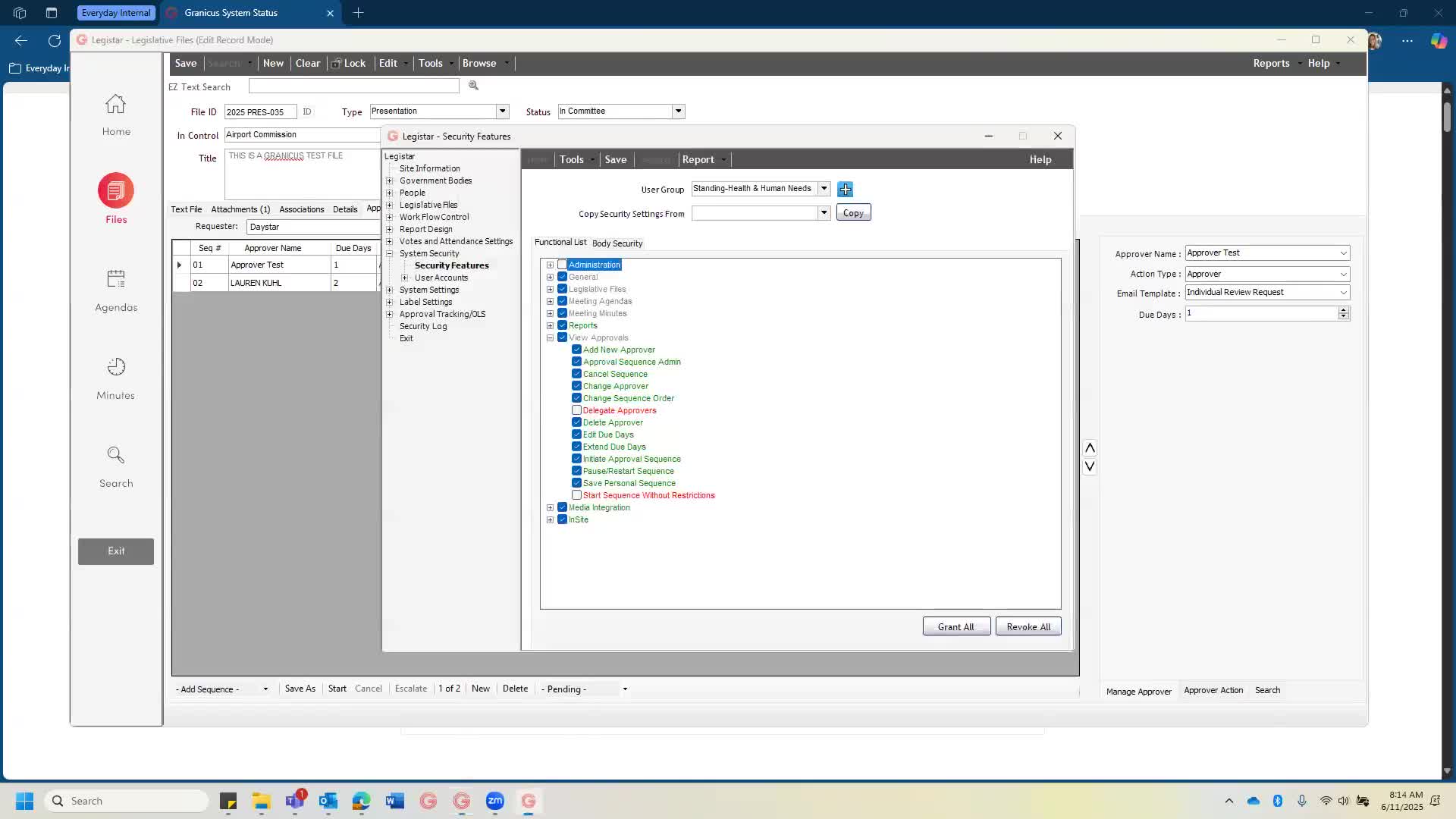
On a vendor training call, Granicus advised Dane County to remove 'cancel sequence' and other broad rights from non-administrator users to prevent accidental loss of approval history and to simplify approver workflows.
Dane County and Granicus on a support call agreed to restrict several Legistar approval-tracking permissions for non-administrator users and to simplify approval sequences to reduce accidental deletions and user confusion.
Granicus recommended removing the ability for non-admin users to cancel an approval sequence because canceling deletes the entire sequence history. The vendor said pausing and restarting should remain available; pausing retains history while canceling removes it.
County attendees agreed to remove non-admin rights to add or remove individual approvers from an existing sequence and to limit who can extend due dates. The group decided to keep the ability for approvers to change the order of approvers in one-off situations and to allow non-admins to adjust due days to account for weekends and county-observed holidays.
Granicus explained the rationale: many user errors stem from too-broad permissions. The vendor recommended that administrators be the only role allowed to cancel sequences and to extend due dates. The county agreed that removing cancel rights for non-admins would prevent cases where a sequence is accidentally deleted when it is nearly complete.
The training covered sequence ownership and file-type filters. Granicus staff demonstrated how sequences can be limited so only specific departments or system administrators see certain sequences (for example, claims or zoning-specific sequences), and how a small set of sequence templates reduces user errors.
The vendor suggested keeping approval order strict where legal and fiscal review sequencing matters — for example, controller before clerk on fiscal reviews, attorney before controller on ordinance reviews — and advised against enabling the “early approver” function for sequences that must follow a strict review order.
County administrators asked Granicus to investigate why the people list defaults to checking the approver box when new user records are created; the vendor agreed to flag that to product and operations teams.
No formal policy change was enacted during the call; Granicus staff agreed to implement the configuration changes agreed on the call (remove cancel for non-admins; remove add/remove approver permissions for non-admins; retain pause and limited due-date editing), and county staff agreed to provide a list of who should remain approvers so the vendor could clean up the people list.