Get Full Government Meeting Transcripts, Videos, & Alerts Forever!
Get email alerts on the Budget topic
No spam. Unsubscribe anytime.
Bolivar R‑I board adopts FY26 budget, adjusts pay lines to meet new state wage rules
Summary
The Bolivar R‑I Board of Education on Wednesday adopted a nearly $39 million revenue budget for fiscal year 2026 and approved salary schedule changes to comply with a new state minimum‑wage requirement for school employees.
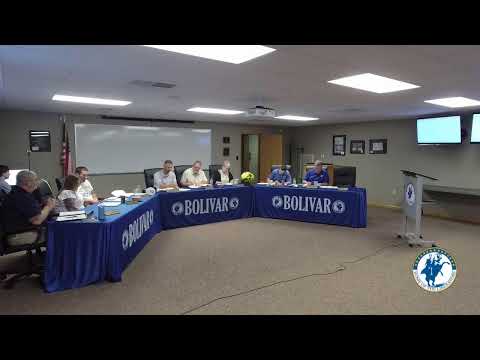
The Bolivar R‑I Board of Education adopted the district's fiscal year 2026 budget on a unanimous vote Wednesday, after staff outlined revenue and spending projections and the pay changes needed to meet recent state legislation.
Chelsea Aberdand, who presented the budget details, said the district's projected revenue for FY26 is just under $39 million and that planned expenditures total about $44.5 million. "Salaries and benefits are estimated about 25,500,000 together," Aberdand told the board during the budget presentation.
The board heard that capital outlay is budgeted at about $9 million, including roughly $7.5 million for bond projects and an early childhood learning center (ECLC) expansion; other district projects such as a primary roof replacement and a high school parking lot repair are included in district capital funding. Aberdand told the board the district is also budgeting for an up to $200,000 increase in property and liability insurance and a planned transfer to capital funds.
Why it matters: the budget establishes how the district will pay staff, run programs and finish bond projects already underway. Board members spent time questioning enrollment and assessed valuation assumptions and how recent and pending state legislation affect revenues and payroll costs.
A key personnel cost driver discussed at length was a recent state law requiring higher minimum pay rates for certain classified employees. Aberdand said House Bill 567 (as referenced in the meeting) requires school minimum pay schedules to reach $15 per hour on Jan. 1; as a result, the district will reset the base for four schedules (child care, food service, custodial and secretary) and make accompanying adjustments to the schedules. The administration told the board these changes increase payroll by about $554,000 before benefits and $650,000 to $700,000 after benefits.
Superintendent-level and administrative staff emphasized that the changes are intended to comply with state law while limiting disruption to current employees' step placements. "When we move that $15 as the base for those four schedules, it affects the whole schedule," Aberdand said, adding that employees on those schedules would remain on their current step but receive the base increase required by law.
Board members also discussed enrollment trends and assessed valuation: Aberdand said the district has lost about 100 average daily attendance (ADA) since 2021 and said the budget uses a conservative ADA projection for FY26. The presentation flagged a provision discussed in the legislature (referred to in the meeting as Senate Bill 3) that could put limits on assessed valuation growth and require a ballot question in Polk County; administrators said that could affect local revenue growth in future years.
After discussion the board voted to approve the FY26 budget. The board also approved several companion items included on the agenda that relate to operations for next school year, including certified and classified salary schedules, extra‑duty schedules and extra‑duty assignments.
What happens next: district staff will finalize FY26 budgets and complete the July audit and any ASBR reporting required by the state. The board will monitor enrollment and state funding updates and expects to revisit projections if the state's final June payment differs from current estimates.