Get Full Government Meeting Transcripts, Videos, & Alerts Forever!
Get email alerts on the District Budget topic
No spam. Unsubscribe anytime.
Coronado Unified adopts 2025–26 budget, board commits to reductions to meet state reserve rules
Summary
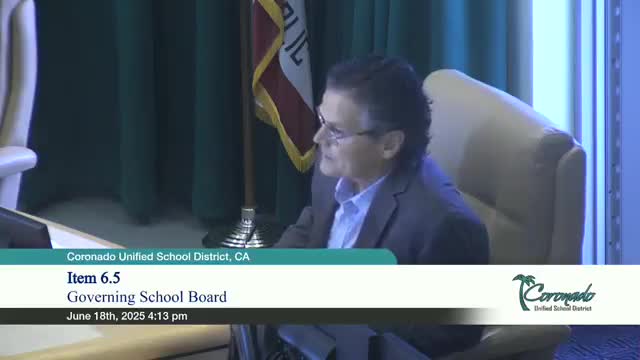
The Coronado Unified School District Governing Board on Thursday approved the district's proposed 2025'26 budget and passed a business-services resolution directing staff to identify approximately $2,000,000 in budget reductions or revenue enhancements to meet a state-mandated minimum reserve.
The Coronado Unified School District Governing Board on Thursday approved the district's proposed 2025–26 budget and passed a business-services resolution directing the district to identify approximately $2,000,000 in budget reductions or revenue enhancements to meet a state-mandated minimum reserve.
Deputy Superintendent Salvador Salamanca, presenting the budget, told trustees the district had built the 2025–26 plan without a signed state budget and is projecting a transition to "basic aid" funding in the 2027–28 school year. Salamanca said Coronado has accelerated repayment of redevelopment agency (RDA) debt and expects most remaining RDA-related payments to finish in the 2026–27 school year, but a small share of property-tax receipts (about $400,000 a year) will continue to flow through the successor agency until some long-lived obligations are resolved.
"We're projecting to become a basic aid district in 27–28," Salamanca said. "One point of information: some RDA debt will outlive the final payment, but that does not change our projection for basic aid in 27–28." He urged trustees that cash flow in a basic-aid district will change because property-tax receipts arrive on a different schedule and recommended maintaining stronger reserves (about 17 percent of annual expenditures) to float monthly obligations.
Why it matters: shifting to basic aid changes how the district receives operating revenue (property taxes instead of monthly state apportionments) and increases near-term cash-flow and reserve-management challenges. The board must also show how general-fund spending aligns with its Local Control and Accountability Plan (LCAP) goals and supply the county office of education with a plan to close a projected shortfall in the 2026–27 fiscal year.
Key details from the presentation and board discussion: - Salamanca said the district has paid roughly $55 million of a projected $64 million in accelerated RDA ("turbo") redemptions and that about $9 million remains. He projected the large remaining payment to occur in the 2026–27 fiscal year and said that payment schedule means Coronado will reach basic aid in 2027–28. - The budget uses transfers from reserve funds (funds 17/40) to balance the general fund for 2025–26; roughly $7.5 million in transfers are shown in the multi-year projections. The district also expects to dissolve a fee-based preschool fund (fund 63) into the main operating fund as programs are consolidated. - The county office of education advised removing a governor'proposed discretionary block grant from projections; the district complied. Salamanca said the district is projecting to deficit-spend in the near term while managing a planned spend-down of reserves tied to the long-range plan. - The presentation outlined possible financing options (tax-exempt lease financing limited to capital uses, or taxable financing to refund non-voter-approved debt) as a potential bridge if needed; staff emphasized any borrowing would be limited to the minimum necessary and repaid as soon as feasible.
Public commenters and staff raised concerns about program impacts and enrollment trends. Three speakers urged the board to protect arts programs and to be transparent about personnel changes: - Jennifer Landry, a Coronado resident, said some arts positions have been quietly reduced and called for clearer public notice, saying, "The district needs to be transparent about cuts and what they are basing those cuts upon." - Carrie Jackson, who identified herself as a longtime arts educator, warned that cutting arts programs "is not just cutting a line item. It's cutting a lifeline for students" and asked trustees to consider mental-health and social benefits of arts programming. - Kim Strasburger, a 20-year arts teacher at the Coronado School of the Arts (COSA), described COSA as a revenue and prestige generator and warned that eliminating a COSA coordinator would jeopardize production, recruitment and fundraising.
Trustees and staff discussed interdistrict transfer (IDT) students and enrollment assumptions. When Trustee Kavanaugh asked for numbers, Salamanca said last year's IDT applications were "close to 500" and that so far this year the district had "somewhere in the 250 realm," a drop the district is watching because IDT students currently contribute attendance-based revenue but would not provide the same per-pupil revenue after the district becomes basic aid.
The board voted to approve the 2025–26 budget (action item 6.5) and then approved a companion business-services resolution (action item 6.6) directing staff to implement approximately $2,000,000 in reductions or revenue enhancements to ensure the district meets the state'required minimum reserve. Trustees amended the resolution during debate to change the operative language on the floor from "at least $2,000,000" to "approximately $2,000,000, as necessary to meet the 3% mandated reserve," to preserve flexibility.
What the board decided (formal actions): - Approved the 2025–26 proposed budget as presented (motion passed). - Approved the business-services resolution committing to approximately $2,000,000 in reductions/revenue enhancements to meet the 3% reserve requirement; the board amended the resolution'language before the vote (motion passed).
Next steps and context: staff will close year-end accounting and present unaudited actuals in September; the county office of education will continue its fiscal oversight. Trustees and staff said they will continue evaluating staffing through attrition and postponing some hires where possible to avoid involuntary reductions, and will return in future meetings with more-detailed line-item options to meet the 2026–27 reserve target.
Ending note: the budget debate included sustained public concern about the district's arts programs, specifically the Coronado School of the Arts, and trustees asked staff to try to minimize program impacts while meeting fiscal obligations.