Get Full Government Meeting Transcripts, Videos, & Alerts Forever!
Get email alerts on the Sustainable Materials Management topic
No spam. Unsubscribe anytime.
Benton County consultants present regional plan calling for a regional waste authority, intermodal hubs and new recovery infrastructure
Summary
Consultants who led Benton County’s Sustainable Materials Management Task Force presented a final report to the Board of Commissioners recommending a regional collaboration to reduce landfill disposal, new transfer and recovery infrastructure and state-level policy changes to support reuse and circular building materials.
Consultants who led Benton County’s Sustainable Materials Management Task Force presented a final report to the Board of Commissioners recommending a regional collaboration to reduce landfill disposal, new transfer and recovery infrastructure and state-level policy changes to support reuse and circular building materials. Sean (Benton County staff member) opened the presentation and said the effort sought “to address, explore and find solutions” across the region.
The task force’s report frames the work around two central problems: reducing the amount of material generated and improving the region’s ability to manage landfill-bound material if Coffin Butte’s availability declines. Joel Schaining, a consultant on the project, told the board the team analyzed state data and the region’s material flows and found the state produces about 6,000,000 tons of landfill material annually, of which roughly 2,400,000 tons are currently recovered — “about 84% of the state generation,” Schaining said. The consultants emphasized that while the Northwest region currently diverts more material than other parts of Oregon, there remains a sizable residual waste stream that requires regional infrastructure and planning.
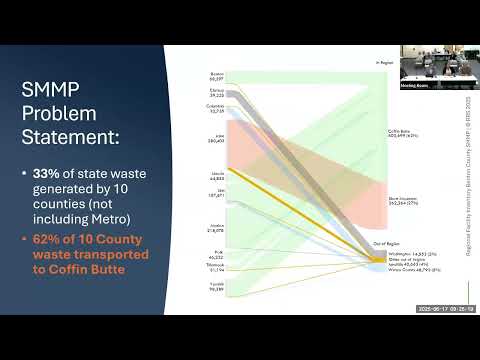
Why it matters: the consultants showed that much of the Mid-Willamette and surrounding counties depend on a small set of disposal options. The presentation identified a 13-county study area and a core seven-county Mid Willamette Valley region that is especially dependent on Coffin Butte: in the narrower seven-county area, presenters said about 97% of landfilled material currently goes to Coffin Butte. In a broader 10-county perspective, approximately 60% of material goes to Coffin Butte. Those flows, the consultants argued, create resiliency and cost risks if local disposal capacity declines.
Key recommendations presented
- Create regional governance: The report’s lead recommendation is establishing a regional waste authority (the consultants described multiple legal/organizational options, including intergovernmental agreements or a more formal authority) to coordinate siting, capital investments and policy across counties. Consultants said an authority could be organized to prioritize the seven most-impacted counties while allowing advisory roles for others.
- Adopt an intermodal hub-and-spoke network: The consultants recommended planning a regional transfer network that favors rail for long-distance moves to reduce truck haul costs and roadway impacts. The presenters described a 10-year horizon to stand up transfer and recovery infrastructure.
- Finance and build publicly owned transfer and recovery stations: The plan recommends publicly financed transfer stations that also host recovery and reuse functions (beyond acting simply as transfer points to landfills) so materials like bulky goods, construction and demolition materials, and organics can be separated, batched and moved to end markets.
- Expand food and organics programming: A dedicated regional approach for food rescue, commercial organics collection, access to composting for multifamily housing and development of end markets for compost.
- Invest in built-environment recovery and adaptive reuse: The built-environment subcommittee recommended improved infrastructure to recover and batch reusable construction materials, integrate adaptive reuse into housing strategies and adopt policies that encourage lower-impact, circular building materials.
- Build reuse, repair and bulky-item hubs: The products-and-packaging subcommittee recommended establishing reuse hubs, repair cafés, tool libraries and other spaces that both divert bulky items from the waste stream and create local jobs. The committee also recommended pursuing state-level extended-producer-responsibility (EPR) solutions for items that are difficult to manage at the county scale.
Process and participation
Presenters said the task force engaged regional stakeholders over roughly eight months. Sean said the team held four task force meetings and roughly 21 subcommittee meetings and that staff and volunteers invested substantial time in the process; he also said the project team interviewed “more than 40 regional elected officials, staff” and subject-matter experts. Consultants said subcommittee members generally followed categories derived from state waste composition data to focus work on organic material, products and packaging, built environment and regional transfer infrastructure.
Numbers cited by presenters and data sources
- State landfill material generation cited by the consultants: about 6,000,000 tons (statewide). - Material currently recovered cited by the consultants: about 2,400,000 tons (presenters described this as roughly 84% of state generation for the Northwest region as defined in the study). - Regional reliance on Coffin Butte: presenters said about 60% of material from a 10-county area goes to Coffin Butte and that 97% of landfilled material from a seven-county subset currently goes to Coffin Butte. - The consultants said the charts in the presentation were based on 2016 DEQ state waste composition data and that updated data are pending.
Questions, concerns and next steps raised by commissioners
Commissioners asked about the proposed scope of a regional authority (seven counties vs. 13 counties) and the practical sequence for implementation. Joel and other presenters said the authority could be structured in multiple ways — starting with an intergovernmental agreement to include more counties or a more formal authority with defined governance if deeper commitments are required. Commissioner Shepherd asked clarifying questions about the geographic scope and governance options.
Commissioner Malone noted Benton County’s current recovery rate cited in the discussion (about 32%) and compared it to higher rates in nearby counties; he urged that transfer stations serve as recovery hubs, not only as points to consolidate loads for long-distance haul.
Presenters listed several immediate next steps: consultants (IRS team) will provide cost estimates for intermodal transfer options; the consultants and county staff will continue conversations with the Oregon Department of Environmental Quality (DEQ) and regional elected officials; the team plans a final written report and a public event in mid-to-late July to present tangible deliverables and options. Sean told the board a pending legislative bill by a state representative to create a state task force was advancing through the legislature; presenters said regional collaboration remains essential regardless of the bill’s outcome. Administrator Purcell reported leftover consulting funds will be used to support Benton County’s solid-waste planning in the county budget.
No formal board votes or ordinance adoptions were recorded in the meeting transcript; the report was presented for discussion and next steps rather than for a final board decision.
Quote highlights
- “In our climate crisis, we cannot solar panel our way out. And in this regional sustainable materials and waste management, we cannot recycle our way out of this issue,” Sean (Benton County staff member) said.
- “These are not consultant driven recommendations. These are driven from our local experts who understand the region,” Liz Start, Start Consulting Group consultant, told the board.
- “The so-called waste, landfill material generated in the state is around 6,000,000 tons … we recover 2,400,000 tons,” Joel Schaining, consultant, said when describing the state context.
What was not decided or needs follow-up
The presentation did not record a formal adoption vote on the plan or creation of a regional authority. Several recommendations require state-level policy or funding (for example, extended-producer-responsibility programs and some building-code or housing-policy changes) and will depend on future legislative or DEQ action. Presenters and commissioners noted capital and operating financing and governance details remain to be defined; consultants said the timeline to bring major infrastructure online would likely be measured in years and they used a 10-year planning horizon as an example.
Tapered next steps and public events
Consultants said they will deliver cost estimates for intermodal transfer infrastructure, work with elected officials and DEQ on policy alignment, prepare a final written report and hold a public event in mid-to-late July to review findings and options with the broader region.
Ending
Benton County commissioners and staff praised the depth of outreach and recommended the county continue pursuing both local infrastructure options and coordinated advocacy to the state for policy tools and funding. The task force report frames regional collaboration as the organizing mechanism for investments, policy change and program development to reduce landfill disposal and build local recovery capacity.