Get Full Government Meeting Transcripts, Videos, & Alerts Forever!
Get email alerts on the Budget Appropriations topic
No spam. Unsubscribe anytime.
Guam Legislature hears Department of Public Works' $22.4M FY2026 request; members press on staffing, village streets and permits
Summary
The Committee on Finance and Government Operations held a public hearing on Bill No. 44-38 COR, the executive-branch appropriations bill for FY2026, focusing on the Department of Public Works' $22.4 million request and operational challenges including recruitment, village-streets paving, abandoned-vehicle removal and delayed permitting.
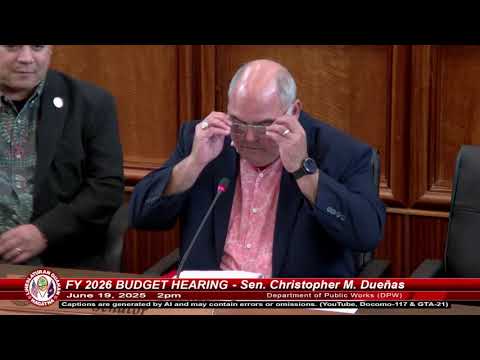
The Committee on Finance and Government Operations held a public hearing June 19 on Bill No. 44-38 COR, the governor-requested appropriations measure for fiscal year ending Sept. 30, 2026, and heard the Department of Public Works (DPW) present a $22.4 million budget request for operations.
DPW Director Vince Areola told senators the request is “a slight increase of a little over $400,000 from the previous fiscal year,” and that most operational funding comes from the Territorial Educational Facilities Fund (TEF) and the Guam Highway Fund. He said federal grants and programs supplement local money for capital and program work.
Why it matters: senators pressed DPW on recurring workforce and procurement problems that directly affect road repairs, school bus service and stormwater work across the island. Lawmakers said the department will need clearer project lists and firmer timelines before the legislature considers larger appropriations.
DPW priorities and constraints DPW described core program budgets and several project lines. In the object-class summary Director Areola listed salaries and benefits at roughly $16 million and contractual services at about $3.2 million, with equipment (~$82,000) and capital outlay (~$410,000) smaller shares of the request. Areola said DPW currently manages about 47 ongoing capital improvement projects with a combined value the department gave as approximately $93.6 million, driven by a mix of federal grants, FEMA awards and local funding.
He highlighted specific projects including renovation of the Hagåtña (Hagåtña) municipal swimming pool (a multi‑million-dollar project), Paseo Stadium repairs following Typhoon Mawar, a federally funded biolab foundation in Mangilao, and a $4.2 million Guam Police Department evidence building in Jigo.
Staffing and salary competition Areola and Deputy Director Linda Banas repeatedly told the committee the department is losing technical staff—engineers, electricians, HVAC technicians and plumbers—to the private sector, autonomous agencies and the U.S. military because of salary differences. “The labor field on Guam for technical personnel is very competitive,” Areola said. He said DPW will request the Department of Administration perform a salary study to evaluate pay for critical trades and engineering roles.
Senators pressed whether the study or agency action would quickly address an ongoing chief‑engineer vacancy; Areola said the department has advertised and received no qualified applicants and that starting private‑sector salaries for engineers are higher than DPW’s posted ranges.
Village streets, paving and asset maintenance Senators and DPW staff discussed village‑streets paving and maintenance, an issue several lawmakers said is a top constituent concern. Areola reported that about $3.5 million shown in DPW accounting is largely encumbered for task orders already issued and that recent village street work has included Agat, Yamitik and Malesso interior roads. He described ongoing striping and rumble‑strip work at hazardous locations such as Dead Man’s Curve, and said DPW had contracted striping work through a single remaining vendor.
Multiple senators urged a larger, staged program that can be executed when funds are available. Areola said DPW can prepare a supplemental budget identifying specific village streets ready for work and that mayors typically help prioritize which roads receive attention.
Abandoned vehicles and enforcement Public Law 37-60 assigned responsibility for abandoned‑vehicle collection to DPW, Areola said; the department has collected more than 150 vehicles in the eastern districts and continues to work with mayors and a draft MOU with EPA to secure disposal funding. He described the work as time‑consuming and said DPW may seek stiffer penalties or community‑service remedies for owners who abandon vehicles.
Bus operations, driver oversight and electric buses Areola said bus operations funding remains drawn from TEF and reported operational work to support school double‑session schedules at Simon Sanchez High School and others. He described tighter supervision of drivers and continued random and incident drug testing (DPW said random testing occurs biannually and post‑incident tests are required). The budgeted drug‑testing line in the draft fell from $3,380 to $880, which senators asked DPW to treat as a baseline figure that can be supplemented during execution.
DPW also told the committee it intends to rebid a previously protested procurement for electric school buses using available federal grant funding; Areola cautioned that charging‑station costs and reliable power delivery from Guam Power Authority will need to be reconciled before final procurement.
Permitting digitization and interagency chokepoints Senators repeatedly asked about one‑stop permitting performance. Areola said DPW has increased pre‑review meetings for large projects to reduce final‑approval delays, and that many permit holdups stem from other agencies—EPA, agricultural or other reviews—rather than DPW plan checks.
He confirmed a prior procurement for a digitized permit portal was protested and that GSA advised the department to rebid; DPW said it will rebid the procurement so applicants can check permit status online in the future.
Stormwater, ponding basins and MS4 obligations Areola reviewed DPW’s stormwater responsibilities, including maintenance of more than 60 ponding basins and periodic cleanup ahead of rainy seasons. He flagged several recurring flood locations (Polaris Point, the Manel Channel and Pago Bay approaches) and noted that federal MS4 (municipal separate storm sewer system) requirements create large, costly obligations to reduce pollutant discharge to receiving waters.
Procurement, GSA and parts availability Committee members and DPW described procurement friction with GSA that affects operations. Areola said DPW routinely sends 150–200 requisitions a year to GSA and that delays in securing parts—for example, a replacement hose for heavy equipment—can keep costly machines out of service and slow road work.
Office of Highway Safety and traffic‑safety programs DPW presented the Office of Highway Safety as a federally funded division that supports data‑driven safety campaigns, officer equipment and community outreach. Areola said the office seeks about $3 million in federal funding for the coming year for programs including DUI countermeasures, child‑safety seats, bike safety and training.
Enforcement and damaged government property Senators asked how DPW recovers repair costs when private contractors or utilities damage pavements during excavation. Areola said DPW requires encroachment permits and typically requires bonds or insurance; historically DPW used a records‑based system to pursue insurers for repairs and intends to restore that capability. If an owner fails to board or remediate an abandoned, deteriorated building after notice, DPW said it may board up or remove the structure and place a lien for costs.
Committee process and next steps No formal vote was taken during the hearing. Chairman Senator Christopher Duenas left the record open for seven calendar days to accept additional written testimony on Bill No. 44-38 COR and encouraged affected parties to submit comments to the committee.
What lawmakers flagged as follow‑up: senators asked DPW to (1) produce a prioritized, mile‑by‑mile list of village‑streets projects ready for appropriation; (2) pursue a salary study with the Department of Administration for technical trades and engineers; (3) rebid the digitized permit portal procurement promptly; and (4) continue coordination with EPA, GSA and GPA on funding and operational bottlenecks.
The committee hearing closed after roughly two hours of testimony and questioning; no votes were recorded on the bill during the session.