Get Full Government Meeting Transcripts, Videos, & Alerts Forever!
Get email alerts on the Pensions And Benefits topic
No spam. Unsubscribe anytime.
Torrington actuary reports pensions largely funded; OPEB remains underfunded
Summary
An actuary told the Torrington Board of Finance on June 17 that the city's pension plans are moderately well funded while the post-employment health benefit trust (OPEB) remains minimally funded; full actuarial funding of OPEB would raise near-term budget costs by roughly $3.7 million.
Torrington's Board of Finance heard actuarial valuation results for the city's retirement plans and its post-employment health benefits on June 17, when consulting actuary Steve Lemanski presented the 07/01/2024 valuations for the City Employees Retirement Fund, the Police and Firemen's Pension Fund, and the city's OPEB trust.
Lemanski said the city's pension plan is about 82.1% funded and the police and fire plan about 65.8% funded, with actuarially determined employer contributions (ADEC) for fiscal 2025-26 and 2026-27 of roughly $1,220,000 for the city plan and $4,600,000 for the police and fire plan. He told the board the plans are closed to new hires and that both use an 18-year amortization for unfunded pension liabilities.
Why it matters: pension contributions affect long-term budget planning and taxpayers. Lemanski told the board that roughly 70% of pension benefits over a plan's lifetime are expected to come from investment returns rather than current employer contributions, which is why the plans are invested and use smoothing to avoid volatile contribution swings.
Key pension details: Lemanski said investment returns over the two-year valuation period were about 11.4% on a market basis but that prior losses from fiscal 2022 are still being phased in and reduce the smoothed asset value. He reported 43 active members in the city pension plan (215 total members) and 59 active members in the police and fire plan (240 total). He also noted the recently implemented deferred retirement option plan (DROP) for public safety increased liabilities by about 0.6%.
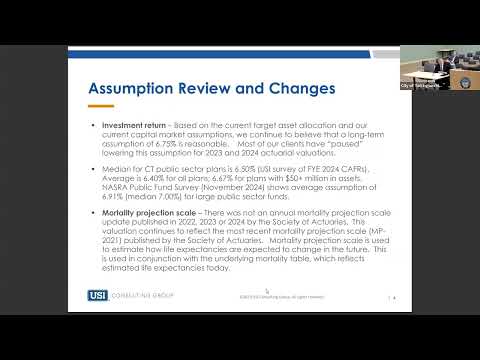
On assumptions, Lemanski recommended keeping the investment return assumption at 6.75% (the valuation's discount rate) and said that while national survey medians range from about 6.5% to 7.0% depending on plan size, the current assumption remains reasonable for Torrington.
OPEB results and budget impact: Lemanski said the OPEB actuarial valuation produced favorable experience relative to expected claims and participant demographics, producing a 16% reduction versus prior expectations on the liability side. He said an updated health-care cost trend assumption (higher outlooks for future medical cost growth) offset some gains, increasing liabilities by roughly 6% on top of the experience gains.
The OPEB plan's accrued liability on the valuation date was about $69,000,000 and assets about $1,900,000, for a funded ratio of roughly 2.7%. Using the valuation's 24-year amortization, Lemanski reported a normal cost of about $1,900,000 and an unfunded liability amortization payment of about $5,400,000, producing an ADEC near $7,700,000. He said current pay-as-you-go retiree medical payments are about $4,000,000 annually, so moving to full actuarial funding would create a near-term net budget increase of about $3,700,000.
Lemanski also explained the difference between the valuation's discount rate (6.75%) and the rate used for GASB financial reporting: because of the OPEB trust's current asset level and the GASB rules, the GASB discount rate used in financial statements was roughly 3.93% on the valuation date, which produces a materially higher liability in the city's financial statements (Lemanski cited an illustrative GASB liability near $110,000,000).
Next steps and context: Lemanski noted the Society of Actuaries will publish updated public-sector mortality tables periodically; he advised the board that applying the SOA's new public-sector experience in the next valuation could slightly lower liabilities for general employees but increase police and fire liabilities by about 1% to 1.2% because public safety mortality improvements have been larger. The board asked several clarifying questions about timing, contribution amounts, and the prospects for budgeting toward full OPEB funding.
Lemanski said he will retire in February and that a colleague will succeed him as the plan actuary. The board voted to receive the presentation.