Get Full Government Meeting Transcripts, Videos, & Alerts Forever!
Get email alerts on the Water Utility Detachment topic
No spam. Unsubscribe anytime.
Ordinance committee forwards measure to remove inactive water meters, with staff asked to address buyer-impact concerns
Summary
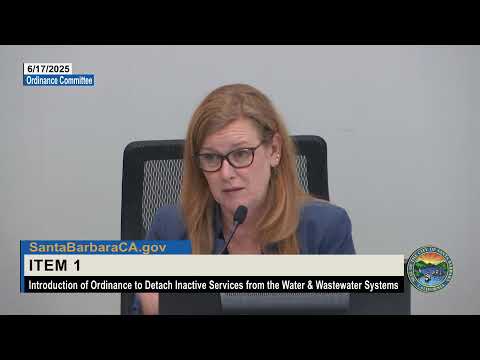
The Santa Barbara Ordinance Committee unanimously voted June 17 to forward a proposed ordinance that would allow the city to detach and remove inactive water and wastewater service connections after one year of inactivity, while asking staff to return with options addressing buyer-surprise and notification concerns.
The Ordinance Committee of the City of Santa Barbara on June 17 voted unanimously to forward to the full City Council a proposed ordinance that would allow the city to deem inactive water and wastewater services "detached" after at least one year of account closure and to remove associated meters and infrastructure.
City staff said the proposal is intended to replace the existing reserved-capacity charges program and clean up unused assets that the city continues to maintain despite receiving no monthly service revenue. "Staff is recommending that the ordinance committee forward to council for introduction, an ordinance adding chapter 14.1 to the Santa Barbara Municipal Code," said Katie Munster, water resources specialist, presenting the item.
The ordinance would apply to utility accounts closed for at least one year. Staff said there are roughly 460 accounts that have been closed for at least a year — about 1.6% of the city’s roughly 27,000 connections. Of those 460 accounts, staff reported about 41% are commercial, 31% irrigation-only, and 28% residential.
Under the proposed program the city would mail written notice to property owners (and to the last known account holder, where different) and allow at least 30 days to reinstate service before deeming a service detached. If a service is detached the city would remove the meter and may remove other utility assets; reestablishing service would require payment of current connection and capacity charges. Munster gave an example for the city’s smallest meter (5/8 inch): a current water capacity charge of $10,827 and a sewer capacity charge of $3,955 (combined $14,782) and estimated connection fees of $4,615 — a combined illustrative total of about $19,400 to reestablish service in that example.
The ordinance would retire the reserved-capacity charges program (established in 2013), which had accrued monthly service charges once an account had been inactive longer than six months. Staff said that program frequently created surprise charges for new property owners who bought parcels with meters left in place, citing one example where a customer seeking service in 2021 was informed of roughly $6,000 in accrued reserved-capacity charges dating to 2013.
Committee members pressed staff on the tradeoffs between surprise back charges and the higher, up-front cost a buyer would face to reestablish service after detachment. "I personally don't think it's ready to forward to council because of that lingering issue," Chair Sneddon said, voicing concern about the optics of removing an asset and later charging a new owner to reinstall it. Committee members and staff discussed options the committee asked staff to consider before council, including caps on back charges, clearer notification methods (certified mail or door hangers), coordination with street work to avoid repeated paving impacts, and outreach to the local real estate community.
Dana Hoffenberg, a water resources analyst who administered the prior reserved-capacity program, told the committee the policy change was driven primarily by the surprise fees experienced by buyers: "The main issue that we found... is the surprise aspect," she said, adding that many buyers and realtors in drought-prone areas look for meters when evaluating properties.
Staff told the committee the administrative procedures for implementing the ordinance will be developed with Water Commission input; the Water Commission voted 5–0 in favor of staff’s recommendation on May 22 and asked for robust notification and documented receipt methods. Staff said fee-resolution updates to retire the reserved-capacity program would go to City Council the same day; if adopted the fee changes would be effective July 1. If the ordinance committee’s recommendation is forwarded and the council moves on the stated schedule, staff said the ordinance would be introduced July 29 and potentially adopted August 5, after which staff would return to Water Commission with draft administrative procedures.
Committee member Jordan moved the staff recommendation and Councilmember Oscar Gutierrez seconded. The committee recorded a unanimous electronic vote to forward the ordinance to council with the request that staff address the committee’s concerns about buyer impacts and notification before the council hearing.
The committee’s action forwards the proposed Chapter 14.1 to the City Council for introduction; the ordinance itself and the administrative procedures remain subject to future council and Water Commission review.