Get Full Government Meeting Transcripts, Videos, & Alerts Forever!
Get email alerts on the Land Use topic
No spam. Unsubscribe anytime.
Board approves Harper Canyon/Sena Hills subdivision after revised wildlife-corridor mitigation
Summary
After reviewing revisions prepared with California Department of Fish and Wildlife, the Board certified a supplemental environmental impact report and approved the Harper Canyon / Sena Hills vesting tentative map with conditions restricting building envelopes and conservation easements.
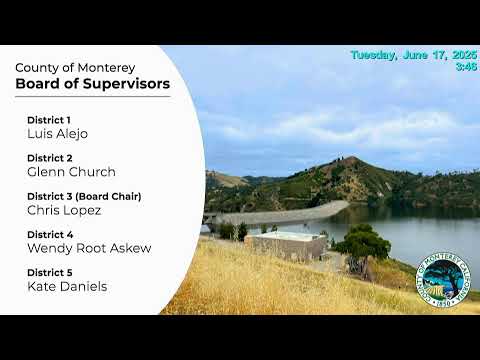
The Monterey County Board of Supervisors on June 17 approved the Harper Canyon / Sena Hills vesting tentative map and certified a supplemental environmental impact report (SEIR) that includes additional mitigation measures focused on wildlife connectivity and visual impacts.
Staff said the revised mitigation language, developed in consultation with the California Department of Fish and Wildlife (CDFW), requires building envelopes to be recorded on the final map, limits each envelope to one acre, places area outside envelopes into conservation easements, and restricts disking for vegetation maintenance outside building envelopes. The revisions also include specific direction on wildlife-friendly lighting and other design features intended to reduce impacts to movement corridors.
County staff and the applicant maintained the SEIR addresses the Court of Appeal's prior instruction to analyze wildlife corridor impacts. CDFW submitted a letter saying it concurs the revised mitigation package "minimizes potential impacts to wildlife connectivity to the extent feasible." CDFW recommended, but did not require as a condition, prohibiting free-ranging horses outside building envelopes and a county-administered trapping response for wildlife conflicts; staff said the latter is a county operational function rather than a project condition.
Speakers at public comment included conservation organizations urging stronger protections for contiguous habitat and residents concerned about tree removal and wildfire risk. The board debated the practicality of site-level fuel management and acknowledged that more intensive vegetation management by homeowners or insurers may affect habitat over time.
Supervisor Church moved to approve the project with the updated SEIR and conditions; Supervisor Daniels seconded. The board called for the ayes and the motion carried. The approval directs staff to finalize the conditions and proceed with the final map and recordation steps.
Why it matters: The approval changes a decade-old entitlements process by adding site-level, enforceable building-envelope constraints and conservation easements intended to protect wildlife movement across the Toro Park uplands. Project opponents had sought further lot reconfiguration; proponents said the revised mitigation meets the Court of Appeal's requirements.
Ending: With certification and approval, the county will require a wildlife-corridor plan and mapping on the final map before any lots may be sold or developed; recordation of building envelopes and conservation easements will be required as conditions of approval.