Get Full Government Meeting Transcripts, Videos, & Alerts Forever!
Get email alerts on the 3400 Laguna Heritage On The Marina topic
No spam. Unsubscribe anytime.
Board upholds environmental review and clears Heritage on the Marina to proceed with modified historic-review conditions
Summary
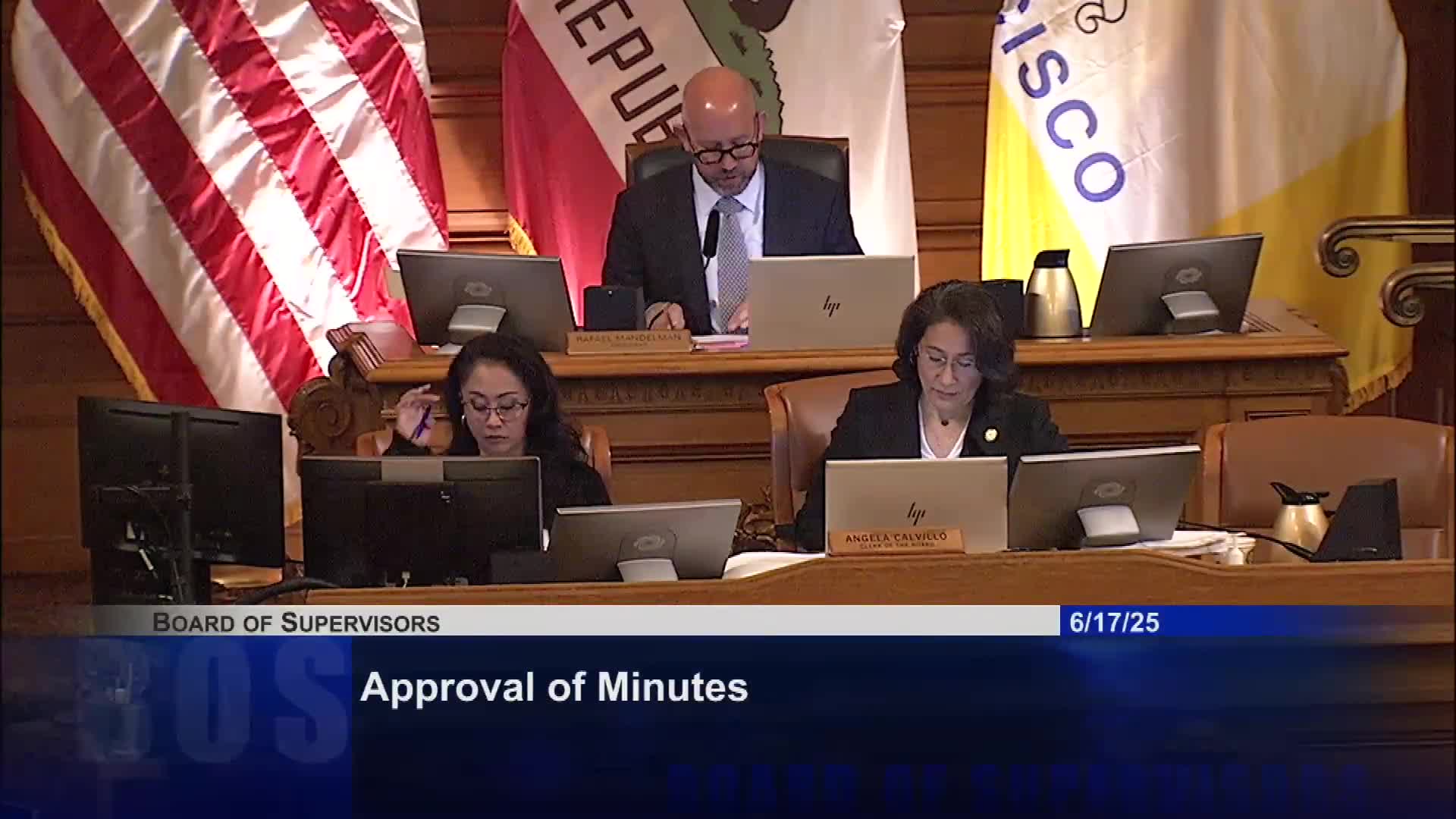
The San Francisco Board of Supervisors on June 17 upheld the Final Environmental Impact Report for the Heritage on the Marina project at 3400 Laguna Street and approved the project's conditional use authorization and certificate of appropriateness with revised conditions that shift final design sign-off to planning preservation staff.
The San Francisco Board of Supervisors on June 17 upheld the certification of the Final Environmental Impact Report for the proposed Heritage on the Marina redevelopment at 3400 Laguna Street and approved the project's conditional use authorization and certificate of appropriateness with revisions to the historic-review process.
The board voted 11-0 to affirm the planning commission's certification of the FEIR (item 26). Later votes amended the planning commission's conditional use and Historic Preservation Commission approvals so that final review of architectural details will be performed by planning department preservation staff rather than an ad-hoc Historic Preservation Commission architectural review committee; those motions passed 10-1, with Supervisor Chan voting no.
Why it matters: the project would renovate the century-old Julia Morgan landmark building and demolish two non-historic structures to build new buildings that add roughly 23 residential care units, increasing residential care suites from 86 to 109 and adding roughly 58,000 square feet of institutional space. Opponents said the scale and placement of the new buildings would overwhelm the landmark and that the operator had illegally converted nearby rent-controlled housing into institutional use. Project supporters said the owner needs the expansion to remain financially viable and to modernize homes for seniors.
Opponents pressed preservation, housing and legal concerns. Tanya Albuquerque, speaking for the neighborhood group Save the Marina's Heritage, told the board the Heritage'project "would renovate 2 of the existing buildings and make improvements to the Julia Morgan building" but that the sponsor'plans "will surround and tower over the mansion, hiding much of it and many of its protected and distinguished features from public view." Albuquerque said the Historic Preservation Commission attached a critical condition ("condition 1") requiring the owner to work with the HPC's architectural review committee (ARC) on massing and details before a building permit was issued, and she urged the board not to remove that oversight. "The certificate of appropriateness and condition 1 must stand or fall together," she said.
Steve Williams, representing the appellants, argued that Heritage had violated its existing conditional use by incorporating adjacent residential buildings into its institutional operation, converting what he described as 10 rent-controlled family units into institutional senior housing without proper approvals. Williams cited the planning code and said the sponsor's acquisition and reuse of those units triggered a requirement for a new conditional use.
Supporters and the project sponsor defended the proposal as necessary to preserve the institution and adapt to seniors' needs. Mary Lindy, chief executive officer of the San Francisco Ladies Protection and Relief Society (doing business as Heritage on the Marina), said the nonprofit faces growing operating deficits and aging, undersized units that are often vacant because they do not meet modern senior needs. "This project is not about profit. It's about survival," Lindy said. Developer and sponsor representatives said the project's average unit size would grow from about 250 square feet now to roughly 700 square feet on average, and that the plan would retain and restore the Julia Morgan building while providing more suitable long-term senior housing.
Planning staff and the city attorney's office told the board the environmental review and entitlements complied with applicable law. Megan Kalpin, senior environmental planner, recommended rejecting the CEQA appeal and said the draft EIR adequately analyzed topics including traffic, loading, shadowing and cultural resources. "For these reasons, the planning department respectfully requests that the board reject the CEQA appeal and uphold the planning commission certification of the final EIR," Kalpin said. Rich Sucre, deputy director of current planning, recommended clarifying the HPC condition to avoid unlawful delegation to the ARC and suggested a modified condition requiring specified final design review by planning preservation staff, with a 90-day timeline to comply with the Permit Streamlining Act. Deputy City Attorney Brad Russi told the board his review indicated the HPC could not delegate broad approval authority to the ARC.
The board's actions and vote counts: - Item 26 (affirm certification of the Final EIR): Motion to approve passed 11-0; items 27 and 28 (related motions) were tabled. - Item 31 (conditional use authorization): The board amended the planning commission decision to revise finding 6L, directing final review to planning preservation staff rather than the HPC ARC; amendment passed 10-1 (Supervisor Chan no). The board then approved item 31 as amended and directed the clerk to prepare findings (item 32); the combined action passed 10-1 (Chan no). Item 30 was tabled. - Item 35 (certificate of appropriateness): The board amended Condition 1 to substitute planning preservation staff review and approval of final architectural details prior to building-permit submittal and to require that "no reduction in project square footage shall result from such review." The amendment and approval passed 10-1 (Chan no). Item 34 was tabled.
Matters the board weighed but did not resolve fully: opponents pointed to a Notice of Special Restrictions recorded for the landmark and said the project had not been evaluated against that instrument; one speaker, Bart Draper, urged the board to send the project back to the ARC to review the NSR implications. Opponents also raised traffic and pedestrian safety concerns at the Bay/Laguna intersection and about a proposed Bay Street driveway; the planning department said the project will relocate the driveway, provide off-street freight and passenger loading, and add pedestrian bulb-outs to improve safety. Appellants questioned public notice and alleged unpermitted conversions of nearby units; planning staff said public notice complied with CEQA procedures and planning-code notice standards and that the department found no code violations in the record.
What the revisions mean procedurally: the board's amendments keep the project approvals in place while narrowing the post-approval review role to planning preservation staff, who must sign off on specified fenestration, material and finish details before building permits are issued and must do so without reducing the approved project square footage. The board also directed the clerk to prepare written findings supporting its decisions. Because some related motions were tabled, limited procedural steps remain before building permits can be issued.
Next steps and context: the sponsor will proceed to building-permit review, where final plans must match the approved entitlements and the planning department will re-review permit-level drawings. Opponents said they may pursue additional administrative or legal review. The project remains one of the highest-profile redevelopment and preservation disputes in the Marina district this year, combining heritage protection, questions about the preservation of rent-controlled housing, and senior care capacity in San Francisco.
Ending: With the board'approved modifications, Heritage on the Marina can move forward through the city's permit process subject to the new condition that planning preservation staff approve final architectural details prior to any building-permit issuance. Supporters hailed the decision as a pathway to stabilize a long-running seniors' nonprofit; opponents said the board's changes did not fully address their preservation and housing-loss concerns.