Get Full Government Meeting Transcripts, Videos, & Alerts Forever!
Get email alerts on the Technology Management topic
No spam. Unsubscribe anytime.
Department of Technology urges retaining two deputy posts and warns of costs in shifting digital services billing
Summary
The Department of Technology argued two vacant deputy director positions are critical to manage enterprise applications and network infrastructure; the Budget and Legislative Analyst recommended the roles as policy matters and proposed eliminating a redundant work order that funnels digital services billing through DT instead of the City Admin.
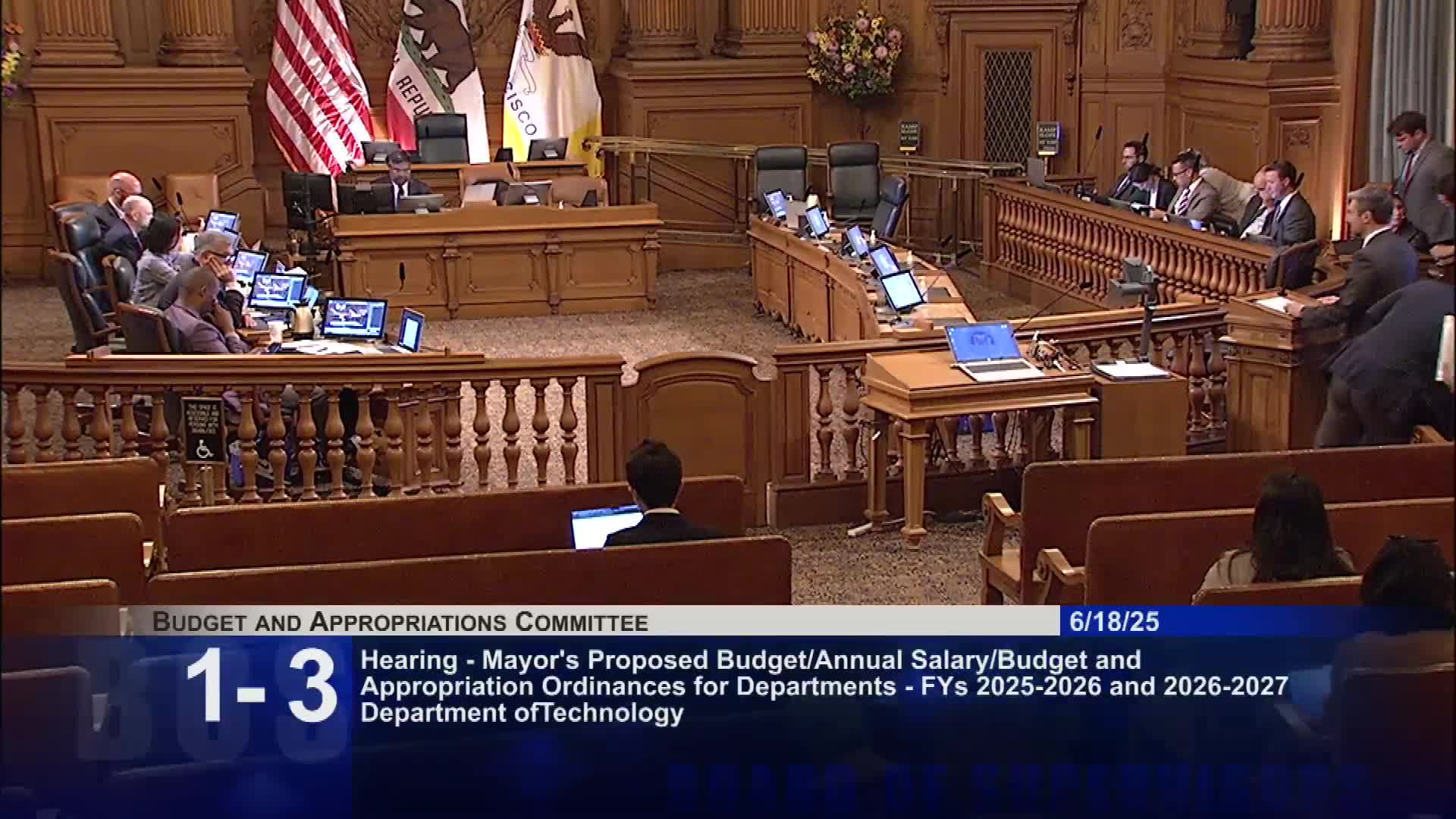
Department of Technology leaders told the Budget and Appropriations Committee on June 18 that two currently vacant deputy director management positions are functional necessities for enterprise applications and network infrastructure, and cautioned the committee about the operational risk of deleting them to meet budget targets.
The Budget and Legislative Analyst recommended the committee treat both deputy director vacancies as board-level policy decisions, and also recommended eliminating an internal work order used to bill department-level digital services and then remit those funds through a second work order to the City Administrator’s office. The BLA characterized that billing as redundant and said responsibility for charging should move to the City Administrator in the second budget year.
Why it matters: The two deputy roles cited by the department oversee systems that touch many city agencies — enterprise applications that support permitting and justice functions, and network infrastructure that supports 44–45 city agencies and expanded public internet access to affordable housing units. The BLA’s recommended work-order change could reorganize how about $8.4 million in second-year charges are reflected in departmental budgets.
The Department of Technology’s director emphasized operational consequences of deleting management authority while the vacancies reflect the hiring freeze and structural complexity, not lack of need. The director said the department’s staff-to-management ratio has grown flatter — from 13:1 in 2020 to 17:1 today — and argued losing the enterprise applications director and network services director would increase outages, duplication and emergency costs.
Christine Martin of the BLA reiterated that the digital services and data functions were transferred from DT to the City Administrator in 2018, but DT continues to bill for those services and then passes the revenue on. The BLA recommended shifting the billing mechanics to the City Administrator in fiscal year 2026–27 and noted a commensurate recommendation exists in the city administrator’s report; the city administrator told the committee the longer window for implementation (second year) made the office comfortable accepting the BLA’s recommendation.
City Administrator representatives said they and the Department of Technology would use the 12-month runway to coordinate implementation and review the civil grand jury’s forthcoming recommendations on citywide technology organization before making structural changes. No formal action was taken at the committee; the BLA left the vacancy and work-order items as policy recommendations for the board to consider.