Get Full Government Meeting Transcripts, Videos, & Alerts Forever!
Get email alerts on the Transit Congestion topic
No spam. Unsubscribe anytime.
San Francisco research, local officials tell Assembly TNCs contributed to congestion and transit ridership declines
Summary
San Francisco County Transportation Authority and UC Berkeley researchers told the Assembly committee that local analyses link TNC growth to increased congestion and earlier ridership losses, and urged that CPUC release trip data so local agencies can plan and evaluate mitigation.
San Francisco County Transportation Authority (SFCTA) staff and university researchers told the committee that TNCs have measurable local impacts on congestion and transit ridership and that public trip data are necessary to plan mitigations.
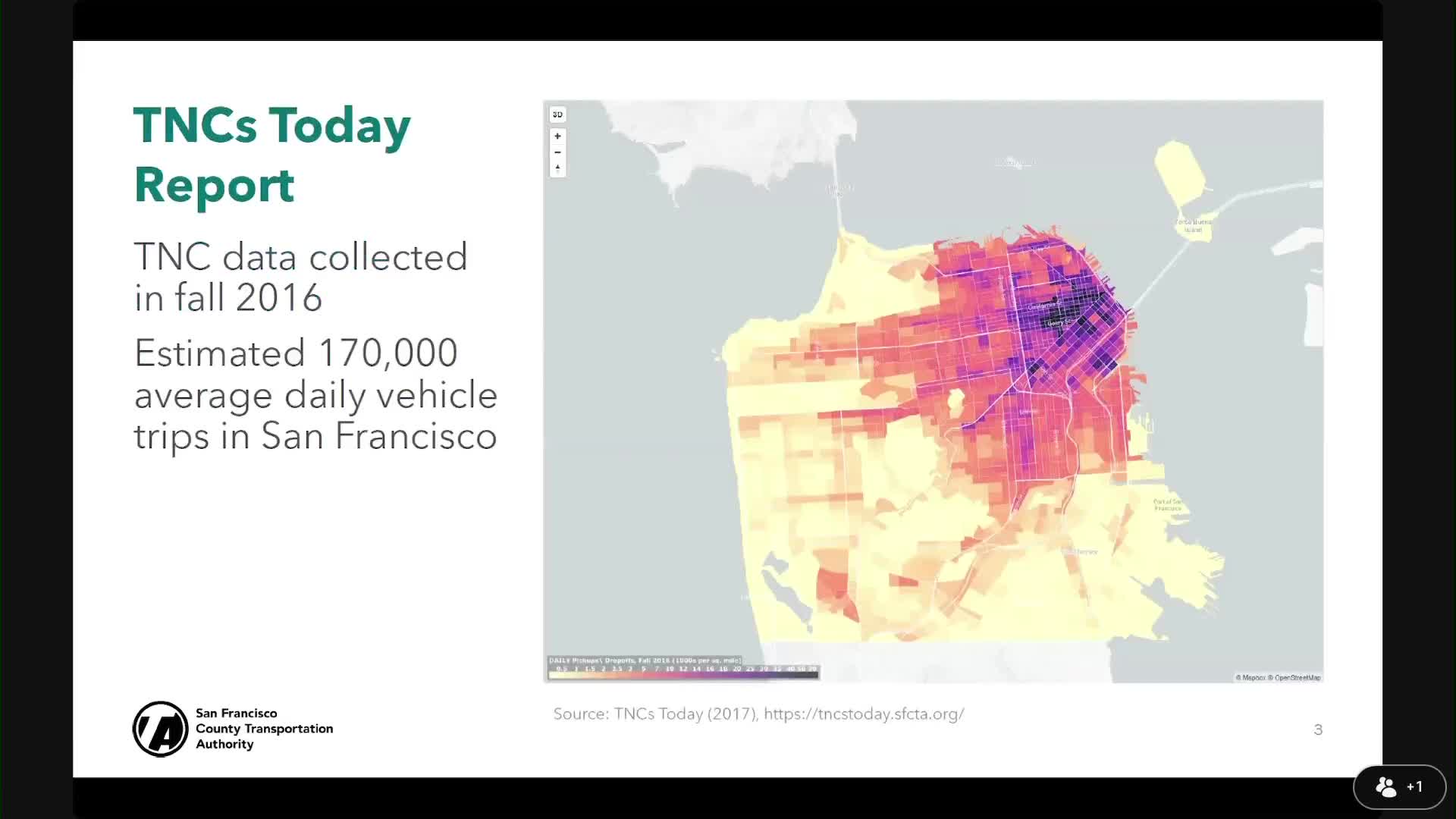
Drew Cooper of the SFCTA described peer‑reviewed studies built from vendor trip datasets and CPUC filings that found TNCs contributed substantially to San Francisco congestion and a decline in transit ridership. "Between 2010 and 2015, we estimated that TNCs led to a 10% loss in transit ridership in San Francisco," Cooper said, and he added TNCs accounted for approximately half of the rise in congestion in that period.
Cooper said the Transportation Authority and the municipal transit agency use a locally enacted congestion mitigation tax — a 3.25% fare tax approved by voters in February 2019 — to fund safety projects (bike lanes, intersection improvements) and transit service improvements; the levy has generated roughly $8 million per year over the last three years, Cooper said.
University researchers echoed the need for more regular, detailed data. Elliot Martin of UC Berkeley said robust analyses require trip activity data plus survey and fleet composition information. He noted that while some CPUC trip files for 2021 are available, the files are heavily redacted in places and earlier years remain unavailable despite CPUC decisions designating them public. The academic witnesses recommended curated researcher access and data obfuscation techniques that retain policy value while protecting personally identifiable information (PII).
Both witnesses warned that autonomous vehicle (AV) services may have similar local system impacts as they scale and urged policymakers to ensure timely data access for planners and researchers so cities can assess systemwide effects and prepare mitigation strategies.