Get Full Government Meeting Transcripts, Videos, & Alerts Forever!
Get email alerts on the Clean Miles Standard topic
No spam. Unsubscribe anytime.
Lawmakers and industry debate rollout of California's Clean Miles Standard and driver incentives
Summary
At an informational hearing, CPUC staff and TNC representatives described Clean Miles Standard targets, the 9¢ per‑ride funding mechanism, and driver assistance initiatives; industry witnesses said electrification faces supply and infrastructure hurdles.
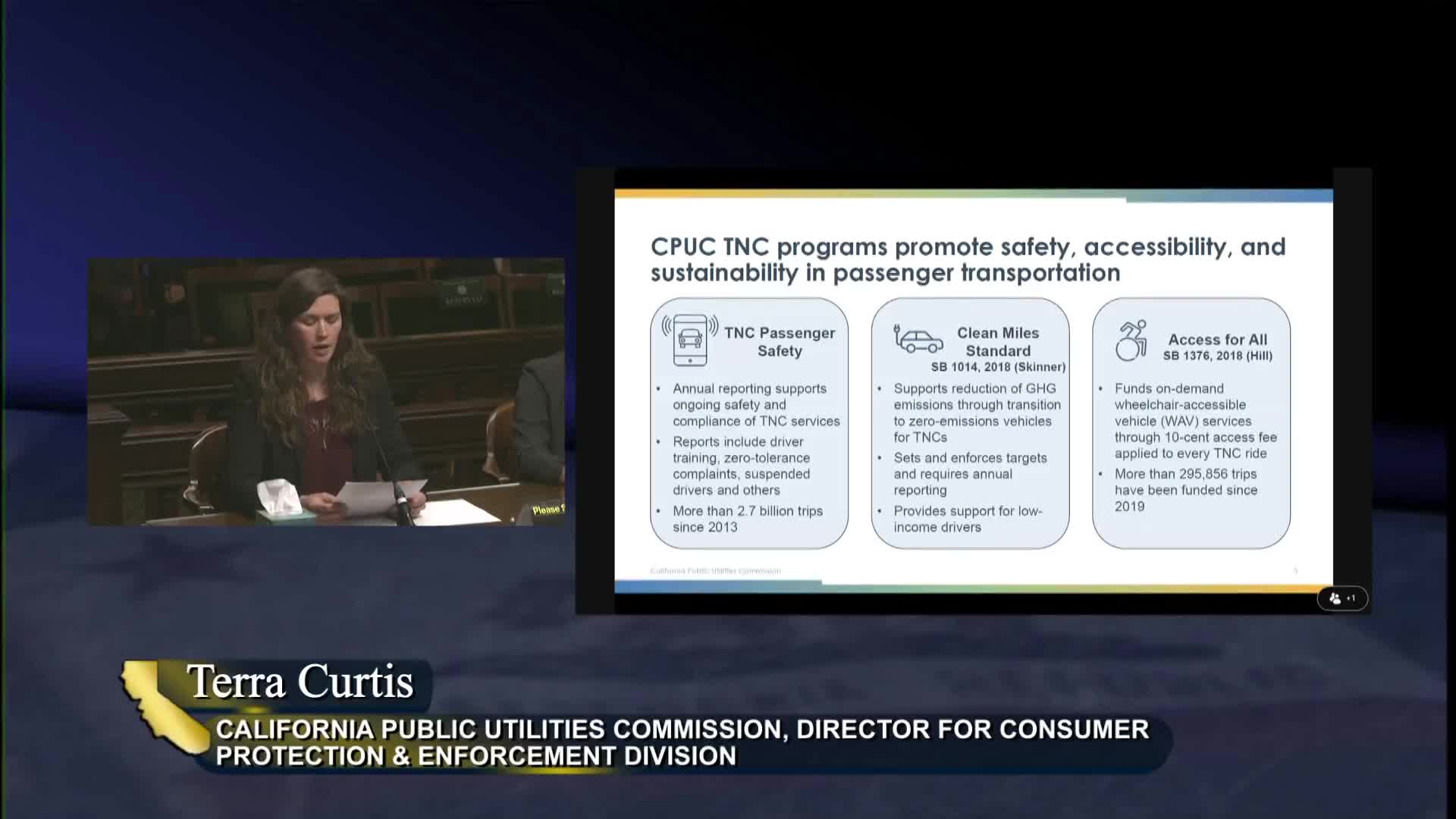
The committee heard detailed descriptions of California's Clean Miles Standard (CMS), the state program that requires Transportation Network Companies (TNCs) to reduce greenhouse gas emissions per passenger mile and raise the share of zero‑emission vehicle miles on their platforms.
Pat Fenn of the California Public Utilities Commission reminded members that the Clean Miles Standard was enacted by the legislature in 2018, with implementation shared between the CPUC and the California Air Resources Board. Fenn summarized CARB's targets described in the rulemaking, including a goal to reduce per‑passenger‑mile greenhouse gas emissions toward zero by 2030 and a target for 90% of TNC vehicle miles to be zero‑emission by 2030. She said the CPUC is implementing the program and has an open rulemaking in which the commission set a regulatory fee to fund incentives.
Fenn and CPUC staff explained the fee the commission adopted to fund the program and related incentives: a per‑ride regulatory fee initially set at 9¢ per trip to finance driver assistance programs and other CMS initiatives. "We have established what we call a driver's assistance program that is going to provide incentives to low and moderate income drivers to help them transition their personally owned vehicles to zero emission vehicles used in the TNC fleets," Fenn said.
Uber and Lyft testified about corporate electrification efforts and constraints. Uber said it operates significant zero‑emission vehicle (ZEV) activity globally and in California and has invested hundreds of millions of dollars in driver incentives and partnerships; the company reported 230,000 active zero‑emission drivers globally and highlighted more than 105 million quarterly ZEV trips globally. Uber cautioned that the pace of adoption depends on vehicle affordability, charger availability and broader market forces.
Lyft described several programs to accelerate EV adoption, including driver bonuses totaling about $45 million to date, an EV rental pathway, a green‑ride selection option for riders and partnerships with charging providers such as EVgo. Lyft said in the fourth quarter of 2024 EVs accounted for over 13% of ride miles on its platform — higher than the statewide EV share — but noted industry barriers remain.
Committee members asked about evaluation and reporting. Fenn said the statute calls for a biennial “unanticipated barriers” report (with the first scheduled in 2026) and that the CPUC has hired an external evaluator for the driver's assistance program to measure impacts. Members pressed companies and CPUC staff on whether drivers would have realistic access to affordable EVs and charging infrastructure; industry witnesses said they are investing but warned public and private investment will be necessary to meet aggressive targets.
The hearing highlighted the tension between ambitious electrification goals and practical road‑level constraints, while identifying the 9¢ per‑trip fee and the driver's assistance program as central tools the CPUC and industry are using to accelerate the shift to zero‑emission ride‑hailing trips.