Get Full Government Meeting Transcripts, Videos, & Alerts Forever!
Get email alerts on the Data Transparency topic
No spam. Unsubscribe anytime.
California committee presses CPUC on delayed, redacted TNC trip data
Summary
At an informational hearing, California state lawmakers and transportation researchers pressed CPUC staff and TNC representatives about delays and redactions in Transportation Network Company (TNC) trip data the commission holds, arguing timely, usable data are needed for planning, safety and regulatory oversight.
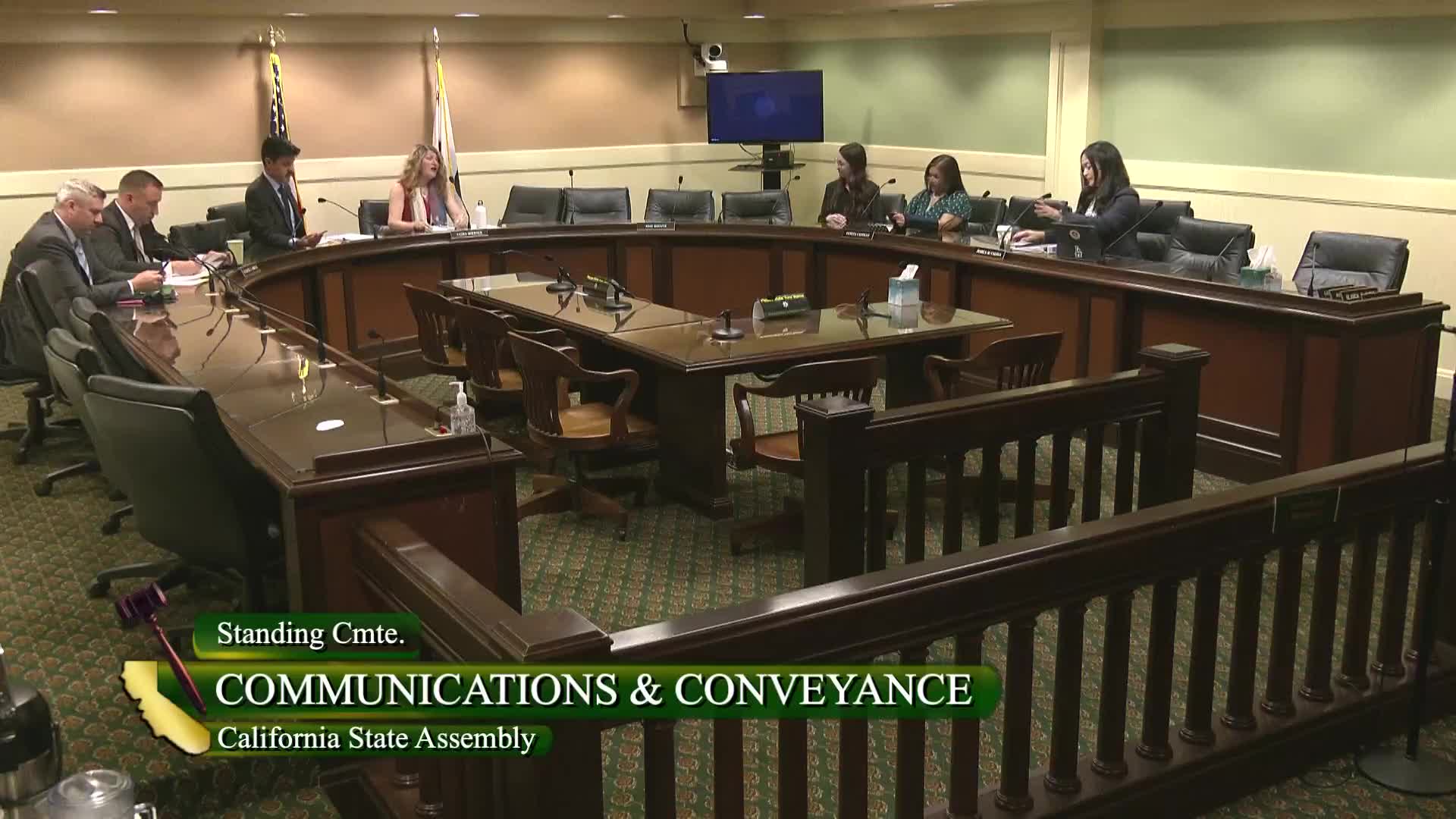
Chair Tasha Burner opened a California State Assembly Communications and Conveyance Committee hearing on Transportation Network Companies (TNCs) by asking CPUC staff and industry representatives to explain the agency's data collection and public‑disclosure practices for TNC trip files.
Pat Fenn, deputy executive director for consumer policy, transportation and enforcement at the California Public Utilities Commission (CPUC), told the committee the commission collects trip‑level data from TNCs and uses those annual reports to support oversight programs, compliance work and implementation of state laws, including the Clean Miles Standard and Access for All programs. "We favor disclosure unless the interest in preserving confidentiality outweighs the public interest in getting access to that information," Fenn said.
But multiple committee members, local transportation officials and academic researchers said the data the CPUC has declared public are not being released in a timely or usable form. Drew Cooper, principal transportation modeler at the San Francisco County Transportation Authority, said the CPUC has designated eight of the 11 annual TNC reports submitted so far as public but that only one year (2021) appears on the commission's portal and that those files are “heavily redacted.” Cooper said the lack of consistent release hampers efforts to measure congestion and transit impacts.
Elliot Martin of UC Berkeley's Transportation Sustainability Research Center said researchers need trip‑level data, with appropriate protections for personally identifiable information (PII), to measure effects on vehicle miles traveled, emissions, transit ridership and driver incomes. He recommended data‑design techniques — for example, obfuscating precise latitude/longitude to a census unit and adding controlled randomness to times/locations — and curated, cloud‑based researcher access to reduce PII and trade‑secret risks while preserving analytic value.
CPUC staff described the procedural background. Fenn and Tara Curtis, director for the CPUC's Consumer Protection and Enforcement Division, said confidentiality claims are governed by CPUC General Order 66D; submitters mark data they claim are confidential and include a declaration explaining the legal basis (trade secret, privacy, etc.). The commission reviews claims and has issued decisions over the past five years that have narrowed automatic confidentiality and in several cases ordered aggregated disclosure.
Committee members pressed about process and timing. Fenn said the CPUC issued decisions addressing a first tranche of trip data (2014–2019) and the 2021 files; a rehearing and supplemental decisions followed and certain appeals remain under the commission's regulatory rehearing process. "We're in the 30‑day period for impacted entities to submit any additional appeal or rehearing," Fenn told the committee, adding the commission's general policy is in favor of disclosure.
Representatives from Uber and Lyft said they provide detailed annual reports to the CPUC but stressed privacy and commercial confidentiality concerns. Uber testimony emphasized location data as particularly sensitive; Lyft also supported protections and noted that large, structured datasets contain information competitors could use to infer operations.
Local and academic witnesses urged the CPUC to publish trip files in the formats already required by the commission, with the combination of aggregation and limited obfuscation recommended by researchers. Cooper said San Francisco had used a one‑time vendor dataset in 2016 to estimate that TNCs accounted for roughly half of the increase in congestion and a 10% drop in transit ridership; he said ongoing public access would support similar jurisdictional planning.
The hearing closed with committee members saying they expect the CPUC to continue processing rehearing issues and to make more of the statutorily submitted data available to policymakers, local agencies and vetted researchers in formats that preserve privacy but allow robust analysis.