
Local advocacy group requests county ordinance and public-awareness campaign on human trafficking
Get AI-powered insights, summaries, and transcripts
Sign Up Free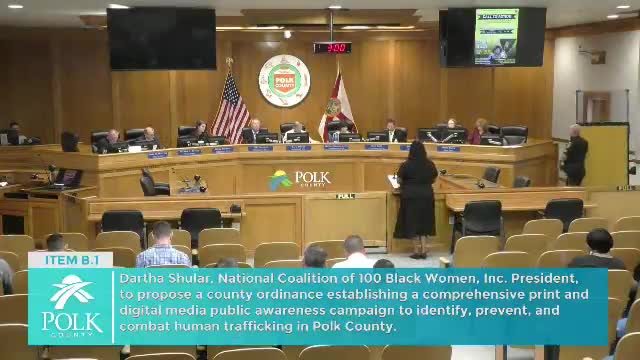
Summary
Representatives of the Polk County chapter of the National Coalition of 100 Black Women urged commissioners to begin a county ordinance and a print/digital public-awareness campaign to address human trafficking, citing statewide case counts and local recruitment sites.
A representative of the Polk County chapter of the National Coalition of 100 Black Women urged Polk County commissioners on Tuesday to begin the process of drafting an ordinance and launching a targeted print and digital public-awareness campaign to combat human trafficking.
Dr. Sally Stone, co-founder and owner of The Well business incubator in Lakeland, told the board the chapter has been building a coalition and has met with Sheriff Grady Judd to involve law enforcement. "We respectfully ask this board to begin the process of initiating a county ordinance to implement a print and digital public awareness campaign to combat human trafficking in Polk County," Stone said during the public comment period.
Stone said Florida ranks third nationally in reported human trafficking cases and that the national human trafficking hotline documented 821 Florida cases in 2023; she also cited law enforcement estimates that many incidents go unreported. She described recruitment taking place in schools, foster care, group homes, hotels and online, and said victims can be hidden in parks, shopping centers and transit stops. The proposed ordinance, she said, would mirror the structure of an earlier county initiative addressing tobacco awareness and would focus on data-informed, community-based education.
Commissioner Bridal asked what resources already exist for public education; Stone cited a statewide coalition and a past summit that included local law enforcement participation and said she would provide links and follow up with staff. Stone said the chapter had secured meetings with Sheriff Judd and was prepared to collaborate with county staff and community stakeholders.
No formal board action was taken during public comment; commissioners acknowledged the request and asked staff to receive follow-up information.