Get email alerts on the Water Supply And Conservation topic
No spam. Unsubscribe anytime.
Water Forward task force asks commissioners to track conservation metrics as supply projects face hurdles
Summary
The Water Forward Task Force reviewed a quarterly conservation report showing rising gallons-per-capita figures and noted programmatic challenges with aquifer storage and recovery and indirect potable reuse projects. Commissioners were asked to monitor metrics and project progress.
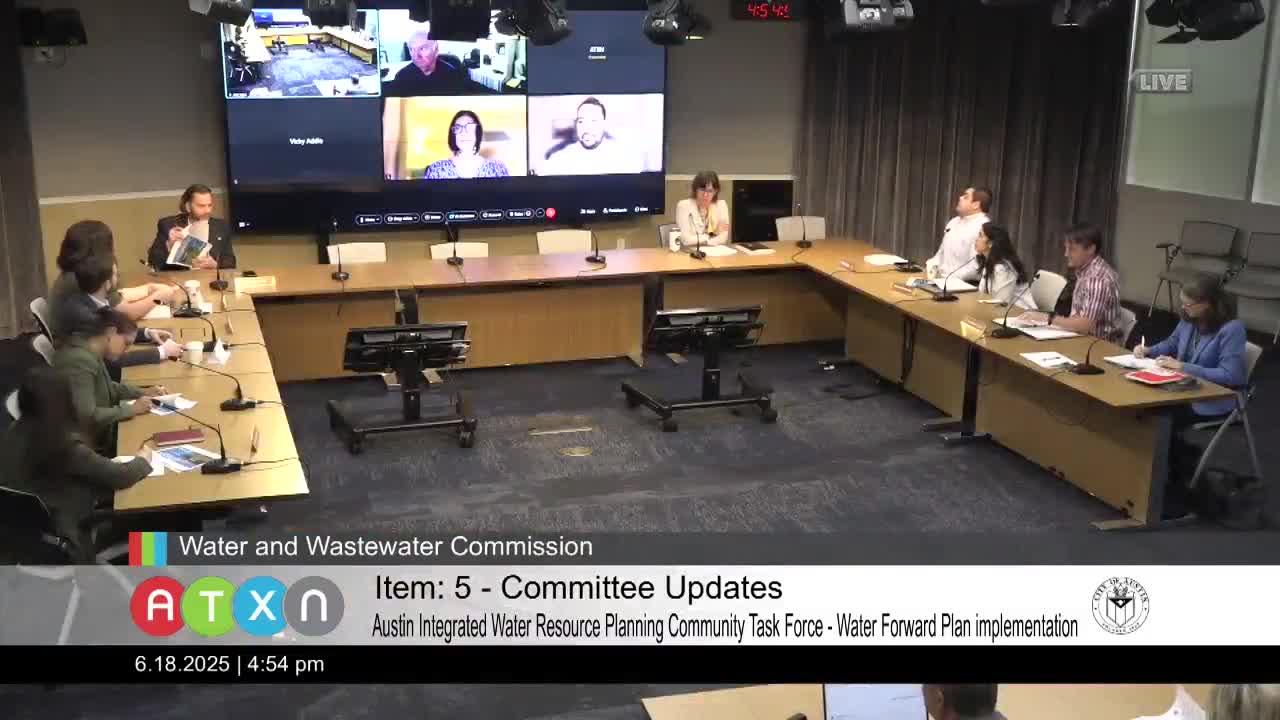
The Water Forward Task Force provided the Water and Wastewater Commission with a quarterly update on June 18, highlighting rising per-capita water usage and progress issues on two major supply projects.
Commissioner Moriarty summarized the task force report and emphasized concern about conservation metrics. "The q1 25, gallons per capita versus q1 24, the numbers are going up, which is not what we want," Moriarty said, urging commissioners to review the quarterly document.
The task force also reviewed major supply projects identified in the Water Forward plan. Commissioners were told aquifer storage and recovery (ASR) work has encountered sticking points that have slowed progress, and the indirect potable reuse project—planned to introduce reclaimed wastewater to Lady Bird Lake and subsequently to the Ulrich Water Plant—has its own unresolved issues. Moriarty did not detail the technical problems but described both projects as having issues that need attention.
Moriarty noted the two supply lakes serving Austin were at about 53% on the morning of the meeting, a modest improvement following recent rains. The task force recommended continued quarterly reporting to provide transparency on both conservation metrics and project milestones.
No formal action was taken; the update was provided as a committee briefing with a recommendation that commissioners and staff continue monitoring both conservation trends and the status of large supply projects.
AI generated
The text on this page is AI generated. Summaries, highlights, analysis, and video transcripts are all produced from the original source material.
AI can make mistakes, so if you spot one, and we will fix it for everyone.
Note: the source content is unaltered by us. Any content source we link to, be it a video, an audio recording, or a document, is presented exactly as its publisher released it. That publisher is usually a government body, sometimes an individual official or another organisation.