Get Full Government Meeting Transcripts, Videos, & Alerts Forever!
Get email alerts on the Zoning Community Centers Meals topic
No spam. Unsubscribe anytime.
Allentown hearing on Bill 16 would remove senior-only meal restriction for community centers
Summary
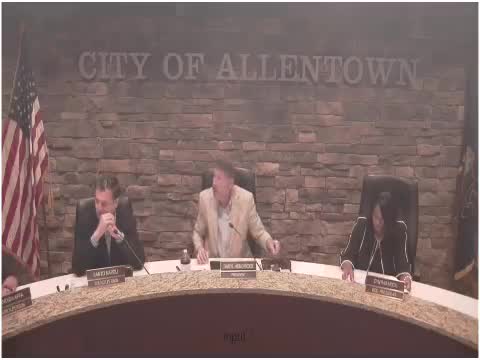
A special hearing of the Allentown City Council drew residents and nonprofit leaders to comment on Bill 16, a proposed ordinance to change the cityzoning codedefinition of "community center" by removing language that limits meal provision to senior citizens.
A special hearing of the Allentown City Council drew residents and nonprofit leaders to comment on Bill 16, a proposed ordinance to change the cityzoning codedefinition of "community center" by removing language that limits meal provision to senior citizens.
Jennifer Gomez, planning director for the city of Allentown, told the council: "The amendment would be to remove the specific provision of meals for senior citizens and open it up more broadly to any meal provision." Gomez said the change responds to a court interpretation and to a pending application from RCI Properties for a community-center use at a property in a residential district; she emphasized that no decision about a specific property was being made at the hearing.
The amendment follows a zoning hearing board denial of a special-exception request for a property at 1539 Chiu Street and subsequent litigation involving RCI Village Properties and the zoning hearing board. Gomez said the Lehigh County Court of Common Pleas interpreted the current ordinance language to mean nonprofit community centers may serve meals only to senior citizens, a limit city staff said is undefined in the code, difficult to enforce and vulnerable to legal challenge. Gomez also said the applicant indicated they would file a new special-exception application if the definition were changed and that the city is beginning a broader zoning-code rewrite, with an advertised Planning Commission hearing on July 8 to start that process.
Nonprofit leaders and many residents urged the council to approve the change now to protect existing services. Sherry Bender, executive director of Ripple Community Inc., said the provision has placed multiple nonprofits at risk and described a recent complaint to the state that she said wasted organizational resources. "Nonprofit community centers make our city healthier and they make it stronger and they deserve our support," Bender said.
Several speakers described community centersand the meals they provideas vital to food security and social connection. Susan Karpovich, a volunteer, said: "If somebody comes to the window and they're hungry and they want food, we feed them." Residents working with young people and social services also urged the council to remove the restriction so centers can serve broader needs.
Opponents, particularly neighbors from the West Park area, said the bill appears aimed at overturning prior local decisions and the court ruling and expressed concerns about neighborhood impacts if community centers with expanded meal services operate under by-right language in some zones. Evie Balak, speaking on behalf of the West Park Civic Association, read a letter opposing "pending bill number 16-2025," citing the association's view that the neighborhood had prevailed at the zoning board and in court and that the change would undermine that process.
Other critics raised practical concerns about health and safety inspections, parking, and the capacity of city agencies to regulate potentially increased food-service operations and daytime shelter-like activities. One speaker warned that blurring distinctions between soup kitchens, shelters and community centers could create administrative and legal headaches for the city.
Speakers on both sides urged the council to allow the Planning Commission and public process to proceed. Gomez reiterated that the proposed wording change is limited to the definition and would not automatically approve any use at a particular site; special-exception procedures for residential districts would still apply. No vote on the ordinance was taken at the hearing.
The council placed Bill 16 on its agenda for future consideration; the Planning Commission's advertised start of the zoning rewrite process is scheduled for July 8. Gomez said the applicant for the denied special exception confirmed they would file a new application if the definition is amended, which would trigger a public hearing before the city's zoning hearing board.