
Board hears investment and financial reports and discusses House Bill 2 implications for raises, penny tax and budget gap
Get AI-powered insights, summaries, and transcripts
Sign Up Free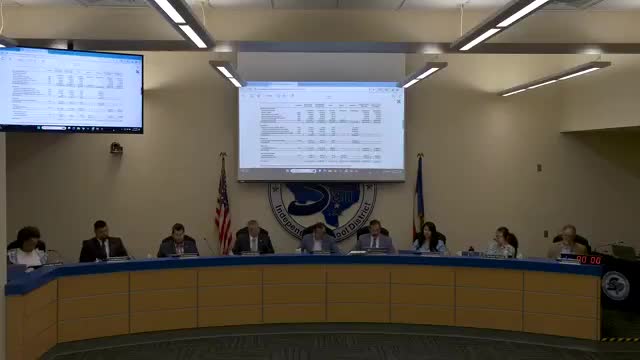
Summary
District finance staff presented quarter and May financials, outlined a projected year-end deficit and discussed the unclear impact of House Bill 2 on teacher and support staff compensation; the board and staff discussed Fund 199 (penny) and other options to close a projected shortfall.
South San Antonio Independent School District finance staff presented the quarterly investment report and May 2025 financials at the June 16 board meeting and answered board questions about budget strategy, House Bill 2 implementation and the district’s options to close projected deficits.
Tony Kingman, the district’s chief financial officer, said the district began the quarter with an investment balance of roughly $46.3 million and ended about $41.6 million, typical seasonality tied to property-tax receipts and year-end expenditures. Kingman said the portfolio is concentrated in safe instruments: 45% cash repurchase agreements, 32% federal agency bonds and 21% U.S. Treasury securities; the average yield declined from 4.51% to 4.39% during the quarter.
On the General Fund, year-to-date revenue through May was reported at $62.5 million with $56 million in year-to-date expenditures; Kingman said the district remains on pace for projected year-end operations but that auditors may report a one-time nonrecurring deficit of about $2.5 million tied to transfers and discontinued federal grants. He also projected the portfolio balance could decline to the low $20 millions by late August because of year-end expenditures.
Board members asked how the recently approved state legislation known as House Bill 2 (HB2) will affect district finances and compensation. In public comment, Tom Cummins of the American Federation of Teachers (AFT) urged the board to address pay for staff categories not covered by the bill — counselors, librarians, nurses, instructional coaches and paraprofessionals — and noted the state’s HB2 raises of $2,500 for teachers with three to four years’ experience and $5,000 for teachers with five or more did not address teachers with zero to two years’ experience. Cummins said the state provided $45 per student for non-classroom raises but characterized it as inadequate and warned support staff salaries would fall further behind.
CFO Kingman and other staff said TEA has sent early guidance on defining teachers for HB2 and that additional clarifications — including how support staff and special-education allocations will be handled — are expected in the coming months. Kingman said the district anticipates bringing a compensation strategy to the finance committee and a budget workshop in July after receiving more definitive state guidance.
The board also discussed Fund 199 (the "penny" voter-approved rate) and other revenue options. Kingman said Fund 199 provides essential revenue to balance the budget; without it the district would face difficult choices including expenditure reductions or asking voters for a tax ratification election (TRE). He said many district expenditures are staffing-related (approximately 85%), making cuts painful, and noted continued enrollment decline has reduced revenue: enrollment was a little over 10,000 in 2013 and dropped to 7,429 by October 2023.
Separately, Dr. Abe Saavedra, the TEA conservator assigned to South San Antonio ISD, presented a needs assessment that highlighted decades of governance challenges, cited earlier conservator placements (1990 and 2016) and traced financial decisions and enrollment trends that contributed to a roughly $12 million deficit the district inherited. Saavedra praised the current Board of Managers’ collaboration with the superintendent, noted strengths in the district’s CFO and recent administrative changes, and urged continued focus on reducing the facility footprint, improving marketing and restoring capital investment.
Board members asked about other revenue and savings options; staff mentioned grants (including 21st Century and other federal grants), enrollment growth strategies, asset choices (e.g., reducing vehicle purchases), and potential bond or TRE measures. The board signaled a desire to study options in finance committee meetings and in a July budget workshop.
No formal budget amendment was adopted at the meeting; staff will return with a full compensation and budget strategy after receiving more complete state guidance.