Get Full Government Meeting Transcripts, Videos, & Alerts Forever!
Get email alerts on the Gaza Humanitarian Crisis topic
No spam. Unsubscribe anytime.
UN warns of worsening humanitarian crisis in Gaza after deadly incidents at aid sites and critical fuel shortages
Summary
The United Nations said dozens were killed and hundreds injured near aid distribution sites in Gaza, called for independent investigations and immediate restoration of humanitarian access, and warned that fuel shortages threaten hospitals and essential services.
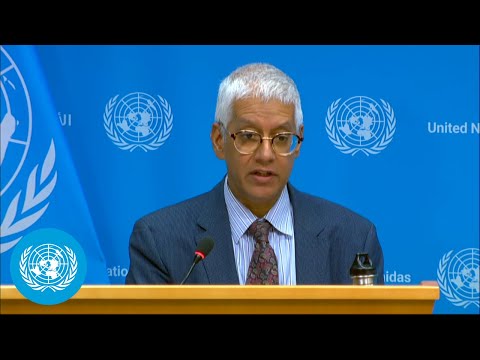
The United Nations spokesperson said dozens were killed and hundreds injured in shootings near food distribution sites in Gaza and renewed calls for independent investigations, immediate humanitarian access and protection for civilians.
"It is unacceptable," the spokesperson said, reporting that partners working on health told U.N. agencies that more than 60 people were killed and over 280 injured, some critically, while waiting for aid in Khan Yunis. The spokesperson said the Israeli military told U.N. officials its troops shot at a crowd and that the incident is under review.
Why this matters: U.N. agencies described the incidents as part of "a chilling pattern" in which civilians are attacked while seeking food. The spokesperson cited Office for the Coordination of Humanitarian Affairs (OCHA) field reporting and said the Ministry of Health counted 338 people killed and more than 2,800 injured while trying to access food near distribution sites (referring to non-UN, non-militarized hubs).
The U.N. called for an "immediate and independent investigation into all such reports" and for accountability. The spokesperson reiterated that "Israel has clear obligations under international humanitarian law to agree to and facilitate humanitarian relief for all civilians who need it," and urged the unimpeded entry of humanitarian assistance at scale.
U.N. agencies also reported that fuel stocks in Gaza have reached critically low levels. The World Health Organization told the U.N. that no fuel has entered Gaza for more than 100 days and that attempts to retrieve fuel stocks from evacuation zones have been denied. The U.N. said about 17 hospitals, seven field hospitals and 43 primary health centers are operating on minimal daily fuel and will soon run out, threatening emergency and intensive care services and cold-chain storage for vaccines.
Telecommunications and displacement: The briefing said the fiber-optic cable on Al Rashid Road between Khan Yunis and Gaza Governorate was cut because of hostilities, leaving central and southern Gaza without Internet and landline services. U.N. child-protection partners reported that several child protection centers have closed because of displacement orders, increasing overcrowding in remaining centers.
West Bank operations and displacement: The spokesperson said Israeli forces continued a large-scale raid in Askar camp in Nablus involving house-to-house searches and arrests, and that Israeli authorities ordered evacuation of at least 15 residential buildings ahead of a planned 48-hour operation, displacing about 75 people. The Office for the Coordination of Humanitarian Affairs told the briefing that movement restrictions in the West Bank have intensified and that more than 800 checkpoints, gates and other barriers are restricting access to essential services.
The U.N. repeated calls for safety and security for humanitarian actors and said ‘‘the U.N. and all humanitarian actors must be allowed to work in safety and security under conditions of full respect for humanitarian principles.’’
Ending note: The U.N. spokesperson said the secretary-general continues to call for an immediate permanent ceasefire and for all hostages to be released "immediately and unconditionally."