Get Full Government Meeting Transcripts, Videos, & Alerts Forever!
Get email alerts on the Mental Health Crisis Capacity topic
No spam. Unsubscribe anytime.
CDCR seeks staffing and funding to license 50‑bed mental health crisis unit; LAO warns of excess inpatient capacity
Summary
CDCR requested staff and funds to convert an existing 36‑bed unlicensed crisis unit at the California Institution for Men (CIM) into a licensed 50‑bed facility. LAO recommended approval but urged ongoing adjustment of inpatient capacity because CDCR reported hundreds of excess inpatient beds beyond the court’s 10% buffer.
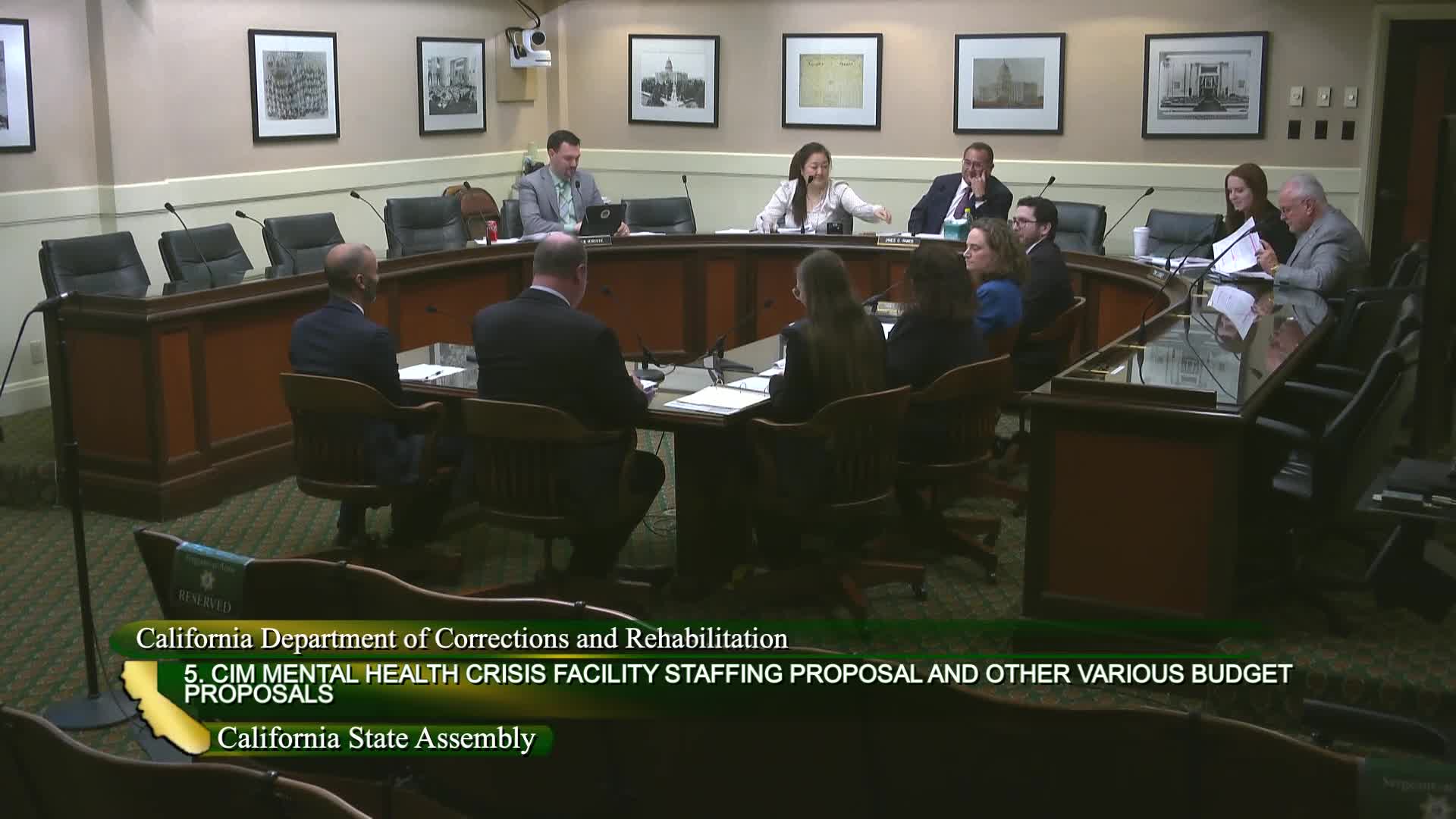
Duane Reeder, deputy director for California Correctional Healthcare Services fiscal management, said CDCR is seeking staff and funding to activate a licensed 50‑bed mental health crisis facility at the California Institution for Men (CIM). Reeder said the request is for a net 13.4 positions and $3.0 million general fund in 2025–26, expanding to 20.4 positions and $4.4 million general fund in 2026–27 and ongoing, to replace an existing 36‑bed unlicensed facility with a 50‑bed licensed unit.
Reeder and Dr. Amar Mehta, deputy director of statewide mental health, said the facility will add licensed capacity and help reduce reliance on unlicensed beds in the Southern Region. The department said licensed crisis beds are important to comply with court expectations and to provide appropriate levels of care.
The Legislative Analyst’s Office recommended approving the activation because converting unlicensed beds to licensed beds can reduce transfer time and better match clinical needs. LAO noted, however, that CDCR’s most recent bed needs study indicates roughly 680 excess inpatient beds across the system in addition to the Coleman court’s required 10% buffer. LAO recommended provisional budget language requiring CDCR to seek Coleman‑court approval to reduce capacity when appropriate and to routinely request adjustments informed by the semiannual bed needs studies. LAO also said deactivating excess beds could generate substantial savings—potentially more than $100 million—if the court permits deactivations and the Legislature counts transport and operating savings.
Panelists and members discussed the difficulty of deactivating licensed capacity and the court’s conservative posture in approving reductions; Mehta said licensing and security constraints, variations in housing types, and clinical match requirements complicate simple bed reductions. The subcommittee did not take action on the activation request during the hearing.
Ending
LAO supported the activation of the licensed crisis facility at CIM but recommended reporting and regular requests to the Coleman court to avoid accumulating excess licensed capacity. CDCR said it will pursue needed activations while coordinating with the court; the subcommittee requested further detail on how deactivations would be pursued if the court allows them.