Get Full Government Meeting Transcripts, Videos, & Alerts Forever!
Get email alerts on the Cdcr Budget Reductions topic
No spam. Unsubscribe anytime.
CDCR outlines reductions and says further cuts would threaten services; LAO presses for detail on service impacts
Summary
CDCR told the Assembly committee it has implemented numerous reductions and cannot safely meet an earlier $392 million reduction target without risking services; the Legislative Analyst's Office urged legislators to scrutinize service impacts and requested more detail.
Orlando Sanchez of the Legislative Analyst's Office told the subcommittee that the 2024–25 budget assumed savings roughly equivalent to 10% of general fund state operations and that an agreement with the administration set a target of $392 million in savings for CDCR, about 3% of its budget. Sanchez said the January report to the Legislature showed a lower statewide assumed savings level and that CDCR provided more detail than many departments but that important specifics were still missing, such as which classifications and programs would be reduced.
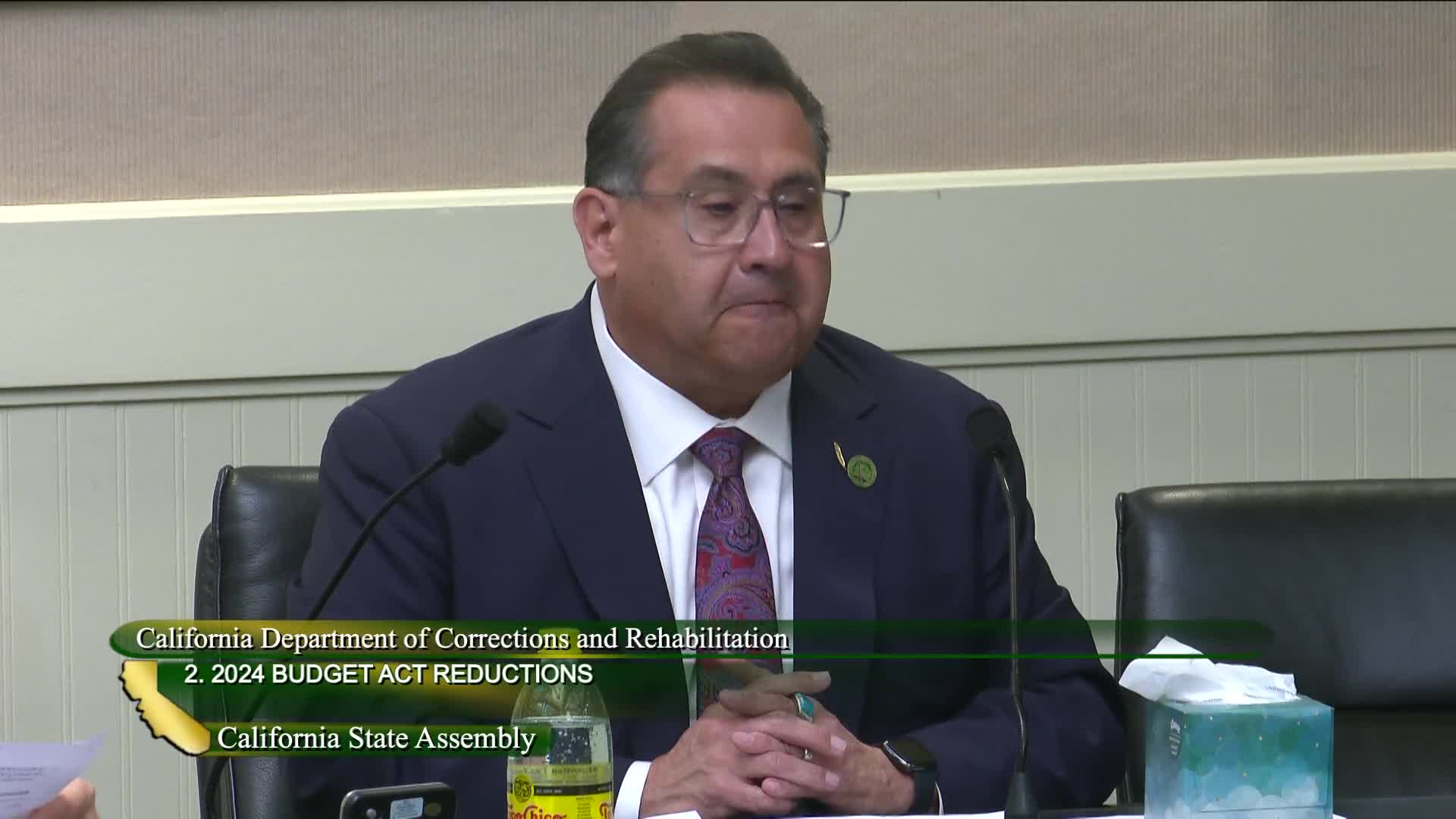
Cynthia Mendonza, deputy director of the CDCR Office of Fiscal Services, told the committee CDCR has identified reductions while protecting health care and core programming where possible. Mendonza said the 2024 enacted budget already included $358 million in identified reductions and required CDCR to identify a further $392 million in savings while avoiding cuts to rehabilitative and reentry programs, community‑based organizations and family‑connection programs. She described department actions that include gatehouse reductions, housing unit conversions and deactivations, academy reductions, contract efficiencies and other operational steps. Mendonza noted CDCR’s operational budget has declined in recent years after accounting for bargained increases and called out higher inflationary costs in food, utilities, waste disposal and staff costs as complicating factors.
CDCR and Department of Finance representatives told the subcommittee they have continued to seek additional efficiencies but that some savings are one‑time, some are ongoing, and some affect service levels. The LAO recommended the Legislature ask CDCR for details on: how the administration set the savings list, what service‑level impacts are expected, what alternatives were considered, and what it would take to reach the $392 million goal.
Members pressed CDCR and the Department of Finance on next steps and oversight. CDCR officials said they will continue to identify efficiencies and report to the Legislature; Dwayne Reeder of California Correctional Healthcare Services said healthcare budgets are heavily personnel‑driven (roughly 80 percent salaries and wages) and that moves such as bringing services in‑house or multiple hiring strategies are being pursued to reduce costs while avoiding layoffs where possible.
Ending
The subcommittee did not adopt any reductions at the hearing. Members asked CDCR and the Department of Finance for more detailed, itemized information on proposed cuts and their service impacts ahead of the May revision and future budget hearings.