Get Full Government Meeting Transcripts, Videos, & Alerts Forever!
Get email alerts on the Corrections Population Projections topic
No spam. Unsubscribe anytime.
CDCR projects short-term prison uptick from Prop 36; LAO says estimates likely overstated
Summary
California Department of Corrections and Rehabilitation presented fall 2024 population projections that include a preliminary estimate of the impact of Proposition 36. The Legislative Analyst's Office warned the administration's method likely overestimates the effect and urged revisions for the May budget update.
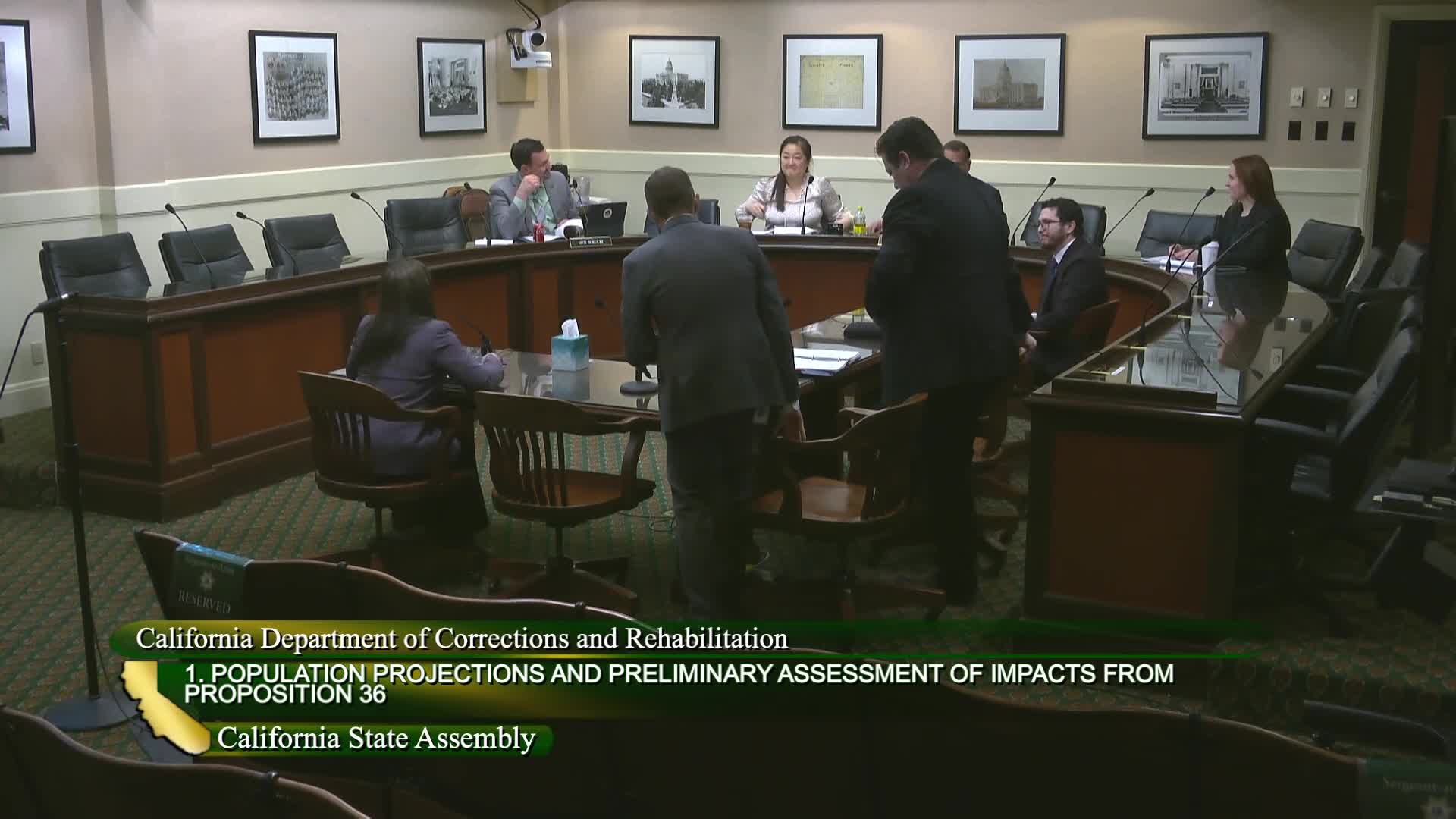
Kathy Jefferson, deputy director of the California Department of Corrections and Rehabilitation (CDCR) Office of Research, told the Assembly Budget Subcommittee No. 6 on March 19 that CDCR’s fall 2024 population projections include a preliminary, "below the line" adjustment to capture the potential impact of Proposition 36.
Jefferson said CDCR’s projections run through June 30, 2029, and that the department’s total incarcerated population as of Feb. 28 was 90,934. With CDCR’s preliminary Prop 36 estimate included, CDCR provided an institution average daily population (ADP) estimate of 91,672 for the current year and 93,278 for the budget year; by fiscal year 2028–29 the institution population is projected to decline to 88,787. CDCR reported a parole population of 34,583 as of Feb. 28 and estimated parole ADP of 34,490 for the current year and 34,671 for the budget year, declining to 34,241 by FY 2028–29.
The Legislative Analyst’s Office (LAO) told the subcommittee it has concerns with the administration’s methodology for estimating the Prop 36 effect. Caitlin O’Neil of the LAO said the administration’s method "effectively assumes that Proposition 47 is entirely reversed by Prop 36," and that in reality Prop 36 only partially rolls back changes made by Prop 47. O’Neil added that LAO’s own high‑level estimates suggest the actual impact could be “less than half of the magnitude of the administration’s estimates,” and that the administration should revise estimates for the May revision to the governor’s budget.
LAO also cautioned the parole‑population effect is likely to be smaller within the budget year because many offenses affected by Prop 36 carry relatively longer sentences; those people would more likely be released to county supervision rather than state parole within the near term. O’Neil recommended the administration revisit assumptions about which offenses are affected, how enhancements and treatment‑mandated felonies operate under Prop 36, and how length of stay and good‑conduct credit are being modeled.
Jefferson told members CDCR used historical trends, admissions data (including fiscal year 2013–14 admissions for an analog to pre‑Prop 47 sentencing), and limited implementation data for Prop 36 to produce the preliminary estimate and that the department will update its numbers in the May revision as data becomes available. She stressed the estimate is preliminary and that CDCR will continue to refine its model as counties and courts implement the new law.
The subcommittee discussed the timing of expected admissions and the uncertainty inherent in early implementation data. Several members asked whether the initial projected uptick would reverse in later years; Jefferson said long‑term downward admissions trends that predate Prop 36 (including sustained lower admissions since the COVID era) continue to influence the multi‑year projection.
Ending
CDCR and the LAO agreed the assumptions behind the Prop 36 adjustment need work; both parties said they are continuing technical conversations and that CDCR will update its estimates in the May revision to the governor’s budget. The subcommittee did not take votes on the projections at the hearing.