Get Full Government Meeting Transcripts, Videos, & Alerts Forever!
Get email alerts on the Emergency Medical Services Governance topic
No spam. Unsubscribe anytime.
Douglas County commissioners review Lawrence Douglas County Fire Medical governance, service levels
Summary
Lawrence Douglas County Fire Medical leaders updated the Douglas County Board of County Commissioners on the joint governance agreement, service benchmarks, staffing and data needs; commissioners asked for broader rural participation, clearer governance and longer contract terms.
Lawrence Douglas County Fire Medical leaders briefed the Douglas County Board of County Commissioners during a Jan. 22, 2025 work session on plans to update the joint governance agreement with the City of Lawrence, the department’s service-level benchmarks and operational staffing.
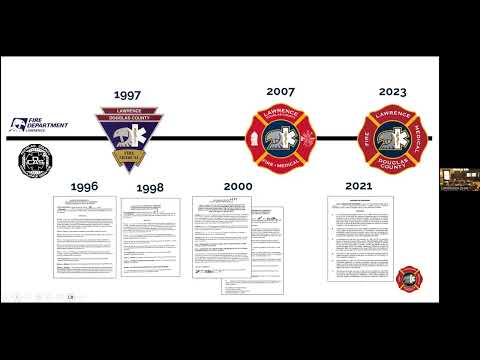
The presentation, given by acting Fire Chief Joe Hardy and interim chief of staff Mackenzie Zell, reviewed LDC FM’s history since the 1997 merger of the Lawrence Fire Department and the Douglas County ambulance service, and outlined performance targets, accreditation findings and budget and governance questions that county commissioners said should guide the next contract period.
“We have a currently have a 3 year agreement with the city of Lawrence for the joint op governance of Lawrence Douglas County Fire Medical,” Sarah (county staff) told the commission as the governance committee explained why the agreement is under review. “We thought it was important to check‑in with both governing bodies and try to get some feedback because ultimately, you will be brought these agreements for approval.”
“I am Joe Hardy, the acting fire chief for LDC FM,” Hardy said while presenting the department’s history and operational structure. Mackenzie Zell introduced staffing and performance data and noted the department’s accreditation and compliance obligations.
Why it matters: LDC FM provides advanced life support (ALS) ambulance transport countywide, fire suppression in Lawrence and Grant Township and first‑response medical support through local volunteer fire districts. Commissioners said the next agreement will affect county budgeting, response standards, mutual‑aid arrangements and governance authority over service levels and capital planning.
Key facts and figures presented
- LDC FM operates seven stations, five frontline fire apparatus in Lawrence, one ladder truck (Station 5) and seven ambulances (five in Lawrence, one in Baldwin City and one in Eudora); total staff is about 60 career employees. (Mackenzie Zell, Joe Hardy)
- In 2024 LDC FM was dispatched 17,572 times. About 70% of calls are medical in nature. (Zell)
- The department uses a standards-of-cover/community risk assessment that sets travel-time benchmarks of four minutes in urban areas (Lawrence, Baldwin, Eudora) and eight to 10 minutes in county areas; performance is reported at the 90th percentile. Zell said, “We are not meeting those goals,” and that a forthcoming annual compliance report will explain gaps by call type and cause. (Zell)
- LDC FM is accredited and measures cardiac arrest survivability countywide through the CARES registry; countywide reporting enables comparison across jurisdictions. (Zell)
- The department requires new hires to attend paramedic school within three years; at the time of the meeting nine employees were in paramedic training. Officials said this was intended to reduce burnout and improve retention, while acknowledging the near‑term cost of training. (Hardy, Zell)
Data, mutual aid and IT
Presenters discussed limitations in current data systems and said a new federal data system scheduled for implementation in 2026 should permit more integrated, countywide analysis of first‑on‑scene response and combined incident classification (fire + EMS + technical rescue). Commissioners and staff also discussed mutual‑aid agreements with volunteer fire districts, neighboring jurisdictions (including DeSoto and Johnson County) and large local employers; presenters said many relationships now operate by informal understanding and that formal written agreements remain a work in progress.
Governance, finance and next steps
Commissioners repeatedly asked for clearer governance and budgeting mechanics. Several said the current three‑year agreement cycle is short and complicates capital and staffing planning because the city and county budget on different timetables. Commissioner Bridal said she would “prefer at least [a] 5 year contract” to reduce churn and enable longer‑range planning. Other commissioners urged that rural fire districts and Eudora and Baldwin be more engaged in the review so that response metrics reflect first‑on‑scene providers in unincorporated areas.
Zell and county staff said the governance committee — made up of city and county representatives — will use today’s discussion to draft a project charter and bring recommendations to both governing bodies. No votes were taken at the work session.
What was not decided
The commission did not adopt a new contract term or change funding formulas at the meeting. The presentation flagged the department’s “10% administrative fee” calculation and budget allocation method as topics for future review, but no formal change was approved.
Why commissioners pressed the issues
Commissioners said they want clearer delineation of what costs the county will cover, more inclusive countywide participation (including rural fire districts), and a governance structure that gives the county adequate input when shared service levels — and their associated costs — change.
What comes next
Zell said the governance committee will meet to produce next steps and a draft project charter to be returned to both the City of Lawrence and Douglas County commissions for further direction. Officials said an updated annual compliance report on response times and resource utilization will be distributed to the commissions in about six weeks. No formal actions or votes were taken during the work session.