Get Full Government Meeting Transcripts, Videos, & Alerts Forever!
Get email alerts on the Eugene Budget 2025 27 topic
No spam. Unsubscribe anytime.
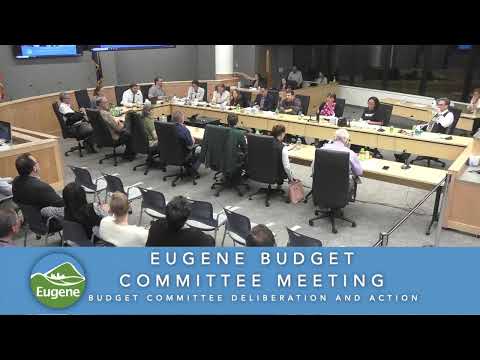
Budget committee backs amended 2025–27 budget, directs study of Cahoots-style crisis response
Summary
After more than three hours of public testimony focused on child care, libraries, animal services and crisis response, the Eugene Budget Committee recommended the city manager's amended 2025—27 biennial budget and directed staff to study options to restore Cahoots-like alternative crisis response at roughly $2.2 million annually.
The Eugene Budget Committee voted to recommend the city manager's amended 2025—27 biennial budget, including a stormwater-rate option that would collect an additional $4.7 million annually to restore services cut earlier in the process. The committee also voted to direct the city manager to investigate how an alternative crisis-response program "with Cahoots-like services" could be provided and to identify potential funding sources for approximately $2,200,000 a year, bringing recommendations back by October.
The committee's action followed a 90-minute public hearing in which 41 registered speakers urged restoration of services trimmed in initial budget drafts: community centers and childcare at the Sheldon Community Center, summer programming and Amazon Pool access, the Eugene Public Library's hours, animal sheltering through Greenhill Humane Society, and non-police crisis response modeled on Cahoots. Witnesses included Cahoots staff and cofounders who said the model de-escalates crises, saves money and is a critical part of community safety.
Councilor Zach Mulholland, who made the motion to flag several one-time-funded items for inclusion in the council's long-term financial-stability work, told the committee those items were "incredibly important to the community" and urged council to start identifying ongoing funding sooner rather than later. The motion to include those one-time items in the long-term work passed 11 to 3.
Councilor Matt Zelenka moved the study of a Cahoots-like alternative after repeated public testimony and presentations by former and current Cahoots staff and organizers. The motion asked the city manager to identify options, including reallocating existing Community Safety Payroll Tax (CSPT) funds, and cited an approximate top-end cost of $2.2 million per year to restore a 36-hour equivalent response. That motion passed 13 to 1. City staff said the $2.2 million figure reflected an approximate upper bound for providing the service in-house; staff also said an RFP and contracting route would be a parallel option.
Public testimony emphasized that the original Cahoots contract had ended and that a local nonprofit, Willamette Valley Crisis Care, had been organizing to provide Cahoots 2 services. Michelle Perrin, introduced herself as a cofounder of Willamette Valley Crisis Care and former Cahoots supervisor, saying, "We are trying to figure out who is the lowest common denominator to provide a basic service function," and urging the committee to restore non-police crisis care built on "comfort, compassion, competency, and empowerment." Robert Parrish, identified in testimony as a current Cahoots worker, told the committee, "We are a highly valuable part of public safety. Sending Cahoots is a humanistic response. It is a professional response, and it deescalates many issues before they spiral out of control." Heather Anderson, a ward 1 resident and Ph.D. student, described families' reliance on facilities such as Sheldon Community Center and Amazon Pool.
Committee members debated how quickly an outside nonprofit could be contracted and whether city employment was the right model. City staff said they had been in contact with Willamette Valley Crisis Care and other local groups but that the city would need to issue a request for proposals (RFP) and confirm readiness and eligibility before awarding public funds. Staff also noted a $500,000 placeholder in the budget to support transition while an RFP or other procurement moved forward.
On other items the public emphasized: - Library and youth services: multiple speakers said reduced hours and summer programming would hit families and students who rely on library services and affordable childcare. - Animal services: advocates for Greenhill Humane Society warned that cuts would impair the city's ability to meet legal and public-health obligations, citing Oregon Revised Statute Chapter 609 in testimony about animal control duties. - Neighborhoods and downtown: speakers urged continued funding for neighborhood associations and downtown cleanup; some committee members proposed shifting or prioritizing cleanup spending for Highway 99 and Bethel but a motion to reallocate downtown cleanup funds failed.
Votes at a glance - Motion (Mulholland): include one-time items (homeless services transition, downtown cleanup and beautification, alternative-response transition, central services communications, sustainability program) in the council's long-term financial-stability work. Outcome: passed 11—2 (amended as friendly). Provenance: motion introduced at the start of deliberations and final vote recorded later in the evening. - Motion (Zelenka): direct the city manager to investigate how an alternative response program with Cahoots-like services could be provided and identify potential funding sources for approximately $2,200,000 annually; bring back results by October. Outcome: passed 13—1. Provenance: motion text and vote recorded in deliberations. - Motion (Moore): immediate ongoing restoration of $2,229,000 for non-police alternative response funded by specific police-program cuts (drone program, volunteer policing administration, community engagement, vacancies). Outcome: failed 12—2. - Final recommendation (Konofsky): committee recommended the city manager's amended proposed 2025—27 budget with stormwater-rate option to raise an additional $4.7 million annually and the set of amendments captured above. Outcome: passed 14—0. The committee also recommended the Urban Renewal Agency budget 14—0.
What comes next The Budget Committee's recommendation goes to the City Council for final action. The council public hearing on the budget will be held June 23, and staff said the city could use a supplemental budget process this fall or December to finalize contracts or funding changes identified by the October check-in the committee requested. Committee members and multiple speakers urged the council to move quickly if it intends to contract with a nonprofit alternative-response provider because organizers warned that experienced crisis workers would accept other jobs if funding were delayed.
Ending Committee members praised broad public participation and asked staff to return with clear options, costs, and timelines. The budget committee adjourned after recommending the amended budget and the study of Cahoots-like options to the City Council.