Get Full Government Meeting Transcripts, Videos, & Alerts Forever!
Guam Legislature advances package of bills on property transfer, environmental funding and election rules
Summary
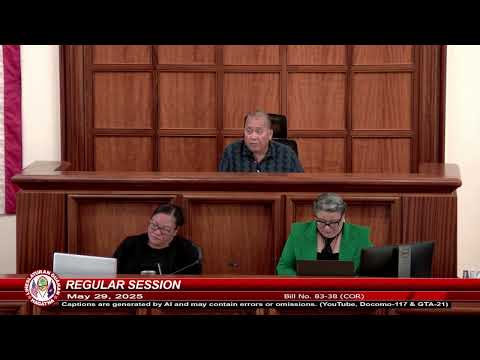
Hagatna — The Legislature advanced a set of bills to the voting file on measures ranging from a new transfer‑on‑death deed for real property to changes in how Guam funds environmental enforcement and how elections and campaign finances are administered.
Hagatna — The Legislature advanced a set of bills to the voting file on measures ranging from a new transfer-on-death deed for real property to changes in how Guam funds environmental enforcement and how elections and campaign finances are administered.
Senators moved the measures to the third‑reading/voting files after floor discussion and, in most cases, amendment. The bills were introduced or sponsored by multiple members and were discussed at length in committee markups and on the floor. The measures include (among others) Bill 23‑38 COR (a Uniform Real Property Transfer on Death Act), Bill 28‑38 COR (revising the use‑tax allocation for the Guam Environmental Protection Agency), Bill 53‑38 COR (removing public posting of voter registration lists), Bill 54‑38 COR (technical election law updates), Bill 55‑38 COR (quarterly campaign finance reports), Bill 75‑38 COR (driver‑license recognition for active duty service members and dependents), Bill 80‑38 COR (raising the small‑estates threshold), and Bill 83‑38 COR (allowing certain agencies to employ environmental law attorneys).
The most detailed floor presentation came on Bill 23‑38 COR. The bill’s sponsor described the measure as creating a "transfer on death" (TOD) deed to allow property owners to name a beneficiary who receives title when the owner dies, without probate. The sponsor said the deed would be revocable while the owner is alive, would not transfer any present interest, and would leave the property subject to debts and liens. The sponsor said amendments added definitions for contingent beneficiaries, required recording of TOD deeds with the Department of Land Management, and attached optional, legally sufficient deed and revocation forms to help the public. The sponsor told colleagues the bill was intended to help families who lack resources for formal estate planning and to reduce lengthy, costly probate proceedings.
On the…
Already have an account? Log in
Subscribe to keep reading
Unlock the rest of this article — and every article on Citizen Portal.
- Unlimited articles
- AI-powered breakdowns of topics, speakers, decisions, and budgets
- Instant alerts when your location has a new meeting
- Follow topics and more locations
- 1,000 AI Insights / month, plus AI Chat