Get Full Government Meeting Transcripts, Videos, & Alerts Forever!
Get email alerts on the Legislation Session Roundup topic
No spam. Unsubscribe anytime.
Guam Legislature advances package of bills on property transfer, environmental funding and election rules
Summary
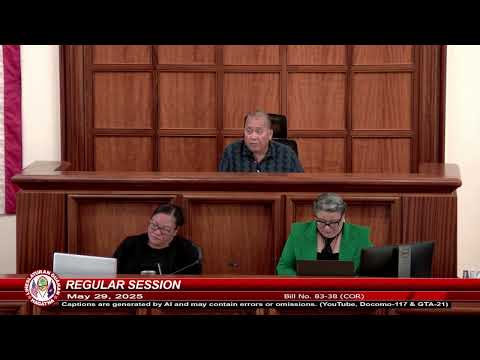
Hagatna — The Legislature advanced a set of bills to the voting file on measures ranging from a new transfer‑on‑death deed for real property to changes in how Guam funds environmental enforcement and how elections and campaign finances are administered.
Hagatna — The Legislature advanced a set of bills to the voting file on measures ranging from a new transfer-on-death deed for real property to changes in how Guam funds environmental enforcement and how elections and campaign finances are administered.
Senators moved the measures to the third‑reading/voting files after floor discussion and, in most cases, amendment. The bills were introduced or sponsored by multiple members and were discussed at length in committee markups and on the floor. The measures include (among others) Bill 23‑38 COR (a Uniform Real Property Transfer on Death Act), Bill 28‑38 COR (revising the use‑tax allocation for the Guam Environmental Protection Agency), Bill 53‑38 COR (removing public posting of voter registration lists), Bill 54‑38 COR (technical election law updates), Bill 55‑38 COR (quarterly campaign finance reports), Bill 75‑38 COR (driver‑license recognition for active duty service members and dependents), Bill 80‑38 COR (raising the small‑estates threshold), and Bill 83‑38 COR (allowing certain agencies to employ environmental law attorneys).
The most detailed floor presentation came on Bill 23‑38 COR. The bill’s sponsor described the measure as creating a "transfer on death" (TOD) deed to allow property owners to name a beneficiary who receives title when the owner dies, without probate. The sponsor said the deed would be revocable while the owner is alive, would not transfer any present interest, and would leave the property subject to debts and liens. The sponsor said amendments added definitions for contingent beneficiaries, required recording of TOD deeds with the Department of Land Management, and attached optional, legally sufficient deed and revocation forms to help the public. The sponsor told colleagues the bill was intended to help families who lack resources for formal estate planning and to reduce lengthy, costly probate proceedings.
On the environment and agency funding, the floor accepted a substitute for Bill 28‑38 COR that restores some original language and clarifies where use‑tax revenues should be deposited. The substitute reaffirms a 20% allocation of use tax receipts to support Guam EPA’s operations and corrects the statute to deposit funds into the Guam Environmental Trust Fund rather than a defunct cleanup account. Floor discussion cited recent staffing shortfalls (the record shows Guam EPA had 41 staff of 94 authorized positions in prior years) and testimony that steady, predictable local funding is needed to support enforcement programs for hazardous waste, water quality, air pollution, solid waste and related programs. The substitute also clarifies annual budgeting and reporting expectations and restores a requirement that Guam EPA submit a budget for use‑tax appropriations.
Lawmakers also advanced a package of election‑related bills the Guam Election Commission requested. Those include: Bill 53‑38 COR, repealing the statutory requirement to post hard copies of the voter registration index outside polling places; Bill 54‑38 COR, which updates definitions, aligns deadlines for provisional and absentee ballots, and adjusts voter‑registration and clerk‑appointment timelines; and Bill 55‑38 COR, which converts campaign finance reporting to a quarterly schedule (with additional pre‑ and post‑election filings in election years). Supporters said these changes modernize procedures, improve voter privacy, and provide earlier transparency of campaign finances.
On military families and licensing, the Legislature advanced Bill 75‑38 COR, a measure to recognize valid driver’s licenses issued by other U.S. jurisdictions for active‑duty service members and their dependents while they are stationed on Guam. The sponsor emphasized the exemption applies only to valid, unexpired licenses and does not abolish Guam’s authority to require a Guam license when a license lapses or endorsements differ.
Other measures moved ahead as well: Bill 80‑38 COR raises the small‑estate threshold by 50% to reduce probate costs for low‑value estates (the floor discussion cited inflation since the threshold was last set in 2016), and Bill 83‑38 COR allows the Guam Environmental Protection Agency and the Guam Coastal Management Program to hire or procure dedicated environmental law attorneys for their exclusive use, including through classified positions funded by federal grants where permitted.
Votes at a glance
- Bill 23‑38 COR (Uniform Real Property Transfer on Death Act): Moved to third reading file as amended (motion by sponsor; "no objections so ordered" on the motion to move to third reading). - Bill 28‑38 COR (Use‑tax allocation and Guam EPA funding; substitute accepted): Moved to third reading file as substituted and amended (no objections on floor motion). - Bill 53‑38 COR (Voter Privacy Protection Act — repeal public posting of registration lists): Placed on voting file (no objections). - Bill 54‑38 COR (Election law technical updates): Placed on voting file as amended (no objections). - Bill 55‑38 COR (Quarterly campaign finance reporting): Placed on voting file as amended (no objections). - Bill 75‑38 COR (Driver‑license recognition for active duty members and dependents): Placed on voting file as amended (no objections). - Bill 80‑38 COR (Increase small‑estate threshold by 50%): Placed on third reading file (no objections). - Bill 83‑38 COR (Allow certain agencies to employ environmental law attorneys): Placed on third reading file (no objections).
What passed the floor as motions to move forward was, in most cases, the placement of the bills on the third‑reading or voting files; formal final passage and recorded roll‑call votes were not part of the transcript segments provided. Several bills were amended in committee or on the floor before the motions to move them were agreed to without objection.
Why this matters
Collectively the measures seek to reduce procedural burdens for families (TOD deeds, higher small‑estate thresholds), strengthen local capacity for environmental enforcement (use‑tax allocation and in‑house legal counsel), protect voter privacy and modernize election administration, and improve transparency in campaign finances. If enacted, the changes would touch estate planning, environmental enforcement staffing and funding, how voters’ personal data are handled at the polls, and how campaign receipts and spending are reported to the public.
What’s next
Most measures were moved to the third‑reading or voting files; the transcript ends with the Legislature going into recess and scheduling continued floor work. Final outcomes (passage, amendments adopted on final vote, or vetoes) are not recorded in the provided transcript and will be determined when the Legislature takes final votes on the listed measures.
Quotes (select)
"This legislation provides a straightforward and affordable legal tool that allows individuals to pass their real property to a designated beneficiary upon death, all without the need for probate," the sponsor of the transfer‑on‑death measure said during her floor presentation.
"The substitute bill restored much of the original language of the law including the requirement for Guam EPA to submit a budget for use tax appropriation, which is estimated to be approximately 1,300,000," a floor sponsor said while explaining the environmental funding substitute.
Ending
Lawmakers said they advanced the measures to reduce administrative delay and increase clarity on several long‑standing issues. The bills will return for final consideration on the Legislature’s calendar; interested members of the public can follow the Legislature’s published docket and subsequent roll‑call records for final vote details.