Get Full Government Meeting Transcripts, Videos, & Alerts Forever!
Get email alerts on the Legal Ethics topic
No spam. Unsubscribe anytime.
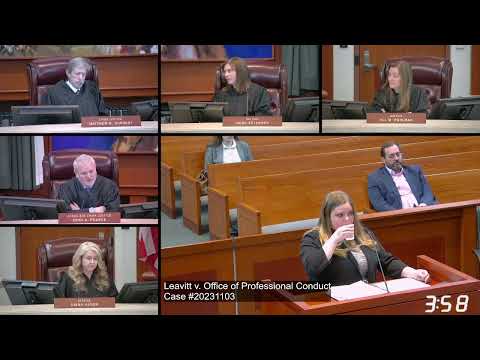
Utah Supreme Court hears appeal over prosecutor’s press‑conference remarks and public reprimand
Summary
The Utah Supreme Court heard argument in an appeal by former Utah County Attorney David Leavitt, who challenges a disciplinary finding that his 2019 press‑conference remarks violated Rule 3.6(a) of the Utah Rules of Professional Conduct and warranted a public reprimand.
At oral argument, the Utah Supreme Court heard David Leavitt’s appeal of a disciplinary finding that he violated Rule 3.6(a) of the Utah Rules of Professional Conduct by commenting on a high‑profile criminal matter during a July 2019 press conference. Leavitt is challenging both the committee’s determination that his remarks had a substantial likelihood of materially prejudicing the proceedings and the vice chair’s decision to impose a public reprimand rather than a confidential admonition.
Why it matters: The case tests how courts should apply Rule 3.6 and its Comment 5 — which singles out topics such as witness credibility and opinions on guilt — to prosecutorial remarks made to the media, and whether the mental‑state standard used to prove a violation should control the presumptive sanction. That balance affects prosecutors’ public communications and the range of disciplinary penalties that may follow.
In argument, counsel for Leavitt, Brea Johnson, framed the key legal issue as the factual mental state at the moment the comments were made. Johnson said the rule requires that ‘‘he knew or reasonably should have known there was a substantial likelihood of materially prejudicing the proceedings’’ at the time he spoke, and she relied on this court’s Bates precedent to argue that an attorney’s after‑the‑fact realization does not prove the requisite mindset at the moment of the remarks. Johnson also emphasized the screening panel’s factual finding that Leavitt acted negligently rather than knowingly, and argued that under the rules in effect in July 2019 the presumptive sanction for negligent conduct would be an admonition or reprimand rather than a suspension.
Opposing counsel, Christine Greenwood for the Office of Professional Conduct, urged the court to affirm the panel’s findings and the public reprimand. Greenwood told the justices that disciplinary sanctioning is a flexible, holistic inquiry and that, on balance, a public reprimand is appropriate here even if the court treats certain sanction rules differently. She argued the record shows both the seriousness of the remarks — made at a widely publicized press conference about a death‑penalty prosecution — and resulting litigation and court actions that constitute injury or interference with the legal process, pointing to a judge’s subsequent order removing Leavitt from the criminal prosecution.
A central factual excerpt from the July 2019 press conference was read into the record during argument: “We believe this witness quite frankly based on a lot of evidence that the jury will never hear,” language the committee relied on as an example of commentary about evidence that would not be presented to a jury. Johnson countered that, in context, Leavitt’s overall remarks emphasized deferring ultimate determinations to a jury and that the specific line cited related to the charging decision rather than to an attempt to influence jurors’ deliberations.
The justices probed both sides about two related questions: (1) whether the statements fell within Comment 5 subjects that are more likely to cause prejudice (for example, credibility of witnesses or opinions on guilt), and (2) whether the record supports a finding that Leavitt ‘‘knew or reasonably should have known’’ his comments created a substantial likelihood of material prejudice when made. The bench also examined whether litigation that followed the press conference — motions, briefing, a sua sponte court admonition about publicity, and the county attorney’s subsequent walled‑off status in the prosecution — constitutes ‘‘injury’’ or ‘‘interference’’ for sanctioning purposes.
Counsel debated which version of the sanctioning rules should govern: Leavitt’s side argued the rules in effect in July 2019 control because sanctions turn on the mental state at the time of the conduct; the Office of Professional Conduct and the court questioning explored whether later rule changes affect the presumptive sanction without running afoul of ex post facto concerns. Both sides cited this court’s and other precedents (including Bates and cases interpreting knowledge and negligence in the disciplinary context) on how to measure ‘‘knowledge’’ and whether knowledge can be inferred from circumstances.
The parties also disputed aggravating and mitigating factors. The committee and vice chair had identified experience and lack of remorse as aggravators; Leavitt’s counsel highlighted prompt remedial steps (informally withdrawing from the case, changing press‑conference procedures) and a record of good character and reputation as mitigating. The Office of Professional Conduct argued factors such as Leavitt’s senior role, the prominence and sensitivity of a death‑penalty prosecution, and the impact on judicial resources are appropriate for the court’s consideration.
Procedural posture: The screening panel of the Ethics and Discipline Committee found a Rule 3.6(a) violation and the vice chair affirmed an order imposing a public reprimand. The criminal court later issued an order formally removing Leavitt from participation in the underlying prosecution; Leavitt subsequently removed the death‑penalty option for that case. The Utah Supreme Court heard argument and took the matter under advisement.
The court did not issue a decision at the conclusion of oral argument.