Get Full Government Meeting Transcripts, Videos, & Alerts Forever!
Get email alerts on the Clean Energy Finance topic
No spam. Unsubscribe anytime.
Minnesota climate finance authority outlines loan strategy, flags $25 million federal freeze
Summary
The Minnesota Climate Innovation Finance Authority told a Senate committee it will make loans, not grants; has funded three projects so far; and warned that a $25 million federal grant is frozen at Citibank, which could chill private investment.
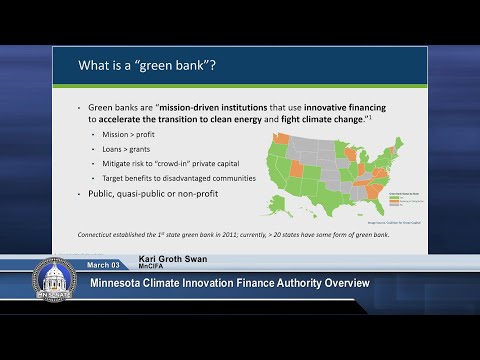
The Minnesota Climate Innovation Finance Authority (MNCIFA) told the Minnesota Senate Energy Committee on March 3 that it will operate as a lending authority — not a grantmaker — and outlined its investment strategy, recent loans and a federal funding freeze that officials say threatens the authority's ability to crowd in private capital.
“We are a lending authority,” Kari Growth Swan, executive director of the Minnesota Climate Innovation Finance Authority, said during the presentation. “We do not provide grants. We loan out money, it is repaid, and we do it again.”
The authority, created by state statute in 2023, said it has a statutory requirement that at least 40% of direct benefits flow to environmental justice communities and that it must submit a strategic plan to the Legislature every two years. MNCIFA described three lending programs it will offer — tax-credit bridge lending, pooled lending and direct debt financing — along with loan-loss reserves to de-risk lending for local intermediaries.
MNCIFA officials told senators the authority has funded three projects to date with about $11 million in loans. The projects include Renewable Energy Partners, a solar-plus-storage resiliency project serving four school buildings in North Minneapolis; a geothermal and HVAC financing package for Avenues for Youth, a transitional shelter for people aged 16–24; and a loan to support geothermal piping installation for The Heights, a 12-acre East Side redevelopment in Saint Paul. Peter Klein, who served as interim executive director during MNCIFA’s start-up period, told the committee MNCIFA holds a first-lien mortgage on the Avenues for Youth facility and has equipment and UCC filings for the school resiliency assets.
“We will have a first lien mortgage on that facility,” Peter Klein said of the Avenues for Youth loan, describing the authority’s collateral positions across the three projects.
Committee members asked about how MNCIFA evaluates risk, repayment and borrower protections. Executive Director Growth Swan and board chair Bali Kumar said the authority has an approved 30-page lending manual, internal risk-rating policies, quantitative and qualitative scorecards, concentration limits and covenants. Kumar said no single loan may exceed 10% of the authority’s capital stack and the portfolio is limited to no more than 25% in higher-risk categories. Growth Swan said most loans in the pipeline are expected to be repaid within 18 to 36 months and that staff perform ongoing monitoring including weekly payroll reports for construction loans.
“We certainly do a cost-benefit analysis,” Growth Swan said, adding that MNCIFA requires two years of audited financials, pro forma cash flows and other underwriting documentation for loans.
Senators pressed MNCIFA about the sources of capital. Growth Swan said the authority’s capital stack includes state funds and federal sources tied to the Inflation Reduction Act (IRA). She told the committee one federal grant—$25 million allocated under a Coalition for Green Capital award that is tied to the federal greenhouse gas reduction fund—has been frozen by Citibank, creating uncertainty.
“The funding is actually frozen by Citibank,” Growth Swan said. She added that the freeze is “very fluid” and that prolonged uncertainty risks making other banks and philanthropic funders reluctant to participate in projects.
MNCIFA officials said the authority currently has roughly $150 million available in its capital stack and a pipeline of projects they estimated at more than $5 billion, though individual loans are generally expected to be in the multi-million-dollar range (Kumar said typical loans will be in the $2 million–$5 million band for MNCIFA’s capital deployment). Officials also noted smaller pooled or bridge loans intended to capture tax-credit cash flows for nonprofits and municipal entities.
Senators raised questions about collateral, the authority’s ability to step into project agreements, and whether MNCIFA would ever operate assets directly. Officials said MNCIFA’s remedies include taking collateral and stepping “into the shoes” of project agreements to stabilize or transfer a project, but they added the authority does not plan to operate assets as an ongoing business.
Committee members also emphasized oversight. Senator Matthews said the committee’s oversight role requires close scrutiny of taxpayer-funded programs and pressed for clarity on repayment expectations and the authority’s plans to limit fraud and misuse of public funds. MNCIFA officials said they are building standard bank-style controls and intend to reserve funds for potential loan losses while pursuing legal remedies and collateral recovery when necessary.
The presentation outlined the authority’s public transparency practices: open monthly board and credit committee meetings, publicly posted agendas and materials, quarterly community input meetings and annual reporting to the governor and legislative committee chairs as required by statute.
MNCIFA board vice chair Tessa Higginson, who represents municipal utilities and electric cooperatives, summarized the strategic plan’s outreach and the authority’s statutory duty to target underserved markets and project types, noting the plan identifies 11 underserved market types and lists examples of indirect societal benefits such as housing preservation, small-business support and urban or rural food-security projects.
Committee members said they will continue oversight as MNCIFA moves to deploy funds and urged work with Minnesota's congressional delegation to resolve the federal funding freeze. The committee concluded the hearing with no formal votes recorded on the presentation.