Get Full Government Meeting Transcripts, Videos, & Alerts Forever!
Get email alerts on the School Mascots topic
No spam. Unsubscribe anytime.
Committee adopts amendments to mascot law: nearest tribal consent and funding process for replacements
Summary
Senate File 1404 would amend Minnesota's 2023 law restricting American Indian mascots by changing the exemption process to require written consent from the nearest tribal nation(s) and establishing a process and timeline for state assistance with mascot replacement costs. The committee approved two amendments (A2, A3) and recommended the amended
The Senate Education Policy Committee on March 3 approved amendments to Senate File 1404, a bill that revises the exemption process and funding assistance created under Minnesota’s 2023 law prohibiting use of American Indian mascots, images and symbols in public schools.
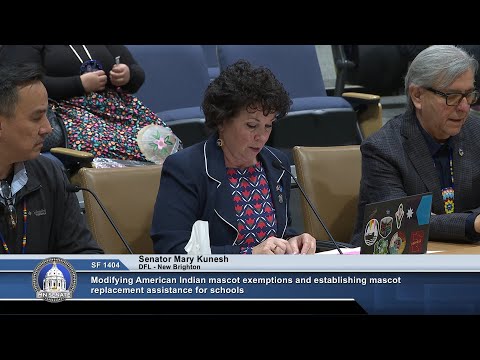
Senator Kunish, who has led prior efforts on mascots and related issues, explained the A2 amendment requires a letter of consent from the nearest federally recognized tribal nation if a school district seeks an exemption to retain an American Indian nickname, logo or image. If more than one tribal nation is proximate to a district, all nearby nations must consent in writing, she said. The A3 amendment adds the Education Finance Committee as a recipient of required reports and requires the Department of Education to establish a process for mascot-replacement assistance, including submission of a work plan and budget and release of funds within 30 days of approval.
Johnny Johnson, identified as former tribal president of Prairie Island and now the community’s education director, testified in support and described his tribe’s relationship with Red Wing Public Schools. Johnson said Prairie Island supports Red Wing’s use of a red-feather logo and the “Wingers” nickname, and that the tribe had provided written consent; nevertheless, he said an exemption was not granted earlier because another tribe objected. Johnson told the committee that Red Wing estimates more than $2 million to replace logos and mascots under the current law.
Brandon Elkayer, legislative director for the Minnesota Indian Affairs Council, testified the bill balances tribal sovereignty and partnerships, arguing that “true honor comes from listening to indigenous voices, respecting their perspectives, and making meaningful changes or engaging in partnerships with tribal nations for the use [of imagery].” Robert Pilot (Distant Thunder), a former teacher and Ho-Chunk Nation citizen, described the negative effects mascots can have on Native students’ self-esteem and school engagement.
Committee members voice-approved the A2 and A3 amendments. The committee then recommended the bill, as amended, be referred to the Education Finance Committee for further consideration; the chair announced the motion carried.
Why it matters: the 2023 law phasing out certain imagery created an exemption pathway that advocates and some tribal leaders said needed revision to respect local tribal relationships. The A2/A3 changes shift decision-making toward the tribe nearest a district and create a clearer funding pathway for districts needing resources to replace mascots.
Next steps: the amended bill will proceed to the Senate Education Finance Committee for consideration of any appropriations for mascot-replacement assistance and final action.