Get Full Government Meeting Transcripts, Videos, & Alerts Forever!
Get email alerts on the Substance Use Disorder Funding topic
No spam. Unsubscribe anytime.
Providers warn of closures as Senate committee considers substance use disorder rate and program changes; several bills advanced or laid over
Summary
Treatment providers told the Senate Human Services Committee that Minnesota's Medicaid rates for substance use disorder services fall short of costs and that rural programs are closing; the committee laid over a major SUD rate bill and referred related measures to other committees after adopting an amendment to one bill.
Substance use disorder treatment providers urged the Minnesota Senate Human Services Committee on Wednesday to adopt higher Medicaid reimbursement rates and statutory clarifications to avoid further program closures, and the committee both advanced and held bills for further work.
Witnesses said cost‑based studies show statewide reimbursements lag far behind operating costs. "Minnesota's rates were over 58% below what was required for sustainability of services," said Dr. Lou Zeidner, chief executive officer of Eiosis (formerly Meridian Behavioral Health), citing the Burns & Associates analysis. Roy John Sutherland, vice president of addiction services at Nystrom & Associates, told the committee 47 programs have closed statewide in the past three years and urged adoption of model rates and automatic inflation adjustments.
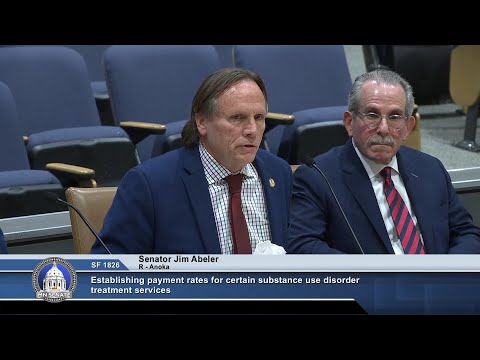
Senate File 18 26, a multi‑part bill that includes implementing substance use disorder (SUD) rate recommendations and creating an automatic inflation adjustment tied to modeled rates, was discussed at length and laid over for possible inclusion in a future omnibus bill. Committee members and providers emphasized that many rural programs rely primarily on Medicaid payments and face recruitment and retention challenges when reimbursement fails to cover rising labor and operating costs.
Brian Zervos, executive director of March (a statewide trade association for substance use and mental health providers), outlined several other bills considered by the committee, including language on timely filing when managed care organizations seek recoupment, program closure notification rules to help clients transition, exclusion of weekends and holidays from certain diagnostic assessment timelines to accommodate small and rural programs, and clarification of county financial responsibility for withdrawal management services (pointing to statutory language for county responsibility).
On Senate File 18 27 the committee adopted an A1 amendment and recommended the bill be sent to the Judiciary Committee. Brian Zervos said the A1 removed two sections that previously drove projected costs and updated terminology (removing the outdated term "chemical dependency"). The committee also recommended Senate File 19 66 be sent to the Commerce Committee.
Providers framed rate increases as an investment with downstream savings: "For every $1 invested in mental health and addiction treatment, society gains $4 to $7 in economic returns," Sutherland said. Several witnesses and senators warned of an immediate service gap: Senator Hoffman said he had heard reports that people in treatment could lose housing within 60 days if programs close and asked state and provider representatives to coordinate contingency planning.
The committee recorded voice votes or announced recommendations for referral; the transcript does not include detailed roll‑call tallies for these actions. Committee members said they will pursue follow‑up meetings with the Department of Human Services, provider associations and other stakeholders to coordinate responses and clarify licensure, closure and capacity issues.