Get Full Government Meeting Transcripts, Videos, & Alerts Forever!
Get email alerts on the Transit Planning And Procurement topic
No spam. Unsubscribe anytime.
MnDOT, Met Council outline new oversight, contracting steps for Blue Line Extension after review of Southwest LRT problems
Summary
State transportation staff and Met Council officials told the Senate Transportation Committee that 2024 law increases MnDOT’s advisory role on future light-rail projects, and both agencies described steps—staffing, procurement templates and possible new contracting authority—to reduce schedule and cost risk on the Blue Line Extension.
State transportation officials and Metropolitan Council leaders told the Minnesota Senate Transportation Committee on Wednesday that they are taking steps to reduce the risk of schedule delays and cost overruns on future light-rail projects, including the proposed Blue Line Extension.
The session reviewed a string of oversight findings presented to the committee and described how a 2024 law authorizes expanded Department of Transportation (MnDOT) staff and project assistance for light-rail projects for which the Metropolitan Council is the designated authority. MnDOT and council witnesses described recommendations on contracting methods, added staff expertise and draft procurement templates aimed at improving cost estimates, schedule controls and change-order oversight.
The changes matter because legislative reviews found multiple investigations and program evaluations into Metropolitan Council decision-making and contractor oversight after the Southwest Light Rail Transit (Green Line Southwest) encountered large cost increases and delays. Committee members and witnesses said those findings informed the 2024 statute that expands MnDOT’s role on future projects.
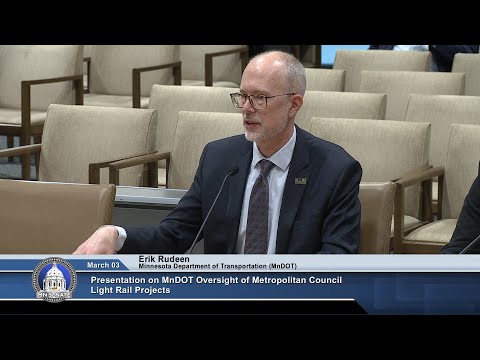
Eric Rudine, MnDOT government affairs, told the committee MnDOT views itself “in an advisory role, and we will keep you informed of our recommendations to the Met Council.” He and Kevin Kozabud of MnDOT’s Office of Construction and Innovative Contracting briefed senators on alternative delivery methods—traditional design-bid-build, design-build, best value, and construction manager/general contractor (CMGC, also described as construction manager at risk). MnDOT staff said CMGC is especially well suited to large, complex projects because it brings a contractor into the design phase to advise on constructability, risk, cost and schedule.
Kevin Kozabud said MnDOT uses best-value scoring to weigh factors beyond price, including schedule and strategies that reduce user impacts. “So those are really good examples of how we would see best value utilized in our project,” Kozabud said.
MnDOT outlined specific guardrails written into 2024 statutory changes as explained to the committee: MnDOT staff assigned to a project must report to the MnDOT commissioner and include at least one licensed professional engineer; MnDOT review can include participation in independent cost-estimate reviews and review of change orders that exceed $500,000 or delays of 30 days or more; and MnDOT must detail its recommendations to the legislative transportation committee within 30 days of submitting them to the Metropolitan Council. The statute, as described in the hearing, applies prospectively to future light-rail extensions and not retroactively to the Green Line Southwest project.
Metropolitan Council procurement chief Jody Jacoby told senators the council “fully agree[s] with the recommendations” from MnDOT’s report and that the council is already developing evaluation criteria, hiring procurement experts and engaging consultants to draft best-value templates and improve internal procedures. Judd Shetnan, the council’s government affairs director, said the council is working with MnDOT and Hennepin County on staffing and procurement changes and will pursue any legislative authority needed to use additional delivery methods for horizontal (transportation) work.
Both agencies pointed to near-term steps. MnDOT has hired Joe Korzilios, a registered engineer and former MnDOT employee, to be its point person on transit project assistance; MnDOT staff said Korzilios will work primarily on light-rail oversight but may be deployed occasionally to other large projects. The Metropolitan Council said it will hire an assistant general manager for capital projects with the qualifications required under the recent law and is creating a construction unit within procurement to work directly with project delivery teams.
Committee members pressed both agencies on resource allocation and the trade-offs of expanding MnDOT involvement. Senator Karin Housley and others said they worry MnDOT could be pulled away from roads and bridges. MnDOT witnesses said assistance would be paid from project budgets and that the department retains usual responsibilities for highways and other programs.
On broader transit demand, Ryan O’Connor of the Metropolitan Council said system ridership has recovered to about two-thirds of pre-pandemic levels and that the council will present a Network Now plan in March to add service. He noted that the region’s colored and arterial BRT lines have recovered faster than some commuter-focused services.
The agencies also discussed metrics that have caused problems in past projects: missing independent cost estimates, late-added scope after bidding, insufficient contract enforcement mechanisms, and inadequate documentation of nonconforming work. MnDOT staff said the CMGC delivery method has produced lower contract overruns (they cited an average of about 1.5% on CMGC projects compared with roughly 4–5% on other projects) because of contractor involvement during design and earlier cost reviews.
Committee members urged continued legislative oversight. Both agencies said they will continue coordinating and report back; the Metropolitan Council indicated it will seek any needed legislative changes to procurement authority for horizontal construction.