Get Full Government Meeting Transcripts, Videos, & Alerts Forever!
Get email alerts on the Paid Family Medical Leave topic
No spam. Unsubscribe anytime.
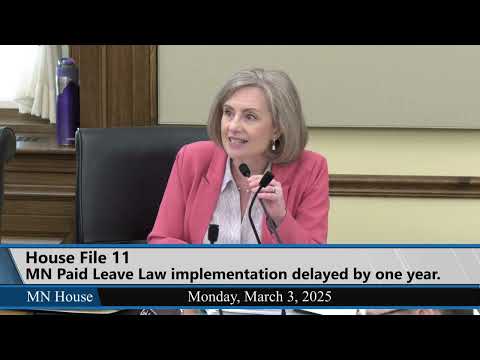
Minn. House panel debates pausing House File 11; motion to send bill to General Register passes
Summary
The House Ways and Means Committee debated a one-year pause to the state's paid family medical leave law (House File 11), heard agency testimony that systems work is on track for a 2026 launch, and rejected two re-referral motions before voting to place the bill on the General Register.
The Minnesota House Ways and Means Committee on March 3 debated House File 11, the paid family medical leave measure, including whether to pause implementation for a year, and voted to place the bill on the General Register after rejecting two motions to re-refer it to other committees.
The discussion centered on program readiness, fiscal costs and impacts on small businesses and school districts. Representative Baker, the bill's author in the committee, said he sought a pause to allow more time for bipartisan work and local input. Evan Roe, identified in the record as deputy commissioner at the Department of Employment and Economic Development, told the committee the department is "very confident that we will be ready for a full launch on 01/01/2026." Committee members cited a fiscal note and stakeholder letters on both sides of the issue as they debated next steps.
Why it matters: The committee's action affects whether the House will continue fast consideration of a law that would change leave policy for millions of Minnesotans beginning Jan. 1, 2026. Lawmakers opposing immediate implementation cited concerns about cost estimates, the effect on small employers and school-district budgets; supporters warned that a delay would postpone leave for families and workers who have been awaiting the benefit.
The committee heard a mix of coded and personal appeals. Several members reading packets of stakeholder letters noted organized-business support for delaying implementation; other members read letters and testimony from worker advocacy groups, health organizations and unions that supported the law and opposed delay. Representative Baker said the pause would allow more time "to make sure that all the partners that are part of this are at the table" and to tailor the program for businesses of different sizes. Representative Robbins and other members argued that many employers already offer leave and that the pause would protect small businesses that need additional time to comply.
On technical readiness, Deputy Commissioner Roe said the department has already deployed program components and employer tools on its website and is building business-process and automated controls to prevent simultaneous receipt of unemployment insurance and paid-leave benefits. Roe testified that program integrity features are being implemented so "an individual who is applying ... cannot receive both sets of benefits." That exchange followed Representative Bierman's question about preventing dual collection of unemployment and paid-leave benefits.
Fiscal concerns drew substantial attention. Committee members cited material in the fiscal note and implementation cost estimates. Representative Baker said school districts face a roughly $78,000,000 cost exposure from the program, a point he raised while arguing for more time to address local financing and collective-bargaining questions. Representative Stevenson summarized numbers from the fiscal note he reviewed and told the committee that the note lists development costs of $9,200,000 in fiscal 2027 and $10,500,000 in fiscal 2028 tied to keeping a vendor online if the start date is delayed. Stevenson warned that delaying the program for a year could impose vendor-retention costs that would offset some expected savings from a pause.
Several members asked how many committee hearings the policy had already undergone; Representative Pinto said the record showed roughly 25 hearings across prior cycles. Members also debated whether the bill had gone through education finance; nonpartisan staff said they did not have that information immediately available.
Motions and votes: Representative Pinto moved to re-refer the bill to the Education Finance Committee; after a roll-call vote that the chair announced as failing, the motion did not carry (committee announcement: the motion "does not pass"). Pinto later moved to re-refer the bill to the Workforce, Labor and Economic Development Committee; that motion also failed on roll call. Representative Baker then moved to place House File 11 on the General Register; the committee approved that motion on a roll-call vote, sending the bill to the next stage of House consideration.
Representative Stevenson, who opposed the delay, framed the policy argument in human terms, saying the fiscal note's dollar totals do not capture "the human costs of this bill. How many babies will be born in the 1 year that is delayed here?" He argued that monetary estimates cannot replace the value of family time. Representative Baker reiterated he intends to continue bipartisan work and said the bill "is not going away; it is going to happen," but that he wants additional time to address complexity for small businesses and for bargaining units.
What the committee did not do: The panel did not adopt a pause amendment that would change the law on the spot; instead it chose procedural steps that move House File 11 forward to the General Register while members continue discussions and draft possible alternative or supplemental measures.
Remaining questions and next steps: Members asked for concrete plans for how additional time would be used; Baker said he expected bipartisan proposals to appear soon and described the committee's action as a chance to "pause and work on this." DEED officials said system work is underway and that controls to prevent benefit overlap are being built into the program. Several members requested follow-up on which committees originally considered prior versions of the bill and on how education finance was or was not involved in earlier consideration.
Votes at a glance: The committee rejected two motions to re-refer House File 11 (one to Education Finance and one to Workforce, Labor and Economic Development) and then approved a motion to place the bill on the General Register. The committee chair announced final counts in the meeting record: the first two re-referral motions failed and the motion to place the bill on the General Register passed.