Get Full Government Meeting Transcripts, Videos, & Alerts Forever!
Get email alerts on the Health Licensing Boards Budget topic
No spam. Unsubscribe anytime.
Minnesota health licensing boards ask Legislature for higher fee authority, staffing and compact fees
Summary
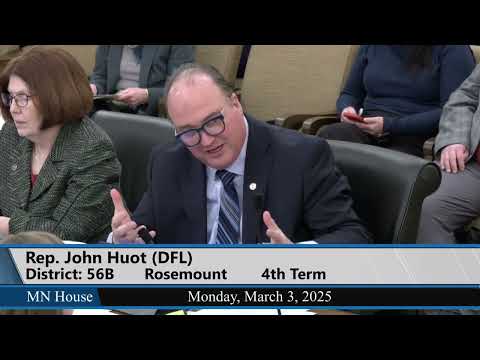
Members of multiple Minnesota health regulatory licensing boards told the House Health Finance and Policy Committee on Monday that rising workloads, statutory requirements and new interstate compacts are straining fee-funded operations and require changes to fee authority and spending limits.
Members of multiple Minnesota health regulatory licensing boards told the House Health Finance and Policy Committee on Monday that rising workloads, statutory requirements and new interstate compacts are straining fee-funded operations and require changes to fee authority and spending limits.
"The boards were created by the legislator to protect the public," Samantha Strehloe, executive director of the Minnesota Board of Behavioral Health and Therapy, told the committee, summarizing the common mission of the 16 health-related licensing boards that testified. Several boards said they are fully funded by license and application fees deposited in the state government special revenue fund and receive no general fund support.
Committee members heard a consistent set of requests: modest increases in fee ceilings or specific fees so boards can cover rising fixed costs (IT, rent and AGO legal services), authority to hire additional staff to clear backlogs or maintain service levels, and statutory language to implement multistate compact fees where Minnesota has joined an interstate compact.
Boards cited several drivers. The Board of Behavioral Health and Therapy said its regulated population rose from about 4,000 in 2014 to nearly 10,000 today and that it receives roughly 1,000 new license applications a year; it also asked for statutory authority to collect up to $100 for nonresident "privileged practice" applications under the counseling compact. Paul Bocken, executive director of the Minnesota Board of Podiatric Medicine, said his board faces a roughly $41,000 annual structural deficit and has been drawing down reserves, and asked for additional fee authority to eliminate the deficit.
The Board of Chiropractic Examiners told the committee it has not raised fees since 1993 and proposed an increase to cover a requested $100,000 per year spending authority boost; the board gave examples of proposed new amounts, including raising initial chiropractic license fees from $250 to $300 and renewals from $200 to $250. Several presenters described long intervals since their last fee changes and said growth in licensees or fixed cost increases — including MNIT rates and Attorney General office charges — have created persistent shortfalls.
Board of Nursing representatives described both staffing and operational improvements and continuing pressures. Director of nursing education Deborah Schumacher said the board is fully staffed now and has added positions in practice, policy and complaint handling, but noted long-running complaint volumes and past delays in case resolution; she told the committee the board is tracking metrics and would provide additional requested timeliness data on licensure and complaint processing.
The Board of Social Work and the Board of Behavioral Health and Therapy described compact-related work. Joy Yang, executive director of the Board of Social Work, said Minnesota adopted the social work compact and plans to collect multistate-license fees from Minnesota licensees when the compact becomes operational; the board asked the committee to add fee language to cover database and implementation costs. Strehloe described the counseling compact and the anticipated need for a nonresident privilege fee to fund Board costs when the compact begins issuing privileges.
The Board of Psychology and other boards highlighted telehealth and interstate compacts as access tools. Sam Sands, executive director of the Minnesota Board of Psychology, said about 14% of the board's licensees reported providing services into Minnesota through PSYPACT and that telehealth usage is substantial in practitioners' practices.
The Board of Pharmacy described two separate budget requests: (1) permission to continue using a 1‑time general fund appropriation for ongoing litigation costs tied to a 2020 lawsuit over the insulin safety net program (identified in testimony as the Pharma v. Williams litigation) by extending the availability through FY27, and (2) increased spending authority to maintain current staff and service levels and to support the Minnesota Prescription Monitoring Program (PMP). Deputy director Katrina Howard and Brock Reid of the Controlled Substance Reporting Section said PMP use has grown to about 7 million unique searches in 2024 and that additional spending authority would preserve integrated access for providers and support license renewals and system maintenance.
Committee members repeatedly asked for follow-up materials: several chairs and representatives requested written testimony (the committee chair asked presenters to submit written testimony for the record), nursing licensure timeliness and complaint processing metrics, and fee- and reserve-specific breakdowns. There were no committee votes during the session.
The meeting closed after roughly two hours of presentations and questions; committee staff circulated budget books to members and the chair said the committee's next hearing would be March 5.