Get Full Government Meeting Transcripts, Videos, & Alerts Forever!
Get email alerts on the Reconnect Rondo topic
No spam. Unsubscribe anytime.
House Transportation committee adopts two amendments and lays over bill that would bar state funds for Reconnect Rondo
Summary
The Minnesota House Transportation Policy Committee adopted two amendments to and laid over House File 4494, a proposal that would prohibit state funding for the Reconnect Rondo land‑bridge project. Committee members and outside witnesses debated project costs, equity and ownership, while MnDOT described the federal environmental review underway.
The Minnesota House Transportation Policy Committee on an informational hearing adopted two amendments to and laid over House File 4494, a bill that would prohibit future state funding and claw back remaining state funds for the Reconnect Rondo land‑bridge project.
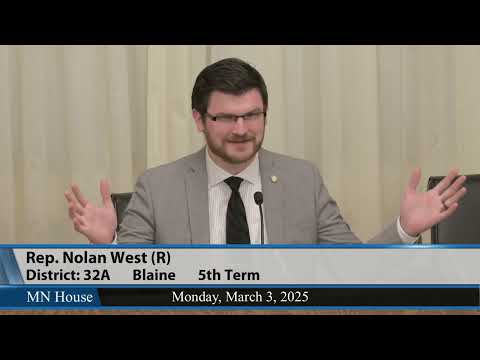
Representative West, who introduced the measure, told the committee that "we find ourselves in a tough fiscal situation" and said HF 4494 would "prohibit future funding and claw back any funding that's left for the Reconnect Rondo project." The committee adopted a technical A1 amendment and then approved an A2 amendment that would redirect any leftover funds to the Highway User Tax Distribution Fund; the committee then laid the bill over for further consideration.
The bill drew sharply divided testimony. Supporters of the prohibition framed the measure as fiscal restraint. John Phelan, an economist at the Center of the American Experiment, said the state is facing a multibillion‑dollar deficit and criticized planned spending on the project, saying Reconnect Rondo "will cost at least an estimated $450,000,000 on top of the $6,200,000 already appropriated." Representative West and others urged prioritizing statewide transportation needs.
Opponents called the proposal a setback for equity and local recovery. Rashida Jenkins, president and founder of Growth Industries, testified "I'm not here to talk about the money because it's about the people," and described the Rondo community's losses after I‑94 was built. Keith Baker, executive director of Reconnect Rondo, told the committee the project is more than a highway fix and said a commonly discussed cost split would leave an estimated $63 million state share if federal funds cover approximately 80 percent: "250,000,000 is part of the cost split ... 80% being federal, 20% being state, which is 63,000,000." Marvin Anderson, board chair for Reconnect Rondo and executive director of the Rondo Center for Diverse Expressions, urged the committee to "reject House file 4494" and to preserve years of trust‑building between Rondo and state and local agencies.
Minnesota Department of Transportation staff briefed the committee on the project status and the environmental review. Eric Rudine of MnDOT Government Affairs said the department "is in the midst of [an] environmental process, governed by NEPA, the National Environmental Policy Act," and that MnDOT had announced six alternatives to advance in the environmental review while recommending four alternatives not be moved forward. Rudine said the land‑bridge concept could be accommodated by the alternatives but that MnDOT could not pre‑determine the outcome of the NEPA process. He also said MnDOT is coordinating with the separate Reconnect Rondo process and serves as fiscal agent for earlier legislative appropriations.
Committee members pressed on several practical questions. Representative Kraft asked whether the committee and public know what the long‑term return on investment would be; Representative Kraft noted that opponents argue the project could yield economic and social benefits. Members also asked who would own and maintain a land bridge; Rudine said ownership typically rests with the state for facilities in interstate right‑of‑way but that practice has become more flexible and that MnDOT has discussed alternative ownership arrangements with local partners.
Witnesses offered differing cost figures and project scopes. Representative West and others described the project's total price tag as "over $400,000,000." John Phelan cited an estimate of "at least an estimated $450,000,000" plus prior appropriations. Keith Baker described a narrower construction component of roughly $250,000,000 with additional development and programming costs to follow and said the project could leverage federal and other funds. Robert Harper of RDTH Consulting cited research on disparities in MnDOT contracting and said Reconnect Rondo planned to use diverse contractors; Harper told the committee his team's review showed that from 2017 to 2020 "black contractors received 0 out of 742 MnDOT contracts that totaled over $3,000,000,000 spent by MnDOT."
The committee did not decide final disposition of the bill. After adopting the A1 and A2 amendments (both adopted by voice vote), Chair Kosnick said the committee would lay House File 4494 over. Chair Kosnick also asked MnDOT to provide committee members a link to the department's posted alternatives.
The hearing included multiple personal accounts from Rondo residents and community leaders describing the neighborhood's history and the effects of I‑94. Testimony and questioning made clear the matter combines transportation planning, federal environmental review, local ownership and maintenance questions, and longstanding disputes over equity and state funding priorities. The committee is scheduled to receive an updated budget forecast later this week, which members said would inform further action on the bill.