Get Full Government Meeting Transcripts, Videos, & Alerts Forever!
Get email alerts on the Rural Finance Authority topic
No spam. Unsubscribe anytime.
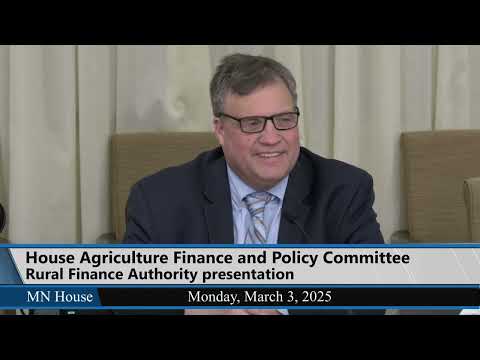
Committee hears Rural Finance Authority briefing; approves referral of bonding bill for RFA funding
Summary
The House Ag Finance and Policy Committee heard a presentation from the Rural Finance Authority on its loan programs and projected funding shortfall, and Chair Anderson moved House File 770 to the Capital Investment Committee as amended. Committee adopted two technical amendments and referred the bill by voice vote.
The Minnesota House Ag Finance and Policy Committee on Feb. 26 heard a briefing from the Rural Finance Authority and approved sending House File 770 to the Committee on Capital Investment, Chair Anderson said.
Tom Peterson, Commissioner of the Minnesota Department of Agriculture and chair of the Rural Finance Authority (RFA) board, told the committee the RFA operates as “our bank for many different loan programs,” administering about 13 programs that partner with local lenders to provide lower‑interest financing to farmers. “We try to react to things that are really important,” Peterson said, noting the authority’s role in opening a disaster recovery loan window during recent avian influenza outbreaks.
The RFA’s Ag Finance Supervisor, Matt McDevitt, provided program details, telling members the authority has made more than 4,000 loans totaling over $417 million with a cumulative loan‑loss experience of “just under $700,000” (about 24 loans). McDevitt said bond‑funded and revolving accounts finance the programs and that the revolving funds are projected to be exhausted by December 2026 unless replenished. “Loan requests have been fairly steady even in a high interest rate environment,” he said.
Why this matters: RFA programs are used by beginning farmers and by operations seeking to restructure or recover from disasters; shortfalls in bond or revolving funding would constrain loans used to buy land, construct or repair livestock facilities, and fund other farm investments.
Key details from the presentation and committee exchange: - RFA offers a variety of products, including beginning farmer seller‑assist loans (shared first position; RFA typically purchases 45% of a lender’s loan), agriculture improvement loans, restructure loans, livestock and equipment loans, disaster recovery loans (0% interest for some revolving funds; interest‑only first two years in select disaster loans), and a $15 million USDA‑backed meat and poultry intermediary lending program created in 2022 to support small and medium processors. - The RFA reported roughly $39 million remaining of a $50 million 2023 bonding authorization and estimated that available funds would be exhausted by about December 2026 without additional authorization. - The beginning‑farmer seller assist program net‑worth cap and current interest rates were discussed (McDevitt cited a current program rate around 5% for beginning farmer loans and lower rates where FSA participation reduces borrower cost). - The RFA administers a $15,000 down‑payment assistance grant (lottery) supporting first‑time land buyers, currently funded at $750,000 annually and used to support 96 farmers to date, McDevitt said.
Public testimony and committee action: Two farmers and two statewide farm organizations spoke in favor of House File 770, which Chair Anderson said would authorize bonding authority to replenish RFA’s bond‑funded account. Matt Hardy of Rust Hill Ranch told the committee the RFA beginning farmer program “helped me purchase 40 acres and realize our dream of owning our own family farm.” Hunter Peterson for the Minnesota Farm Bureau said continuing investment in the RFA “is not just an investment in individual farms… it’s an investment in the economic health of our rural communities.”
Chair Anderson moved the A1 amendment (a technical correction) and an oral amendment reducing an erroneously large line item from $30,000,000 to $30,000 (cost of issuing bonds). Both the A1 amendment and the oral amendment were adopted by voice vote; after final remarks Chair Anderson renewed his motion that House File 770, as amended, be referred to the Committee on Capital Investment; the committee voice voted in favor and the motion prevailed.
Discussion vs. decision: The presentation supplied context and data about loan volume and program risk; public testimony provided constituent examples. The committee’s formal actions were adoption of two technical amendments and referral of House File 770 to Capital Investment. No final appropriation language or appropriation amounts beyond the technical correction were adopted in committee today.
Ending: Committee members thanked RFA staff for the presentation and allowed the bill to advance. The referral sends the bill to a committee that addresses bonding and capital allocation where members will consider funding details and timing related to statewide bonding priorities.