Get Full Government Meeting Transcripts, Videos, & Alerts Forever!
Get email alerts on the Corrections Contraband It Bodycams topic
No spam. Unsubscribe anytime.
DPSCS faces spike in contraband finds, delayed IT projects and seeks bodycam funding
Summary
The Department of Public Safety and Correctional Services told legislators that weapons and synthetic drugs rose sharply in fiscal 2024, that two major IT projects remain delayed, and that a body worn camera pilot is under way with a plan to expand.
The Maryland Department of Public Safety and Correctional Services reported a steep rise in contraband finds in fiscal 2024, delays on two major information technology projects, and a pilot that has deployed 100 body worn cameras to correctional officers at no cost to the state.
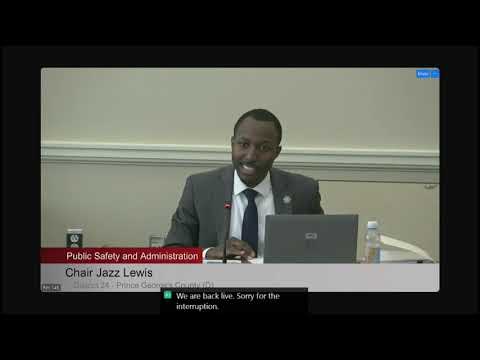
Catherine Barber, Department of Legislative Services analyst, told the Public Safety and Administration Subcommittee that overall contraband occurrences increased 39% from fiscal 2023 to 2024 and that weapons made up 44% of finds in fiscal 2024. "This is an extremely unusual increase... and poses a grave and immediate threat to the safety of inmates and staff," Barber said.
DPSCS Secretary Carolyn Scruggs told the panel contraband can enter facilities through visitation, mail, drones or be manufactured inside facilities. She said new undetectable forms of controlled dangerous substances have reduced canine detection effectiveness. "We use a wide array of methods to intercept contraband to keep facilities safe," Scruggs said, listing x'rays, scanners, canine units and unannounced intelligence'led searches.
Barber also highlighted two delayed IT projects: a Computerized Criminal History (CCH) replacement, which lost a $2.3 million federal grant after repeated procurement reissuances and cancellations, and an electronic patient health record (EPHR) replacement whose updated completion date (est. July 2028) would postdate the June 2026 expiration of related consent decree obligations in Duval v. Moore. DLS recommended restrictions on portions of the fiscal 2026 appropriation pending status reports and procurement plans.
DPSCS said it is pursuing cloud migration planning for CCH with vendor support from IBM and Amazon Web Services and that it is pursuing expedited procurement strategies for the EPHR to secure an implementation vendor, while continuing limited support under a contract extension with the legacy vendor.
On body worn cameras, DPSCS said the pilot includes 100 cameras and supporting cloud infrastructure deployed at five facilities at no cost during the trial. The department said other jurisdictions have reported declines in staff assaults and PREA cases after camera adoption and that cameras can reduce litigation costs by providing evidence to corroborate officer conduct.
DLS recommended deleting $4.1 million in general fund support for an expanded body worn camera rollout in fiscal 2026 because of the state's fiscal outlook; DPSCS objected and said the pilot has already produced operational benefits and could reduce settlement and litigation costs. DPSCS also concurred with most DLS recommended actions but opposed restrictions that would eliminate proposed bodycam funding.
The hearing also pursued staffing and oversight issues. DLS recommended restrictions pending submission of a multi'year recidivism report and a strategy to reduce mandatory overtime. Secretary Scruggs described steps to reduce PIA compliance complaints, saying a centralized tracking unit created in January 2024 has cleared a backlog and that staff have undergone refresher trainings.
Ending: Committee members asked for follow'up on procurement schedules and evidence that DPSCS has an assigned program manager for the CCH project; no formal votes were taken during the hearing.