Get Full Government Meeting Transcripts, Videos, & Alerts Forever!
Get email alerts on the School Construction topic
No spam. Unsubscribe anytime.
State analysis finds $1.1 billion in unexpended school construction funds; IAC warns of widening funding gaps
Summary
The Department of Legislative Services reported $1.1 billion in unexpended school construction funds and recommended shifting $45 million in Healthy School Facility Fund allocations; Interagency Commission on School Construction officials said rising construction costs and local matching constraints create a growing funding gap that could reach $166 million by FY 2027 if unaddressed.
The Department of Legislative Services (DLS) reported to the Capital Budget Subcommittee that the 2025 Capital Improvement Program (CIP) allocates $824,700,000 across seven state school construction programs, but that unexpended balances across school construction programs currently total roughly $1,100,000,000.
DLS analyst Laura Hyde told the subcommittee that of the 2025 CIP amount, $453,500,000 is proposed in general obligation (GO) bonds, approximately $302,000,000 is revenue bonds for the Build to Learn program, and $69,000,000 is special fund PEGO. Hyde said DLS is asking IAC to explain discrepancies between the CIP and IAC’s recorded balances and how the agency plans to spend outstanding balances, including whether older funds could be canceled or transferred to an unreserved statewide contingency account.
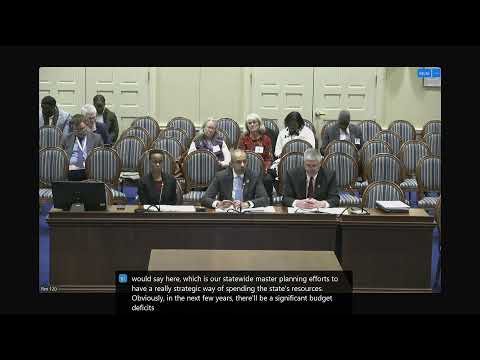
Ed Casemar, chair of the Interagency Commission on School Construction (IAC), and Alex Donahue, IAC executive director, appeared after Hyde’s presentation. Donahue said the state’s school facilities face a large maintenance need: industry-standard annual investment rates would imply Maryland school districts should be spending as much as $2.3 billion annually to keep up with capital maintenance and renewal. He said the average school facility portfolio is about 31 years old and the facility condition index is “53% depleted.”
Donahue said the General Assembly’s investments since 2021 have more than doubled the annual state capital funds for school construction to an average of $880,000,000, which has slowed decline in facility condition but is not sufficient to reverse it. He told the committee the IAC faces a $55,000,000 funding gap for fiscal 2026 between the governor’s proposed CIP and the amount needed to meet state share responsibilities for the districts’ highest priority projects. If that gap is not addressed, Donahue said projected gaps could grow to $111,000,000 in FY 2027 and $166,000,000 thereafter.
Hyde highlighted the Build to Learn bond program in the analysis: bond sales to date total $1.1 billion and, because annual appropriations for debt service are fixed at $100,000,000 per year, higher interest rates reduce bond proceeds. DLS reported the most recent bond sale was October 2024 and estimated project-supporting revenues will support between $1.6 billion and $1.8 billion in projects if rates remain at current levels. DLS said Build to Learn approved allocations total about $1.4 billion, leaving roughly $359,000,000 available for future allocations based on the current estimate.
DLS also called attention to the Healthy School Facility Fund (HSFF), which has received $370,000,000 since FY 2021 and was appropriated $90,000,000 in FY 2026 to meet the mandate. Hyde said IAC allocated a majority of that HSFF funding — $190,000,000 or 51% — to roof and related repairs, but DLS recommended deferring $45,000,000 from the program to FY 2027 because of slow expenditure rates and large unexpended balances totaling roughly $233,000,000 from appropriations made prior to FY 2025.
Donahue and IAC staff explained several reasons for large unexpended balances. IAC deputy director Cassandra Viscara and chief of funding programs Arabia Davis explained that (1) construction projects commonly take three to five years from allocation to completion and reimbursement; (2) statutory restrictions including a referenced education article provision (transcript: “education article 5,303 J3”) require allocations be contracted within two years or be rescinded from the project and held for the LEA for up to two additional years before reallocation; and (3) IAC typically pays on a reimbursement basis after work is completed, which slows outflows.
IAC said it is changing accounting procedures to prioritize dispensing older appropriations first and working with the Department of Budget and Management (DBM), the State Treasurer’s Office and the Attorney General to speed encumbrance and reimbursements. Donahue said IAC is also assisting individual counties that lack the local match to keep projects moving, and in some cases combining Build to Learn funding with CIP funding to preserve project schedules.
The DLS analysis asked IAC to comment on: (1) why its reports are frequently delayed; (2) the balance and intended use of funds reserved for statewide purposes; (3) why balances over seven years old have not been returned to the unreserved statewide contingency account; and (4) discrepancies between program balances in the CIP and IAC recorded balances. Hyde closed by noting the analysis includes exhibits on building age, maintenance effectiveness, program allocations by LEA and state cost share by LEA.
The IAC witnesses answered committee questions about specific county projects and explained the agency’s intention to accelerate older appropriations. The hearing record shows no formal vote or committee action during the presentation.