Get Full Government Meeting Transcripts, Videos, & Alerts Forever!
Get email alerts on the Minimum Housing Code Repair Orders topic
No spam. Unsubscribe anytime.
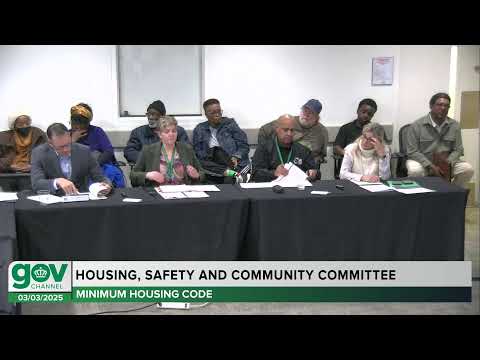
Housing committee backs in-rem repair orders to address unsafe housing; staff to seek contractors and refine relocation support
Summary
The Housing, Safety and Community Committee on March 3 voted to direct staff to procure contractors and advance in-rem repair orders to address unsafe housing conditions, while asking staff to refine relocation partnerships and to return with further analysis on mold testing and cooling-equipment policy.
The Housing, Safety and Community Committee on March 3 instructed staff to move forward with interim in-rem repair orders and related procurement after a multi-month review and public engagement on minimum housing code enforcement.
Staff reviewed the mayor—s referral on minimum-housing code enforcement and summarized outreach including meetings with tenant-advocacy groups, industry associations and residents. Staff reported advocate requests for mold testing, stronger placarding rules and better relocation support; industry groups urged clear, targeted enforcement that distinguishes noncompliant owners from landlords working in good faith. Resident testimonials obtained through partners cited chronic maintenance issues, asthma and mold concerns and calls for more emergency-relocation supports.
City attorneys and code staff said the city already has remedies in its ordinance, including injunctive relief and an in-rem (in rem) repair process that allows the city to repair unsafe conditions and place a lien on the property. Staff recommended using those existing legal tools rather than pursuing immediate ordinance revisions. Staff also proposed several partnership and process changes to support residents during enforcement: (1) procure contractors and project managers for in-rem repair and tenant-relocation services, (2) pilot legal-assistance funding to explore when independent mold testing helps civilian cases (staff cautioned that the city lacks regulatory mold thresholds and would not itself conduct air testing), (3) improve tenant screening/referral tools to link residents to city and nonprofit resources, (4) update educational materials and the city—s open-data lists of properties with frequent violations, and (5) align relocation needs with affordable-housing set-asides and existing displacement-event funding.
The committee discussed policy options and funding constraints. Members asked staff to provide clear cost estimates, to avoid creating a cycle in which city rehabilitation funds indirectly subsidize the same owner groups that caused neglect, and to coordinate with county floodplain and relocation programs. Staff said they would use existing city PAYGO and other displacement-related funding for procurement and would provide a more detailed cost accounting to the committee.
Vote and direction: The committee approved a motion to procure interim in-rem repair services and tenant-relocation/partnership contracts and directed staff to bring individual in-rem repair orders to council for action. The motion excluded immediate city-funded air-testing pilot authorization; the committee requested staff to return with further analysis and, if appropriate, a separate recommendation on any pilot program.
Ending: Staff will start procurement for in-rem services and tenant-relocation providers, present in-rem repair orders to council for specific properties and return with additional analysis on mold testing, cooling-equipment requirements and how relocation connects to rental-subsidy and affordable-housing set-asides.