Get Full Government Meeting Transcripts, Videos, & Alerts Forever!
Get email alerts on the High School Schedule topic
No spam. Unsubscribe anytime.
Kennett High proposes hybrid "skinny-block" pilot schedule to increase instructional consistency
Summary
Kennett High School’s master-schedule committee proposed a hybrid pilot for 2025–26 that combines shorter daily periods on Monday/Tuesday/Friday with longer blocks on Wednesday/Thursday to increase contact frequency and preserve lab time.
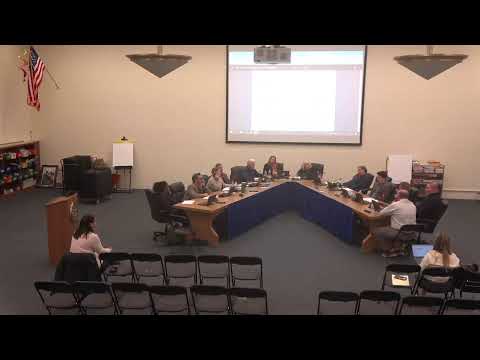
Kennett High School presented a proposed pilot master schedule to the district curriculum committee on Feb. 24 that would combine shorter daily class periods on Monday, Tuesday and Friday with longer block periods on Wednesday and Thursday. The pilot is planned for the 2025–26 school year, starting in the fall, and will be evaluated using surveys, attendance, behavior (class-cut referrals) and grade-distribution measures.
Lorenzo (principal) introduced the master-schedule committee’s two-year development process and said about 25–30 stakeholders — students, parents, teachers and administrators — participated. Jeff Thomas, assistant principal, and teachers including Christine Wilson (English) and Scott Bosch (media communications) described the current A/B block schedule (four 80-minute blocks plus a 30-minute daily intervention/enrichment period called AIE) and summarized perceived strengths and weaknesses.
Committee members said the A/B block schedule provides longer time for labs and project work but can leave students seeing a course every other day and create larger gaps between class meetings. "There are potential scenarios where you go a full week without seeing a student in one of your classes," Thomas said, and the committee cited research suggesting student on-task behavior can decline late in very long class periods.
The proposed 2025–26 pilot keeps four longer block meetings but reorganizes the week so students meet all eight classes across the Monday/Tuesday/Friday "skinny" days while Wednesday/Thursday would be paired longer blocks. The committee said that format preserves lab time for hands-on courses while giving more frequent daily contact in the majority of classes and greater consistency for dual enrollment, internships and transportation to TCHS.
The committee outlined four measures of success: (1) stakeholder surveys (students, parents, teachers) to be administered in spring 2025 and again in spring 2026; (2) attendance comparisons by semester (Jan. 2025 vs. Jan. 2026) to assess student engagement; (3) behavior metrics, specifically class-cut referrals and minutes of instructional time lost; and (4) grade-distribution comparisons (counts of A/B/C/D/F and tracking movement, especially failures to passing by demographic groups).
Administrators said communications will begin immediately, the master schedule will be adjusted in Skyward (the district student-information system) to match the pilot, and the district will compile the pilot’s data after the first semester of implementation. No board vote was recorded; the curriculum committee will monitor implementation and collect the defined metrics during the pilot year.
Supporters said the hybrid model preserves benefits of longer blocks for laboratory and applied courses and increases consistency for students in dual enrollment or internships. Some teachers who responded to internal surveys raised concerns about the time required to develop new curriculum pacing and bridging plans and asked for structured guidance and compensated time for committee work. The district plans to provide additional supports and to host materials and committee work online for staff access.
The committee scheduled surveys and data collection for spring 2025 and the end of first semester 2026; the full curriculum team recommended rolling out the pilot in fall 2025 and reassessing at the end of the pilot year.