Get Full Government Meeting Transcripts, Videos, & Alerts Forever!
Get email alerts on the Historic Theater Restoration topic
No spam. Unsubscribe anytime.
Jayhawk Theater asks Shawnee County and Topeka for $5 million local match to unlock state grant
Summary
Representatives for the Jayhawk Theater told the Shawnee County Board of County Commissioners that a $5 million match from the city and county would unlock $5 million in state Sprint grant funds and help complete critical infrastructure work needed to reopen the historic venue.
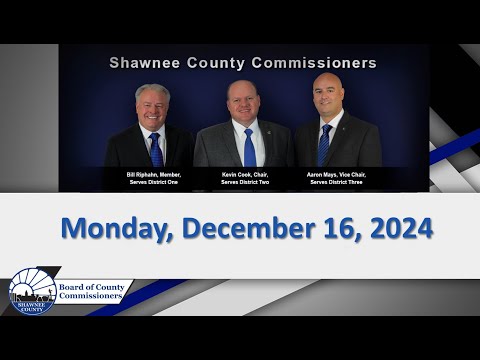
Representatives for the Jayhawk Theater asked the Shawnee County Board of County Commissioners on Dec. 16 to consider committing up to $5 million in local funds to match a $5 million Department of Commerce Sprint grant awarded to the restoration project.
Joanne Morel, who presented the update for the Jayhawk Theater, said the Sprint funds are in hand and “will be allocated by March of 2025,” and that the theater’s master budget and construction plan are phased so work proceeds only when funding is secured. "This will keep our construction in full motion [and] enable us to maximize and leverage other funding opportunities," Morel said.
The Jayhawk team outlined the scope and cost of required work. The presentation described accessibility, life-safety, structural and mechanical, electrical and plumbing upgrades as the initial priorities. Morel said those infrastructure upgrades total “more than $15,000,000 alone.” She and Vance Kelly of Trainer Architects described a phased approach: phase 1 uses the Sprint funds for foundation restoration, masonry, waterproofing and life-safety systems while later phases will finish other critical systems and accessibility improvements.
Kelly, the project architect, described on-site constraints: the building sits against an alley with embedded utilities, requiring careful excavation, shoring and hand work. He said crews are addressing masonry and waterproofing and that new electrical services will be needed to serve the theater and adjacent buildings. Kelly said remediation has included asbestos abatement and complex utility coordination.
On cost breakdowns, Morel said roughly $3.493 million of the initial $5 million Sprint allocation is earmarked for interior and exterior restoration and critical infrastructure, with about $220,000 remaining in contingency, leaving roughly $1.287 million of the Sprint award for other immediate uses. The presenters said the full list of remaining critical infrastructure totals about $11.5 million; after accounting for funds already secured, they said that leaves a gap of approximately $5 million that the team hopes the city and county will help close. The presenters also listed a projected $5 million estimate for historic-preservation tax credits, which they described as a late-stage funding source.
The Jayhawk team described expected community and tourism benefits if the theater reopens at higher capacity. Morel cited prior limited runs and audience surveys, saying some comparable events drew 55% of patrons from outside Kansas and that early reopenings could generate $1 million to $1.5 million in tourism spending in initial years. The presenters called the venue a mid-sized performing-arts niche — roughly 825 seats to 1,200 standing — that they say would complement larger local venues.
Commissioners asked detailed questions about the budget line items, architect/engineering fees, contingency, historic tax-credit timing and whether funding must be provided in a single disbursement. Morel said funding could be phased, but earlier commitments would unlock additional private and grant opportunities because the project must provide firm opening dates to start booking acts for 2026. Commissioners also asked technical questions about accessibility solutions and the extent of required demolition to remove non-historic elements; Kelly said the team has a master plan that phases accessible improvements and removes non-historic obstructions to extend the stagehouse and backstage areas.
No formal county commitment or vote was made at the meeting; commissioners repeatedly expressed support and said they would consider how to participate. Morel said the Jayhawk has pursued multiple grant sources (including a recent federal application) and has relied on transient guest-tax funding and other local grants in earlier phases. The presenters requested collaboration between the city and county to provide a local match that would keep construction moving and leverage additional funding.
The county chair, Kevin Cook, closed the item by thanking the presenters and saying commissioners would take the request under consideration.