Get Full Government Meeting Transcripts, Videos, & Alerts Forever!
Get email alerts on the Surveillance Drones topic
No spam. Unsubscribe anytime.
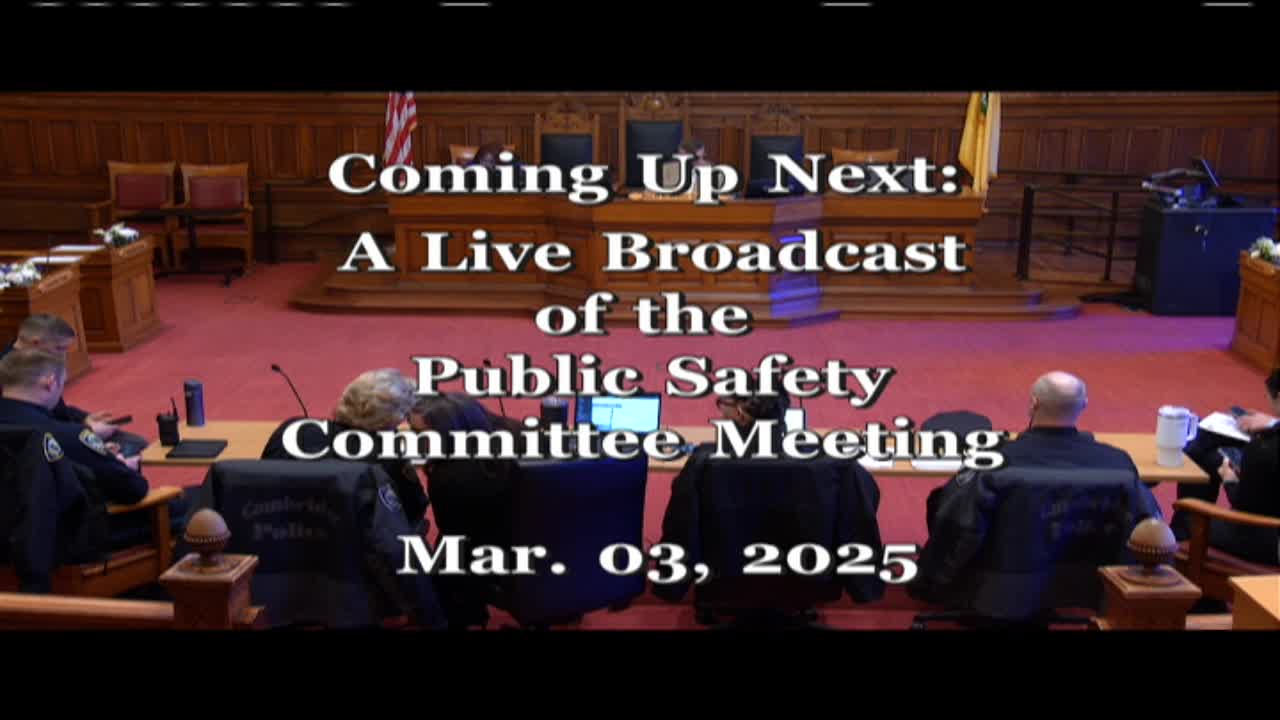
Cambridge committee hears sharply divided testimony on police drone plan, votes to refer STIR back to full council
Summary
The Cambridge City Public Safety Committee on Monday reviewed the Cambridge Police Department’s Surveillance Technology Impact Report (STIR) proposing use of remotely piloted aerial vehicles (RPAs) and heard hours of public comment before voting to refer the matter back to the full City Council for further work on policy details and legal authority.
The Cambridge City Public Safety Committee on Monday reviewed the Cambridge Police Department’s Surveillance Technology Impact Report (STIR) proposing use of remotely piloted aerial vehicles (RPAs) and heard hours of public comment before voting to refer the matter back to the full City Council for further work on policy details and legal authority.
Committee members, police officials, civil liberties advocates and residents debated whether the department should receive permission now to operate drones for limited uses — such as search-and-rescue, tactical overwatch of barricaded suspects and accident reconstruction — or whether the council must first see a binding, written policy that constrains how footage is collected, stored and shared.
Why it matters: supporters said drones could speed lifesaving searches and reduce risks to officers during high‑risk entries; opponents warned the aircraft would expand aerial surveillance of protests and everyday public life without enforceable limits. Several councilors and the ACLU urged a concrete policy — not only assurances in public remarks — before the council grants long‑term approval.
Cambridge Police Commissioner Christine Elo opened the department’s presentation by saying the agency seeks “to harness drone technology as a safety and operational tool while maintaining rigorous safeguards to protect our privacy and civil [liberties],” and stressed that drones would not be armed and would not capture audio. Elo said drones would not record unless the operator “press[ed] the record button,” and that each recording would be documented in a police report.
Detective Krista Casenza, a licensed Federal Aviation Administration drone pilot assigned to the Special Response Team, described tactical examples the department gave the committee: using a small indoor drone to inspect crawl spaces and basements during barricade calls; employing thermal-capable aircraft to find missing elderly residents on rooftops; and providing an aerial view at large events to see rooflines and other vantage points officers cannot reach quickly on foot. Casenza said in one domestic‑violence response a ground robot missed a suspect in cluttered basement areas that a drone’s vantage might have helped locate sooner, potentially improving both medical outcomes and officer safety.
Police also cited the 2022 Highland Park, Illinois, Fourth of July mass‑shooting as an example of how local officials outside Massachusetts said earlier drone capabilities might have been helpful; the department noted other Massachusetts agencies and universities use drones in various roles.
Public commenters were sharply divided. A group of residents and student organizers — including Alex Matthews, co‑chair of Digital Fourth, and Kate Crawford of the ACLU of Massachusetts — said the STIR, as presented, lacked binding operational limits and retention rules and could permit expanded uses beyond the hypotheticals the department offered. Matthews said the police had not provided “any binding constraints on its use,” and Crawford said it was the council’s intent when the surveillance ordinance was drafted that the council retain authority to “claw back” permission for a technology later if misuse or harms appear.
Many residents and student organizers who identified with Boston DSA and campus groups urged the committee to withhold approval, saying drones would chill protest activity and could be repurposed to monitor unhoused people or residents. Jennifer Warren, a Cambridge resident, called the idea of police drones “vile,” and several speakers noted concerns about the potential for federal access to footage through court orders.
Other speakers, including Ori Porat and Rand Gilboa, urged the city to provide the police department with an additional tool, arguing drones would improve crowd safety at large events, decrease risky officer actions in chaotic situations and aid search operations along the Charles River and in wooded areas. Public comment also included practical queries about operations: whether drones would be present at every minor traffic crash (police said no) and the expected altitude of flights (the department said up to 400 feet for event overwatch).
Legal and policy questions animated the committee exchange. Kate Klein Mueller, First Assistant City Solicitor, told councillors the city’s surveillance ordinance and the city’s governance model posed legal questions about whether the City Council could later rescind a STIR approval; the solicitor’s office said the STIR approval process did not on its face provide an explicit “claw‑back” mechanism. ACLU representatives disputed that interpretation and asked the council to require a formal written policy before granting approval.
Councilors pressed the police on operational safeguards and timing. Committee members asked for a written policy to accompany any STIR vote, details on retention and access to stored footage, and a clearer account of who would be authorized to press record. Council members also noted union and collective bargaining considerations the department flagged as possible constraints on immediately publishing a final policy.
Budget and equipment: the police estimated a practical inventory would include higher‑end outdoor RPAs (roughly $10,000–$12,000 each) and smaller indoor platforms (about $1,000–$1,200), plus spare batteries, hard cases and media storage; the department estimated a conservative initial outlay in the neighborhood of $20,000 when equipment and accessories are included. Officials said typical flight endurance for the aircraft cited in the presentation runs roughly 25–40 minutes per battery.
Committee action and next steps: after the presentations and public comment, the committee voted to refer the STIR back to the full City Council for a future vote when the police commissioner and the city solicitor can return with a proposed written policy and clarifications about rescission authority. The clerk recorded the referral vote 4–0 (Councilor Siddiqui recorded absent). The committee then voted to adjourn.
What to watch next: the full Cambridge City Council will receive the STIR and any accompanying draft policy when the administration and solicitor’s office submit it. Several councillors and civil‑liberties speakers indicated they would expect the policy to address: specific permitted uses; retention and deletion practices for recorded footage; rules governing third‑party and federal access (including court orders); transparency and community reporting; and limitations on drone deployment at protests and large public events unless narrowly justified.
The meeting record shows councilors asked the administration to return with a draft policy and legal analysis and indicated that additional community engagement — particularly with neighborhoods and groups the council identified as potentially most affected — would be expected before final approval.